Every year, carriers face audits that uncover missing driver records. Even one lapse can cost tens of thousands in fines and incur lasting damage to your safety record.
Department of Transportation (DOT) previous employment verification is mandated by 49 CFR Part 391 and Part 40, requiring you to confirm every driver’s three‑year history with all previous employers. This crucial step prevents unqualified or underqualified drivers from slipping through the cracks and protects you from legal, financial, and reputational fallout.
Let's walk through this verification process from timeline requirements and documentation best practices to state‑level nuances and the benefits of automating the process with Cisive Driver iQ. By following each step, you can maintain compliance and hire confidently.
What is DOT Previous Employment Verification?
DOT previous employment verification is the process of confirming a driver’s work and safety history over the past three years. It’s mandated by the Federal Motor Carrier Safety Administration (FMCSA) under 49 CFR Part 391, and serves to:
-
-
Ensure drivers meet minimum safety standards before they perform safety‑sensitive functions.
-
Uncover any undisclosed failures in drug and alcohol tests or required rehabilitation steps.
-
When done correctly, this step builds a foundation of trust and compliance, keeps your fleet safe, and helps your company meet FMCSA regulations.
What Does Verification Usually Include?
Verification typically covers four core areas, ensuring transparency in each driver’s motor vehicle records (MVR), past performance, and compliance record:
-
-
Employment dates and job roles: Confirms start and end dates, as well as duties performed, to verify that there are no unexplained gaps or misrepresentations.
-
Accident and incident history: Reviews any reportable accidents (per 49 CFR 390.5T), safety-related incidents, or risk patterns that could indicate future liabilities.
-
Drug- and alcohol-testing records: Includes pre‑employment and post‑incident test results, refusals, and any notes on successful completion of the return‑to‑duty process required under DOT rule 49 CFR Part 40.
-
Rehabilitation and follow‑up actions: Uncovers any documented substance abuse programs or corrective actions completed while ensuring that drivers have met all regulatory requirements.
-
How Does This Verification Work?
Executing DOT previous employment verification involves these practical steps:
-
-
Gather written consent: Secure a signed release from the driver applicant. This is mandatory under 49 CFR Part 40. Without it, no outreach can legally occur.
-
Compile employer list: Identify every DOT‑regulated employer in the past three years. Include even short stints where candidates performed safety‑sensitive functions.
-
Send standardized inquiry packets: Use a consistent template—sent via email, fax, or certified mail—to request safety performance history and drug/alcohol results.
-
Track all attempts: Log each contact attempt (dates, times, methods) in your system as evidence of a good-faith effort to obtain missing records.
-
Review and document responses: Once received, verify the completeness of returned information. Place in the driver’s qualification file for at least one year, per FMCSA retention rules.
-
Recommended Podcast: Better Transportation Hiring Requires More Than Clean Records
When is DOT Previous Employment Verification Required?
Any time you hire a driver to operate a commercial motor vehicle under DOT regulations, you must complete previous employment verification. This includes:
-
-
Applicants holding a commercial driver’s license or operating vehicles subject to FMCSA rules.
-
Roles covered by 49 CFR Part 40 for controlled‑substance and alcohol testing.
-
When rehiring a former driver, you need to verify any new DOT‑regulated positions held since their last engagement.
DOT Previous Employment Verification Requirements
FMCSA rules break down DOT employment verification requirements into these critical steps.
Investigate the Past 3 Years of DOT‑Regulated Employment
Contact every employer where the applicant performed safety‑sensitive functions in the past three years. Confirm dates, duties, and any reportable accidents.
Begin Within 30 Days of Hire
You have only 30 days to start—after that, you must show a good-faith effort if records are delayed. Automating outreach with Driver iQ’s Employment Verifications ensures you never miss this window.
Request Specific Safety Performance Information
Your inquiry should cover:
-
-
-
-
Accident details, per 49 CFR 390.5T
-
Drug-test results and any instances where the driver tested positive
-
Evidence that the return‑to‑duty process was successfully completed, if applicable
-
-
-
Obtain the Driver’s Written Consent
Under 49 CFR Part 40, signed consent is required before reaching out. Embed the consent form into your applicant screening workflow.
Document All Attempts to Obtain Information
Not every prior employer will respond. Log every call, email, or fax as a good-faith effort to obtain the required data.
Retain Records for at Least One Year
Store all completed verifications, consents, and communication logs in the driver qualification file—and keep them for a minimum of one year to satisfy FMCSA audits.
The Cost of Not Verifying Employment History
Failing to verify a driver’s previous employment can have cascading impacts:
-
-
Regulatory penalties: The FMCSA may impose fines for each missing or incomplete file, potentially totaling thousands of dollars per violation.
-
Litigation risk: If an improperly vetted driver causes an accident, plaintiffs can allege negligent hiring, exposing your company to costly lawsuits and resolutions.
-
Insurance spikes: Carriers with audit failures often face premium increases of 5–15%, as insurers perceive a heightened risk.
-
Operational disruptions: Investigations and remediation efforts divert time and resources from core business activities, harming productivity and morale.
-
Recommended Podcast: Why Transportation Has a Trust Problem, Not a Driver Shortage
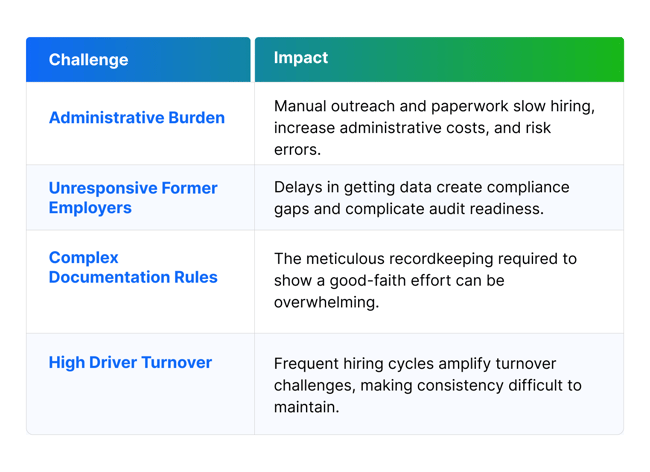
4 Barriers to DOT Employment Verification
Exploring DOT Previous Employment Verification Services
Managing previous employment verification in‑house can overwhelm even the most seasoned safety teams. Driver iQ’s Employment Verifications service combines automation, regulatory expertise, and dedicated support to streamline every phase.
-
-
Automated outreach and reminders: Our platform sends inquiry packets to former employers and auto‑notifies you of missing responses.
-
Real‑time FMCSA clearinghouse checks: Instantly cross‑reference applicant drug and alcohol records within the same interface, reducing manual lookups.
-
Customizable consent workflows: Digitally capture and store signed releases, eliminating paper forms and audit headaches.
-
Comprehensive reporting: Access dashboards that track verification status, audit trails, and retention schedules to ensure you meet all 49 CFR Part 391 and Part 40 requirements.
-
By leveraging Driver iQ, you can cut administrative time by up to 50%, reduce compliance risks, and maintain a robust driver qualification program, all without stretching internal resources.
Choose Cisive Driver iQ to Verify Driver Employment & Hire With Confidence
Manual verification can be resource‑intensive. Driver iQ’s integrated platform:
-
-
Automates outreach to previous employers and captures MVR data
-
Ensures adherence to 49 CFR Part 40 for all drug and alcohol tests
-
Streamlines your continuous driver monitoring and integrates with FMCSA Clearinghouse checks
-
By centralizing compliance, you reduce errors, save time, and keep your hiring pipeline moving.
Meeting DOT previous employment verification requirements doesn’t have to be a burden. With Driver iQ, you get an end‑to‑end solution that automates every step—from consent capture to final record retention—so you can focus on building a safe, compliant fleet.
Talk to a Cisive background check pro today.
Frequently Asked Questions
What is the previous employment verification for DOT?
Previous employment verification is a required FMCSA process that confirms a driver’s work and safety history with any DOT‑regulated employer over the past three years. This process must be completed before they perform safety‑sensitive functions.
How far back does a DOT background check go?
You must contact every DOT‑regulated employer from the past three years, per 49 CFR Part 391.
What disqualifies someone from a DOT background check?
Failing or refusing a drug or alcohol test or not completing the return‑to‑duty process are automatic disqualifiers.
Can a previous employer refuse to verify employment?
Employers must make a good-faith effort; if records aren’t provided, document every attempt as part of your compliance process.