Episode 5
Why Transportation Has a Trust Problem, Not a Driver Shortage When Recruiting CDL Drivers
28 minutes
Tommy Valenzuela
Director of Recruiting
Hansen & Adkins Auto Transport

• 29 min
Why Transportation Has a Trust Problem, Not a Driver Shortage
Don't Get Played
Play
Is There Really a CDL Driver Shortage — or a Trust Breakdown?
Most recruiting leaders in transportation are chasing the wrong problem. They're optimizing pipelines, sourcing new channels, and debating whether the driver shortage is real. Meanwhile, the drivers are already out there. They just don't trust the companies calling them.
Tommy Valenzuela, Director of Recruiting at Hansen & Adkins Auto Transport, knows this from the ground up. He started behind the wheel before working his way into talent acquisition, and that path shapes everything about how he builds a recruiting function. Earlier this year, Transport Topics named him their 2025 Recruiting Professional of the Year.
On this episode of Don't Get Played, host Carlo Solórzano sits down with Tommy to get into what it actually takes to build a process that holds under pressure, and why candidate trust, not volume, is the real failure point.
The argument Tommy makes is deceptively simple: when you understand what the job actually costs a driver, physically and mentally, you stop trying to sell them on it and start being straight with them. Honesty is the foundation on which everything else is built.
Why Drivers Leave: What Recruiting CDL Drivers Gets Wrong
Tommy's entire hiring philosophy starts in a place most recruiters never go: the cab of a truck.
Before he moved into talent acquisition, he drove. He knows what bad dispatch feels like. He knows what it means to miss time with family, to sit alone on a long haul, to manage not just miles but sanity. That experience isn't a talking point for him. It's core to his beliefs about hiring.
He requires his entire recruiting team, including his onboarding coordinator, to load cars onto trailers at Hansen & Adkins. Not as a stunt. As a job requirement. “So they can speak from the reality of what they can look forward to, what the job's gonna be.” When you can describe the job from lived experience rather than a job description, drivers notice. And when you can't, they notice that too.
The leaders who miss this, Tommy argues, optimize for headcount, while drivers are dialing in for something closer to survival. Health, family, the basic dignity of being seen as a person rather than a seat to fill. “If you don't understand that,” he says, “Then your process is already gonna be broken.” Hiring has to be human.
Recommended Read: Recruiting Truck Drivers: Strategies That Work
How Trust Failures Show Up in the CDL Driver Recruiting Process
Tommy spent time in the Marines, and it shows in how he runs recruiting. “It really just comes down to something super simple: standards and accountability,” he says. Close enough for good enough gets people hurt.
At Hansen & Adkins, every candidate gets a response within 24 to 48 hours. Every step, from first contact to MVR screening for driver hiring, has an owner. Every status is documented. If it isn't tracked, it didn't happen. That's not bureaucracy. That's the structure that keeps standards from eroding when a carrier is desperate to move freight and the temptation to bend the bar becomes real.
The Role of Transparent Screening in Building Driver Trust
Because the bar always bends when there's no structure holding it. Candidates sit in review for two or three days, and what feels like a backlog to a recruiter feels like a silent rejection to a prospective driver. “That sloppiness can cost you drivers, it can cost you reputation,” Tommy says. In a market where good drivers are fielding multiple offers, a 72-hour non-response isn't a delay. It's a decision.
His rule when pressure hits: fix the funnel, not the standard. Lowering the bar to fill a seat doesn't solve the problem. It relocates it into turnover, safety incidents, and a reputation that takes years to repair.
A Real Partner Protects Your Process. A Vendor Waits for Instructions.
Tommy draws a hard line between the partners he counts on and the vendors who just show up on an invoice.
The distinction isn't about product features or pricing. It's about ownership. A real partner, he says, acts like they have skin in the game. They flag issues before you see them, whether those issues surface during hiring, verification, or continuous driver monitoring. They reinforce your standards when your team is stretched. “When your internal team is maybe stretched out too far, I would expect my partners to keep me from breaking and not just become another variable.”
A box-checker waits for instructions. A partner shows up like the outcome matters to them, too.
This extends to DOT employment verifications as well. Tommy is clear-eyed about the complexity there. VOEs carry real stakes, but they're not infallible. Former employers can be slow, inaccurate, or occasionally driven by personal grievance rather than fact. Speed and accuracy both matter. And the people supplying that information need to be held to the same standard of honesty that the rest of the process requires.
Recommended Read: Driver Background Check Guide
What Carriers Can Do Differently to Attract and Retain CDL Drivers
Tommy sees complacency as a real risk in the industry. Too many people in positions of authority are still running the same playbook from fifteen years ago, unwilling to examine what it's actually costing them.
“The industry doesn't necessarily have a driver shortage,” Tommy says. “It has a trust shortage.” That's not a branding problem. It's an operational one. And the fix starts with whether your recruiters understand the weight of the job they're asking someone else to carry.
Using the Recruiting Process as a Trust-Building Tool
The companies that are winning on retention aren't winning because they found a better sourcing channel or executed recruiting fundamentals better. They're winning because drivers trust them. That trust is built through communication, follow-through, and treating a driver like someone whose time and career actually matter.
“We're not here to just hire those drivers, man. We're here to raise the standard of how this industry treats them,” Tommy says. “And if we get that right, everything else takes care of itself.”
Transcript
Tommy Valenzuela:
The industry doesn't necessarily have this driver shortage. You know, it has a truck shortage, right? The companies that figured that part out, they're gonna fix the process. They're gonna respect the driver that's in the seat. You know, those are gonna be the ones that win. And everybody else will be wondering, you know, why can't I fill the truck?
Well, it all boils down to that respect and that reputation that you're trying to build as a company that respects their drivers.
Carlo Solórzano:
Welcome to Don't Get Played. A podcast from Cisive. This show is for talent acquisition leaders and people managers who care about trust at work, how it's built, how it's measured, and how leaders design systems that hold up when speed, risk, and accountability collide.
I'm Carlo Solórzano, senior director for Cisive Driver iQ Transportation. Recruiting is one of the most competitive talent markets in the country. And yet a lot of companies are still running the same playbook, chasing volume, bidding standards under pressure, and treating drivers like a number to hit at the end of the month.
The results speak for themselves, high turnover, damaged reputation, and seats that never stay filled. My guest today is Tommy Valenzuela, director of recruiting at Hansen and Atkins Auto Transport. He's also a Transport Topics recruiting professional of the year for 2026. Tommy started his career behind the wheel.
And that experience shapes everything about how he builds and runs a recruiting function. We'll talk about what it means to understand the weight of the job, not just minimum qualifications. We get into the discipline behind a process that holds when pressure hits, and we cover what separates a trustworthy partner from one that just checks a box.
And we get into why Tommy believes the real problem in transportation isn't supply. It's trust. So if you've ever felt the pull to fill a seat and worry about fit later, this one's for you. Let's get started.
Hey, Tommy Valenzuela, welcome to the podcast.
Tommy Valenzuela:
Carlo, my brother. It's good to see you, man. I appreciate you having me on.
Carlo Solórzano:
It's good to see you. I'm glad to have you. Let's just go ahead and jump right in and we'll start by talking about you, your favorite topic of conversation. You know, you started as a truck driver before you moved into recruiting. How does that shape how you think about the job you do today?
Tommy Valenzuela:
You know, in all reality it really changes everything. Right? One thing I tell my team is we don't recruit drivers. We recruit people who really love the job, right? As a former driver myself, I know what it feels like to sit in the seat, you know, deal with a bad dispatch, wait on loads, wait on unloads, you know, going over the road, missing time with the family.
So I want to ensure that the team when they're talking to someone, they're not selling, they're really translating the reality of what the job really is. So you and I both know drivers can smell some fakeness a mile away, so we always hope that we just don't give them anything to smell for.
Carlo Solórzano:
Yeah. You know, that it's, it's really interesting you say that, and you do notice people who've spent time behind the wheel approach the job differently than those who haven't. And it's really refreshing to hear that a lot of organizations are even having people who lead recruiting teams, their recruiting directors or leadership, spend time in the vehicle with the drivers on occasion so that they get a little bit of that flavor that you so intimately know because of your time behind the seat.
Tommy Valenzuela:
It's one of those things that, as a driver myself, I make my entire recruiting team, from my onboarding guy Joe to our recruiters, actually take on what the day-to-day life of a driver would be. So, you know, at Hansen Atkins it's not a hauling company. It's all touch freight. So we load and unload the vehicles as we take 'em.
And my entire recruiting team has actually loaded cars on the trailers, just to have that experience so they can speak from the reality of what they can look forward to, what the job's gonna be.
Carlo Solórzano:
Yeah. I mean, it gives them the opportunity to have a lot more empathy for the people that they're recruiting and working with, if they know what a day in the life is actually like.
Tommy Valenzuela:
100%.
Carlo Solórzano:
Yeah. Awesome. Well, so, you know, what do you think that other recruiting leaders might miss because they haven't actually sat in the seat you have?
Tommy Valenzuela:
You know, it's really an unfortunate aspect of our industry in general, right? So a lot of individuals see drivers as just truck drivers. They don't ever have the ability to move in and, you know, I've been fortunate to start that journey and then work my way through. But I really feel like recruiting leaders really miss the weight of the job. Because it's not necessarily just trying to fill a truck seat. It's a lifestyle. It's health. It's missing somebody's family. And in all reality, when you're sitting in a truck by yourself, you know, it's sanity.
So I think that a lot of leaders really optimize for numbers, where drivers optimize for basically their survival. So if you don't understand that, then your process is already gonna be broken.
Carlo Solórzano:
Yeah. And I've heard you speak before publicly and use that phrase and I really like it, the weight of the job. And I think if more recruiting leadership understood the weight of the job, or not just leadership, but just more people in the recruiting space understood the weight of the job, I think they might approach it a little differently. That's great.
Tommy Valenzuela:
Yeah, and it definitely makes a difference once you can have that understanding of what the expectation is that you're selling and you're trying to be transparent about. You actually fully get what you should and what you shouldn't say.
Carlo Solórzano:
Great, thank you Tommy. One more question about you and your background. How do you think your time in the Marines influenced the way you approach talent acquisition?
Tommy Valenzuela:
Good old Marine Corps. So those are definitely some really good days, but it really just comes down to something super simple. Standards and accountability. Accountability and ownership, right? So as a marine, close enough or good enough gets people hurt. I run recruiting the exact same way. There's clear expectations, no gray areas, and everybody owns their piece of the job. And I hold everybody accountable the same way I hope that they would hold me accountable.
And I tell my team, you know, although I sit at the seat, I can still be held accountable. So if I say something, if I didn't do something the right way, hold me accountable because I'm gonna do the same to you. And you know, it also just comes down to taking care of your people because I respect my team, they respect me, and they want to do the job better.
And I really think that, you know, that part kind of gets lost in what the upper management currently does in our industry.
Carlo Solórzano:
Good stuff. All right, thanks Tommy. Well, enough Tommy time. Let's move on. Let's talk about process a little bit. You know, I've had the pleasure of hearing you speak publicly a few times, and I've heard you talk publicly about the importance of having a process and that you're pretty process driven. What does that mean for you day to day?
Tommy Valenzuela:
It really just comes down to, you know, process isn't paperwork, right? It's discipline. So it means every candidate gets touched within 24 or 48 hours. You know, every status is documented. I use Tenth Street, all the notes are up there. Every step has an owner, and if it's not tracked, technically it didn't happen. Right. So it's really just establishing that discipline aspect of what needs to get done.
Carlo Solórzano:
Yeah. And I'm guessing that military background we just talked about plays a whole lot into how you've worked discipline into your process.
Tommy Valenzuela:
Yeah. 100%. Discipline, accountability, you know, those are my two biggest things.
Carlo Solórzano:
Yeah. So where do you see transportation companies get sloppy and what does that sloppiness maybe cost them?
Tommy Valenzuela:
I'll get into this again. You know, accountability. I think accountability is gonna be the word for 2026, holding not only yourself accountable, but everybody accountable. And it really comes in two places, right? The follow up and the accountability aspect of it. So, candidates can sit in review for two, three days. That's really a silent rejection. And that sloppiness can cost you drivers, it can cost you reputation, it costs the recruiters time. And in the market that we're currently in, you know, time is money walking out the door.
So if you're not hitting those candidates within that first 24 hours, I mean, you're really losing them to your competitors.
Carlo Solórzano:
Yeah. That sloppiness, like you said, it's a silent rejection. It's just a clear signal to the driver that they're not high enough on their priority list. Right.
Tommy Valenzuela:
Right. Right. And I mean, drivers, you know, hear that day to day that they're not enough. Right. So I mean, we can get into the whole aspect of that at a different time, but you know, it's just very important for you to make that initial contact within that 24 hour period.
Carlo Solórzano:
Yeah. And you know, I don't think that enough young recruiters or recruiting leadership can focus enough on that initial touch and how quick they make that initial touch, right? There's just tons of data out there that shows how critical that is. And so let's kind of talk a little bit more about your process then. What is in that first contact, right? What does your process look like from first contact to driver's first day or driver in orientation?
Tommy Valenzuela:
Yeah, so I always try to make sure that it's super fast, clean, and transparent. Application hits or lead hits, it's that immediate contact. So once that contact comes in, you're doing the qualification, you're on that phone screen, you're getting that expectation already going through and processing through, you know, after they do min quals and they meet the company fit.
So we've gone away from really just relying on the minimum qualifications to more, you hit the minimum qualifications, but now do you fit the culture of what we're really trying to do here? And if you do, then we'll move you in through to the verification process. Obviously utilizing Driver IQ to get the MVRs and the backgrounds and everything running through.
And then it runs through the hiring management alignment where the hiring manager decides that they wanna have that face-to-face interview. And that process is always clear. So we always wanna make sure that you can have clear next steps right there. There's no guessing. And the drivers shouldn't wonder where they stand at all. They should know from that first phone conversation what they can expect next. And that process should have a timeframe, whether it's 48 hours, 72 hours. So that expectation is already set and that driver knows where they stand.
Carlo Solórzano:
Yeah, and I think that is super important and just a sign of how savvy you are, right, making sure the driver knows next steps and a clear timeframe on the next steps. Because it's a highly competitive market out there for drivers in general. But the good drivers especially, and if they are considering, you know, if they're in the process with multiple carriers and you're giving them clear expectations and clear timelines and you're sticking and holding to those timelines, I mean, it really puts you in the driver's seat, pun somewhat intended.
Tommy Valenzuela:
Pun fully intended.
Carlo Solórzano:
You know, for getting that driver on board at Hansen Atkins.
Tommy Valenzuela:
Yeah, no. And I really think that people, there might be a lot of, you know, quote unquote, we'll call it throwing spaghetti at a wall and see if it sticks. But you're missing the big picture, which is, you know, that driver was looking for your company specifically. So if you're not hitting them, I mean, you're really starting that disrespect level where this comes back to respecting what the driver does and how they do it.
So, you know, that process is really something that's gonna establish the reputation of your company moving forward.
Carlo Solórzano:
Absolutely. One more question around process. How do you keep standards from eroding when you're under pressure to fill seats fast?
Tommy Valenzuela:
So I hate that, fill seats, right? Everybody's always gotta fill the seats. But the one thing is you really can't negotiate standards, right? You've gotta fix the funnel. So pressure really exposes weakness in the process. And it doesn't justify us lowering the bar just to fill the seat, because the moment that you bend that aspect of it, you're gonna pay for it. Whether it's in safety or claims, turnover violations, retention. So once you allow that process to bend, you're already opening yourself up for possibilities that you didn't really expect.
Carlo Solórzano:
Yeah. Non-negotiables. Right?
Tommy Valenzuela:
A hundred percent, sir.
Carlo Solórzano:
I love it. You've described trustworthy partnerships as a structural fail safe. What do you mean by that?
Tommy Valenzuela:
A real partner, right? They're gonna protect your process. When things get chaotic, they're gonna be there for you. So they just don't do a task. They're sitting there reinforcing your standards, and when your internal team is maybe stretched out too far, I would expect my partners to keep me from breaking and not just become another variable. So I really think that aspect of what it is, owning that partnership, holds a lot of weight.
Carlo Solórzano:
Nice. Yeah, and you see that with really savvy leadership on the carrier side, right? They align themselves with partners with whom they know they can count on, whether it be in the applicant tracking system space or background screening space, or you know, you name it, right? I think choosing wisely really helps you when you're in those high pressure moments.
Tommy Valenzuela:
100%. And I think a lot of people forget this aspect of it, but the personal relationship will always supersede the product.
Carlo Solórzano:
You wanna work with good people, right? And that's whether it's a partner or whether it's an employee or whomever. There's no substitute for quality character, and you can't have enough quality character in your world.
Tommy Valenzuela:
That's a hundred percent, sir.
Carlo Solórzano:
Awesome. So the people matter, the help under pressure matters. What other things do you think separate a vendor that you can rely on from one that just checks a box?
Tommy Valenzuela:
I mean, I really think this comes back down to, a lot of it in my time spent in the military and the accountability aspect of it, I'm gonna say ownership, right? A partner will act like they have the same amount of skin in the game. So they flagged issues before you even see 'em. A box checker is just gonna sit there and wait for instructions and then, you know, at the end of the month send your invoice. So I really think that's just one of the things, man. I'm gonna say ownership, a hundred percent.
Carlo Solórzano:
Yeah. It goes back to the accountability you were talking about earlier, right?
Tommy Valenzuela:
It sure does. Yeah.
Carlo Solórzano:
Be accountable, be upfront, own mistakes when you make 'em. Because, you know, everybody makes mistakes, and owning them and gosh, even bringing it to light to your partner, you know, it takes some guts and some standup, but I think it really goes a long way to deepening that relationship and the trust between a carrier and a partner.
Tommy Valenzuela:
And that's what builds long-term relationships.
Carlo Solórzano:
That's right. Awesome. So verifications of employment, how do those factor into your process and what happens when that layer is missing or slow?
Tommy Valenzuela:
The process for VOEs, I mean, I am a hit or miss on that one, right? So as a former driver and through my process in recruiting and dispatch and all that stuff, there's a lot of individuals who, it might have a personal vendetta against somebody and they throw some language or some words or something on that VOE that might follow somebody for the rest of their career. But VOEs are critical. You know, to a lot of people, that's kind of where the truth lies.
So if the layer is slow or missing, they can really back up your process. We all know that there's that 30 day process and those three good faith effort tries to get it through. But speed matters, accuracy matters even more. So ensuring that the individual who is supplying that VOE is being trustworthy and honest is super important.
Carlo Solórzano:
Interesting that you bring up the vendetta piece. You know, the longer I'm in this business, the more I hear stories and examples of people who have had to deal with the ramifications of an employee at a carrier, right? Maybe not even the carrier themselves, but sometimes the carrier having an ax to grind and, you know, maybe reacting out of emotion versus out of what's really real or what's fair.
And you hate to hear that. And certainly I think good actors and good organizations need to step in and call those out whenever those are highlighted. So
Tommy Valenzuela:
That's one of those things, right? So as director of recruiting, when questions arise from a VOE of a, hey, this is so and so, I always take it with a grain of salt. As a driver and going through and being in those different types of management to where I'm at now, that vendetta piece is unfortunately a huge aspect and it can really ruin a driver from being able to do what they really want to do with a company that's gonna support them the way they wanna be supported.
Carlo Solórzano:
Well, let's talk about something really exciting. You just won Transport Topics recruiting professional of the year for 2026. What does that recognition mean to you, and what do you think it's really recognizing?
Tommy Valenzuela:
You know, it's funny. So it's a very humbling experience. There have been a lot of kudos, a lot of congratulations, and then a little bit of not so fun stuff. But I will say I'm humbled by it. It's not about me. It's really a recognition of doing the hard things right when nobody's watching. Right? Which is basically the definition of integrity, right? It's always doing the right thing when nobody's there to see it.
It's about doing those hard things and the process and the standards, and I'll go back to that accountability aspect of it, right? All the unsexy stuff that nobody necessarily wants to have to do, and that's what's actually gonna move the industry. It's individuals that are willing to do what it takes, even when they don't wanna do it and they know they can get away without doing it. And there are a lot of people and a lot of carriers in our industry that really just stick with the way they've done it because that's the way they've done it, and don't wanna see the change that needs to happen.
Carlo Solórzano:
Yeah. I had to borrow a football analogy, right. The blocking and the tackling. Right? It's not the sexy stuff.
Tommy Valenzuela:
For sure.
Carlo Solórzano:
Not the highlight reel, but the highlight reels don't happen without the blocking.
Tommy Valenzuela:
100%, 100%.
Carlo Solórzano:
Awesome. So what's a hiring decision that you've made that you're particularly proud of and what made it the right call?
Tommy Valenzuela:
I'm gonna go back with not filling seats just to fill seats, right? So the ones where we said no, when it probably would've been easier to say yes just to fill that seat and get those numbers up. But protecting the team, the culture, and the safety of what we're doing, even when that seat needed to be filled, those are decisions that really pay off in the long term. So it's just making sure you're hiring for fit and culture versus just the number that you need at the end of the month.
Carlo Solórzano:
Yeah. Delaying that short term gratification for the longer term, you know, greater good. Right. Protecting the brand.
Tommy Valenzuela:
For sure. And I mean, it's that retention aspect. We all know that the standard in our industry is ridiculous when it comes to the percentage that we allow companies to be at. I mean, there are a lot of companies at a hundred percent retention rate. So, you know, we would rather say no to somebody who's not gonna be the right fit and say, you're a great driver, you're fantastic. We appreciate what you do. You're just not gonna be the fit for us.
Carlo Solórzano:
Yeah, that's good stuff, Tommy. Thanks. What advice would you give a new transportation recruiter who wants to build something that they're proud of?
Tommy Valenzuela:
I'm gonna go back to, as a former driver, really respecting the driver, right? Learn the job, follow your process. Don't chase volume. Do not do quantity over quality. The one thing that's gonna help you is being able to understand the quality of the individual that you're trying to bring on, right? Volume's gonna come when your reputation is right. So if individuals already know that you're doing the job the right way and you're being straight up and honest and leading with integrity, they're gonna come to you. So that volume is eventually gonna come. Spend your time on the quality of driver versus the quantity.
Carlo Solórzano:
Good, good. Couple more questions for you, Tommy. And I could keep you here all day if you let me.
Tommy Valenzuela:
Hey, you know, we'll go hours, man. You know, we can.
Carlo Solórzano:
Not to outrage the portion of our industry that doesn't wanna acknowledge this piece. But let's talk about the driver shortage, regulatory changes, new tools and stuff, you know. Which of those things, or what other things, are the things that keep you up at night?
Tommy Valenzuela:
I'm gonna stick with complacency, man, not the driver shortage, which I've got an opinion on like others that I'll just keep to myself on that aspect of it. But just getting too comfortable doing things the old way. Everything around everybody is changing and I really think that's the real risk. There are way too many individuals in a position of authority that are stuck in that way and will not take the chance on the change. So the biggest risk is that, and we have a lot of individuals that make the decisions that are still stuck in that mindset.
Carlo Solórzano:
Yeah. Do you think that's slowly starting to change, you know? Because if you look at sort of the landscape of transportation, particularly like recruiting and safety, and the people that were running things, you know, even 15 years or so ago versus today, there's a lot of folks who are fishing and golfing today that were running recruiting and safety departments back then. As those folks have moved into retirement and folks like yourself have stepped into the leadership positions, do you see that slowly starting to change? And do you feel optimistic about less complacency and more adaptability in terms of a mindset?
Tommy Valenzuela:
In the circle of leadership and recruiting individuals that I've come around and you've come around, I am very hopeful that our generation is gonna be the one that makes change. There are a lot of great leaders who have great ideas, who, to your point, we've got the sunsetting, right? So these older individuals, the quote unquote good old boys club, they're starting to sunset, and I'm very confident in the leadership capabilities of individuals in the positions that you and I have both spoken to and had a lot of great conversations with, that they're being allowed to make those changes. And it's going to be individuals like us that are going to affect the change. And I think that's a great thing for our industry moving forward.
Carlo Solórzano:
Yeah. And do you know how many of our old friends who are listening to this podcast while they're fishing or cycling or doing whatever they're doing, they're gonna call us and read us the riot act for saying that, right off the bat, right.
So technology, you know, ever changing. We hear a ton about it at every turn, at every conference we go to. How is technology changing what good recruiting looks like in transportation?
Tommy Valenzuela:
You know, technology is one of those really weird caveats because it's always gonna be there and it's ever changing. So it's really speeding everything up, which means mistakes happen faster too. So good recruiting now is about using tech to enhance judgment, not necessarily replace it. So tools don't make decisions, the people do. And I really think that there are a lot of individuals that are scared of the technology because they're afraid it's going to take over their job.
But the one thing about our business is that people aspect will never leave, ever. Because our drivers want that human to human interaction, and the technology's gonna help us be better and help us be more efficient. But it should never, ever replace what we do as people.
Carlo Solórzano:
Yeah. I think the more technology creeps its way into our everyday activities, the more we yearn for that personal touch, the more valuable that personal touch becomes. So I agree with you completely.
Tommy Valenzuela:
100%. And like I said, we can get on a whole other topic about dispatching and having just text messages and everything sent out as far as what their routes look like day to day. But that human interaction is never gonna go unneeded.
Carlo Solórzano:
Yeah. One last question, Tommy, and then we'll start to wrap it up. What's one thing the industry needs to stop doing and what's one thing it needs to start doing?
Tommy Valenzuela:
I think I can go on for an hour about this.
Carlo Solórzano:
Just keep it to one. That's all I'm asking.
Tommy Valenzuela:
I really think that the one thing you need to stop doing is treating drivers like transactions. And it goes back to that human aspect of it, right? So drivers get their day-to-day are so transactional, from when you drop off a bill of lading, you know, to the shipper when you're picking up and loading. And everything just becomes about what the job is. Stop treating them like transactions and treating 'em like humans. And I really think that they'll get a huge understanding of what it takes to get the job done.
And what we're talking about to start is to build systems that respect our drivers' time, their career, and their reality. Everybody is, we've gotta deliver this, we have a dock time, we've got this expectation. Take a few seconds out and just really try to understand and build a system that's gonna help them still feel like they can live a normal life while they do what we need them to do. Because trucking isn't just a job, it's a career, and a lot of people really miss that aspect of what it is.
Carlo Solórzano:
Nice. All right. Second part of the question. What's one thing we need to start doing right?
Tommy Valenzuela:
Yeah, it's back in that system thing that I was just talking about. Like, you've gotta be able to, at the end of the day, the industry doesn't necessarily have this driver shortage. And I'm gonna end it with this one. You know, it has a trust shortage, right? The companies that figured that part out, they're gonna fix their process. They're gonna respect the driver that's in the seat. You know, those are gonna be the ones that win. And everybody else will be wondering, you know, why can't I fill a truck? Well, it all boils down to that respect and that reputation that you're trying to build as a company that respects their drivers.
Carlo Solórzano:
All right, Tommy Valenzuela, Transport Topics recruiting professional of the year for 2026. Thanks for coming in today. We really loved having you.
Tommy Valenzuela:
Carlo, I appreciate the opportunity. Congratulations on this added chapter to all the greatness that you do in our industry. You know, one of the things that we really spoke about was the driver, and this is very driver centric, but yeah, we're not here to just hire those drivers, man. We're here to raise the standard of how this industry treats them. And if we get that right, everything else takes care of itself.
Carlo Solórzano:
Amen. Good job, brother. Thanks. Appreciate all you do, Tommy.
Tommy Valenzuela:
I appreciate you.
Carlo Solórzano:
Tommy's closing point is worth carrying out of this conversation. The companies winning on driver retention aren't winning because they found a better sourcing channel. They're winning because drivers trust them. Process is a big part of how that trust gets built. Every candidate touched within 24 hours. Every step tracked. Every owner accountable. When pressure hits, the process has to hold. Bending standards to fill a seat doesn't solve the problem. It just moves it downstream into turnover, safety incidents, and a reputation that takes years to rebuild.
Drivers already know when they're being treated like a transaction. They've been living it for years. Recruiters who understand the weight of that, who can speak from the reality of what the job actually is, those are the ones drivers trust, and trust is what fills seats long term. Tommy, thanks for your time and your perspective today.
If this conversation resonated with you, subscribe to Don't Get Played on Apple Podcasts, Spotify, and YouTube. And if you know a recruiter or people leader in transportation who needs to hear this, please send it their way. We'll see you next time and remember, in the meantime, don't get played.
More Episodes

EP 13
August 11, 2026
The Driver Hiring Process Problem Speed Alone Can't Fix
with Christy Choice, Amanda Worthen
Listen Now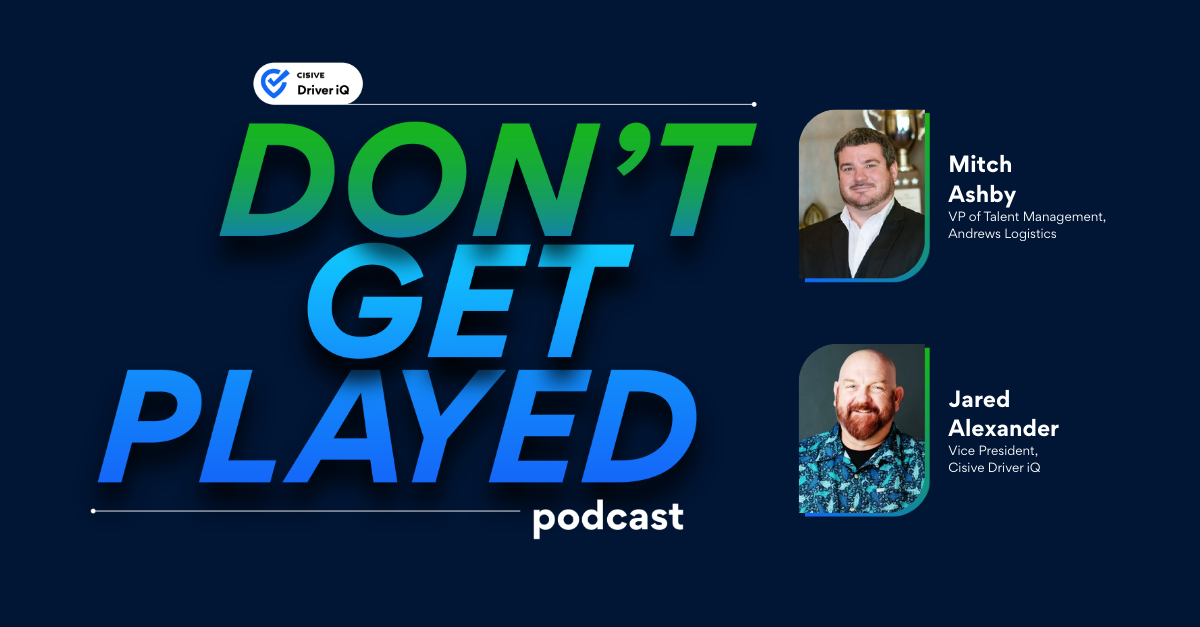
EP 1
February 24, 2026
The Screening Gap in Hiring Truck Drivers: Better Transportation Hiring Requires More Than Clean Records
with Mitch Ashby, Jared Alexander
Listen Now


Ready to get started?
Book time with one of our screening experts to find out how we can streamline your talent process with a free assessment
Get your free assessment