More than 56,000 motor vehicle inspections were conducted in North America alone during the 2025 International Roadcheck, with inspectors placing more than 10,000 vehicles out of service on the spot. This annual event is a targeted enforcement program for commercial motor vehicles and drivers, who must pass a Level 1 U.S. Department of Transportation (DOT) inspection.
The Level 1 DOT inspection is the most comprehensive check for drivers and fleets operating in the United States. If your business isn’t prepared, you’ll suffer the consequences. This guide covers what inspectors examine, the most common violations, and how to use a DOT inspection checklist to keep your drivers and vehicles road-ready.
What Is a Level 1 DOT Inspection?
A Level 1 DOT inspection, formally known as the North American Standard Inspection, is the most thorough roadside enforcement procedure for commercial motor vehicles. It entails 37 steps covering the driver and vehicle, including components that require the inspector to physically go underneath the truck.
Every commercial motor vehicle must be inspected at least once per year, with CVSA-certified enforcement officers conducting Level 1 inspections. Vehicles that pass without critical violations may receive a CVSA inspection decal that’s valid for up to three consecutive months. A Level 1 inspection typically takes 30 to 90 minutes.
The 8 Levels of DOT Inspections
The CVSA North American Standard Inspection Program defines eight inspection levels. Level 1 and Level 2 alone account for more than 90% of all roadside inspections conducted annually.
- Level 1 (North American Standard): Full driver and vehicle examination, including under the vehicle.
- Level 2 (walk-around driver/vehicle inspection): Same scope as Level 1, but without an under-vehicle inspection.
- Level 3 (driver credentials): Driver documents only — no mechanical inspection.
- Level 4 (special inspection): A targeted look at one specific component or issue.
- Level 5 (vehicle-only): Full vehicle inspection, conducted without the driver present.
- Level 6 (enhanced/radiological): Level 1 check, plus a radiological check for vehicles carrying radioactive materials.
- Level 7 (jurisdictional): Applies to school buses, hotel shuttles, and other vehicles outside the standard levels.
- Level 8 (electronic): Remote inspection via wireless technology, focused on credentials and HOS records.
What Level 1 DOT Inspectors Check
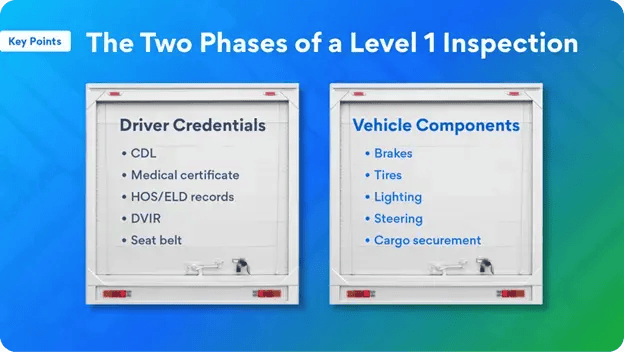
What are inspectors looking for in a Level 1 DOT inspection? Their focus can be divided into two main categories.
Driver Credentials & Documentation
Every Level 1 inspection starts with the driver. Inspectors verify:
- CDL: The license must be valid and have the correct class and appropriate endorsements for the vehicle type.
- Medical examiner's certificate: The driver must physically produce this certificate. As of April 1, 2025, drivers without a medical certificate are immediately placed out of service, as the exemption for property-carrying drivers no longer applies.
- HOS logs/record-of-duty status: Includes electronic logging device (ELD) records covering the past eight on-duty days. This is cross-referenced against fuel receipts and GPS data.
- Driver vehicle inspection reports (DVIRs): These reports document previously reported defects.
- Seat belt compliance and observable signs of drug or alcohol use: These are logged by the inspector.
As of June 25, 2025, inspectors are also required to assess English-language proficiency under a revised FMCSA enforcement mandate. Drivers who can’t demonstrate proficiency are placed out of service immediately.
Recommended Reading: Understanding DOT's Preemployment Drug-Testing Requirements
Vehicle Components
After reviewing credentials, the inspector moves to a full mechanical examination. This section covers:
- Brake systems: Air lines, slack adjusters, S-cam drums, hoses, tubing, pushrod travel, and ABS indicators.
- Tires: Tread depth (minimum 4/32" on steer axle, 2/32" on other axles), sidewall condition, and load rating compliance
- Lighting: All required lamps, including headlamps, taillights, stop lamps, turn signals, and clearance lamps
- Steering: Free play, tie rods, drag links, and gearbox mounting
- Suspension: Includes springs, air bags, and U-bolts
- Coupling devices: Fifth wheel locking mechanism, kingpin wear, and safety chains, where applicable
- Exhaust system: Inspected for leaks and proximity to fuel systems or flammable materials
- Fuel systems: Tank mounting, cap security, and absence of leaks
- Frame: Cracks, breaks, or sagging affecting structural integrity
- Cargo securement: Tie-downs, binders, and chains inspected against cargo-type standards
- Other components include: Windshield wipers, wheels, rims, hubs, and electrical systems
Level 1 DOT Inspection Checklist
Driver Readiness
- Valid CDL with correct class and endorsements
- Current medical examiner's certificate (in your possession)
- ELD device with the last eight days of HOS records
- Most recent DVIR and annual inspection certificate
- Functional seat belt
- No observable signs of impairment
Vehicle Mechanical Systems
- Brake system: Slack adjusters, air lines, tubing, ABS indicators
- Tires: Tread depth, sidewall condition, no improper repairs
- Lighting: Operational
- Steering: Free play within limits, tie rods and drag links secure
- Suspension: No cracked leaf springs, no air leaks
- Coupling devices: Fifth wheel and kingpin condition
- Exhaust: No leaks, proper routing
- Fuel system: Secure mounting, sealed cap, no leaks
- Frame: No structural cracks or sagging
- Cargo securement: Proper tie-downs by cargo type
- Windshield wipers: Operational
- Wheels, rims, and hubs: Intact
Recommended Reading: Recruiting Truck Drivers
What Happens After the Inspection?
All findings are entered into the FMCSA Safety Measurement System, regardless of outcome. Violations carry weighted penalties for your CSA score that remain in the system for 24 months. By contrast, a clean inspection improves your CSA score.
When inspectors identify a serious safety issue, they can issue an out-of-service (OOS) order for the vehicle, the driver, or both. A vehicle OOS order grounds the truck until violations are corrected. A driver OOS order prohibits that individual from operating commercial motor vehicles until the specific issue is resolved.
The financial exposure is real. Under current FMCSA civil penalty rates, a driver operating under an OOS order can be fined as much as $2,364 per violation. Motor carriers that allow such violations face penalties up to $23,647.

How to Improve Your Odds of Passing
Keep Drivers Document-Ready
A driver who can't produce a medical card or pull up clean ELD records will likely be taken out of service, even if the vehicle itself passes inspection. Make document readiness part of every pre-trip routine.
Prioritize Brakes and Tires
These two systems accounted for more than 40% of vehicle OOS violations during the 2025 International Roadcheck. Inspect slack adjusters and tire condition at every service cycle.
Be Proactive With Monitoring Driver Qualification Files
Research from the American Association of Motor Vehicle Administrators indicates that only 50% to 80% of commercial drivers self-report license issues to employers. Meanwhile, only 18 states automatically notify employers of CDL status changes. Proactive motor vehicle records (MVR) monitoring helps you eliminate blind spots before an inspector finds them for you.
Prepare for International Roadcheck
International Roadcheck is held every year. The 2026 focus for drivers is ELD tampering and falsification; the vehicle focus is cargo securement. This targeted enforcement action rewards year-round discipline over last-minute preparation.
Recommended Reading: Best DOT Compliance Services
Be Confident in Your Commercial Trucking Staff With Cisive Driver iQ
A failed Level 1 DOT inspection creates cascading effects — one less vehicle on the road, federal fines, extra paperwork, and a negative effect on CSA scores for two years. Who you hire and how you maintain records are just as important as your fleet’s mechanical condition.
Cisive Driver iQ helps motor carriers hire with confidence and stay ahead of compliance requirements through MVR monitoring, driver qualification file management, and FMCSA Drug and Alcohol Clearinghouse checks. Speak to a Driver iQ pro to learn how we can help you build a more compliance-ready fleet.
Frequently Asked Questions
What are Level 1 DOT inspections?
A Level 1 DOT inspection, officially called the North American Standard Inspection, is the most comprehensive roadside enforcement procedure in the CVSA's eight-level system. It’s a 37-step process that assesses the driver and commercial vehicle, including components requiring the inspector to go underneath the truck. The driver portion covers the CDL, medical examiner's certificate, HOS records, and observable signs of impairment. Truck inspections cover brake systems, tires, lighting, steering, cargo securement, exhaust and fuel systems, and more. A Level 1 inspection typically takes 30 to 90 minutes.
What are the most common violations found during a Level 1 DOT inspection?
Brake-related violations comprised 41% of vehicle OOS orders during the 2025 International Roadcheck. Tires were the second most common vehicle violation. For drivers, HOS violations drove 32.4% of OOS orders. Missing or expired medical examiner's certificates are an area to watch, as there is no longer a first-offense exemption for property-carrying drivers.
What happens if a driver or vehicle fails a Level 1 DOT inspection?
The inspector may place the driver, vehicle, or both out of service. A vehicle OOS order grounds the truck until all cited violations are corrected. A driver OOS order prohibits the person from operating \commercial motor vehicles until violations are resolved. Penalties can reach $2,364 per violation for drivers and $23,647 per violation for motor carriers. All violations are entered into the FMCSA Safety Measurement System and affect CSA scores for up to 24 months.
How should motor carriers prepare for a Level 1 DOT inspection?
The most effective preparation is being ready at every moment and building a safety-first culture. Prioritize brake and tire maintenance at every service cycle. Require thorough pre-trip inspections. Train drivers on document readiness so they can always produce credentials. Monitor driver qualification files proactively rather than waiting for a compliance review to surface an issue. Pay attention to the named focuses for each year’s International Roadcheck.