Healthcare has been the single largest engine of U.S. job creation for three years running. It still carries more than 1.35 million open roles at any given moment, and the average hospital is sitting on 43 unfilled RN FTEs. By any traditional measure, healthcare organizations have never had more pressure to hire, and as of May 2026, that pressure translated to 20% more clinical job openings month-over-month, and 10% more clinical applications.
So why does confidence in hiring quality keep falling even as speed improves?
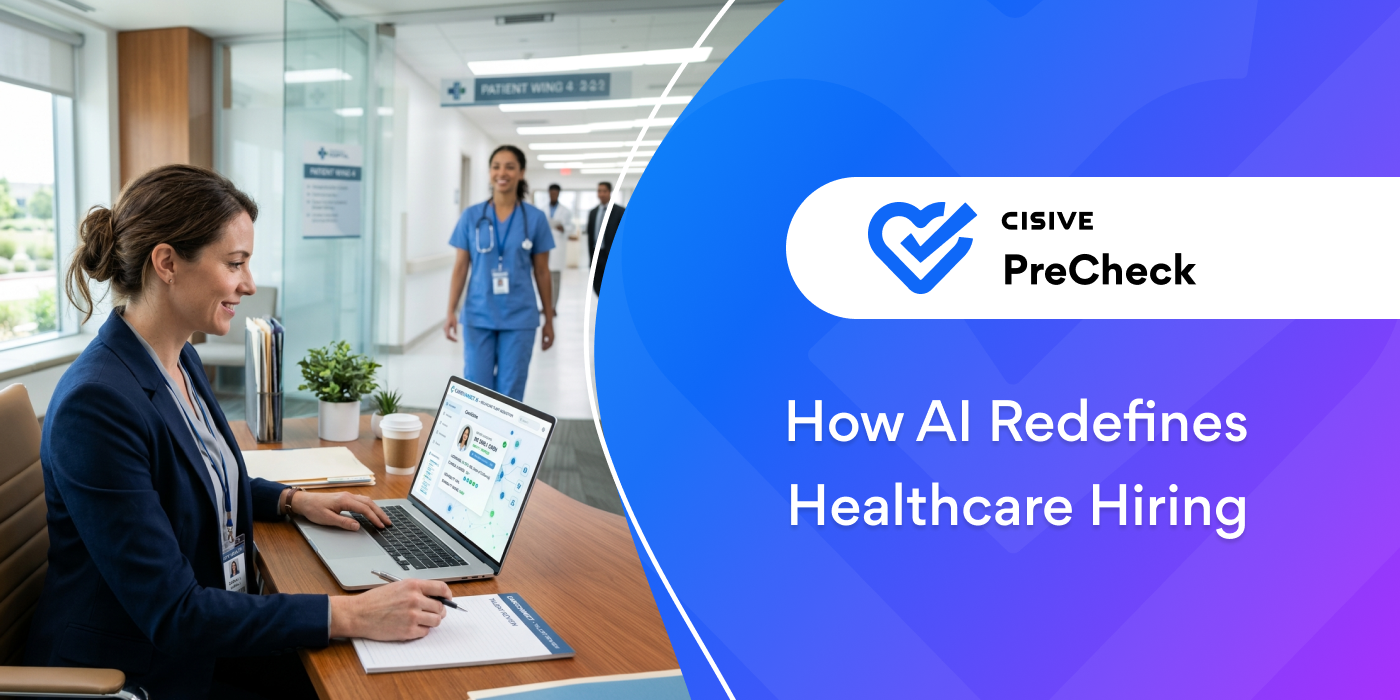
That's the paradox iCIMS and Cisive uncovered in a recent joint webinar, Beyond Time-to-Fill: How AI Is Redefining Quality of Hire in Healthcare, featuring Zach Daigle, Chief Strategy & Customer Officer at Cisive, and Andrew Curtis, Senior Principal Solution Consultant at ICIMS. The takeaway was that it's not a coincidence, but a data issue that AI just made bigger on both sides - accelerating hiring at the exact moment it made candidate-supplied information less trustworthy.
The Paradox: Faster Hiring, Shakier Confidence
The numbers tell a story most TA leaders will recognize. Demand for licensed clinical talent keeps outpacing supply, organizations are filling roles faster than ever, yet fewer than 1 in 4 organizations can measure whether they're hiring well.
AI is fueling both halves of that trend at once. It's made it possible to move ten times faster in sourcing, screening, and engaging candidates at a volume no recruiting team could manage manually. But thanks to AI, it's also much easier for candidates to misrepresent themselves. Gartner projects that by 2028, one in four candidate profiles worldwide will be fake. In a 2025 Gartner survey, 6% of candidates openly admitted to interview fraud (impersonating someone or having someone impersonate them), and that number is considered low, since people underreport cheating. GetReal Security's findings are even more stark: 41% of enterprises report having hired and onboarded a fraudulent candidate, while only 19% of hiring managers feel confident their current process would catch one.
In most industries, a bad hire is a problem you catch and fix at the next performance review. In healthcare, it's someone standing at a bedside tonight, with a badge and access to a medication cabinet, and a patient who assumes the person caring for them has been checked and verified. Cisive's own data backs this up: the failures they see almost never come from organizations that did no screening. They come from organizations that screened once, screened late, or checked a box instead of checking the source.
Defining Quality of Hire: The Four Gates
If confidence is dropping, part of the reason is that most organizations are only measuring one dimension of a four-dimensional problem. Research on mature talent-analytics programs supports this directly: organizations with mature programs track quality-of-hire metrics across four or more dimensions. Immature ones typically track just one.
The webinar proposed a healthcare-specific, four-gate definition:
A quality hire is verifiably who they say they are, eligible to do the work, capable of doing it well, and is still all three of those things twelve months later.
- Identity: Are they real? The newest gate, and one almost nobody had to think about five years ago.
- Eligibility: Are they permitted? Licensure, certification, education, exclusions and sanctions, state-specific registries - binary, non-negotiable, and legally consequential.
- Capability: Are they a fit? Skills, specialty, unit, shift pattern; the gate where iCIMS and AI-assisted screening do their best work.
- Durability: Do they stay, and stay eligible? Retention plus continuous license and sanction monitoring; Cisive's workforce intelligence layer, and the gate the industry most often ignores.
Most quality-of-hire models stop at gate three, which is likely why fewer than a quarter of organizations trust their own numbers.
It's also worth putting a dollar figure on gate two, because speed and fit only matter if what you're hiring on is real. An unfilled RN position costs $418–$591 per day; cutting time-to-fill by just 8 days saves up to $4,728 per vacancy. Even more dramatically, hospitals lose roughly $10,122 per day per unfilled physician role, so hiring even eight days faster is worth nearly $90,000. But a fast hire who shouldn't have cleared credentialing costs far more than the vacancy ever did, both financially and in compliance exposure and patient safety.
Where Quality Is Won or Lost in the Hiring Process
Every stage of the healthcare talent journey - attraction, engagement, application, assessment, interview, offer - emits a signal, if you're watching for it. Healthcare averages 110 applicants per opening, but only 28% are qualified. ICIMS customers see 49% more applicants per role than benchmark (197 vs. 132), a 19-day average time-to-hire, and 77% offer acceptance.
The webinar made a pointed observation here: most of the data needed to measure quality of hire already exists, but it's just not being connected. Inside the ATS, you have source, funnel conversion, drop-off points, and cycle time. Beyond it, you have screening turnaround, credentialing timelines, and 30/60/90-day outcomes. Almost no organization puts those two data sets side by side.
This is where AI earns its place, not as automation for its own sake, but applied specifically to the points where quality is decided:
- Finding the fit earlier, matching on licensure, specialty, and shift rather than resume keywords
- Engaging candidates before they drop, since clinical candidates are applying everywhere at once
- Giving recruiters roughly 2.5 hours a week back, redirected into the candidate conversations that decide quality
- Keeping human agents accountable, pairing intelligent agents with human expertise rather than removing people from the loop
- Time to cleared-to-start, which matches the real business outcome
- Discrepancy rate by sourcing channel, a standing report most organizations don’t run, despite already owning the data
- Post-hire monitoring alerts, read as a leading retention indicator
More volume only helps if the funnel can discern good from fast. That's the job AI is best suited for.
The Confidence Layer: Verification Isn't the Brake, It's the Brake System
The instinct is to treat verification as the friction slowing down AI-accelerated hiring. Cisive's framing inverts that: a car can go fast because the brakes are good enough that going fast is a reasonable decision. AI is the engine in this story, and verification lets you use it.
Two real, public-record cases carried this point home:
AdventHealth Palm Coast: A woman was hired in 2023 as an advanced nurse technician, using a license number belonging to a different nurse who happened to share her first name. Between June 2024 and January 2025, she treated more than 4,400 patients without a valid license. She was only caught when a coworker verified her credentials during a promotion review. The uncomfortable truth: the check that caught her was the same check that would have caught her on day one. The only variable was time, and the price of that variable was 4,400 patients and an eighteen-month exposure window.
Operation Nightingale: Between 2016 and 2021, a network of Florida nursing schools sold more than 7,600 fraudulent diplomas, generating roughly $114 million. Buyers used those documents to sit for the NCLEX, and many passed and were licensed to practice as RNs and LPN/VNs in at least nine states. Every one of those licenses would have verified clean, because the license itself was real; the state issued it. The education underneath it was fiction. This highlights the difference between checking a box and verifying a source, which is the gap an AI screening layer will miss if all it's ever fed is the box.
Verification also isn't one-and-done. HHS-OIG's position is that exclusion screening should happen at hire and monthly thereafter, since the federal exclusion list refreshes monthly. A once-a-year check isn't simply a lighter version of compliance, but eleven months of unmonitored exposure in an industry where exposure is unacceptable. And think about the retention angle: when an employee is disqualified post-hire, the organization simultaneously absorbs a compliance event and loses that person instantly from an already short-staffed unit. Then the clock restarts on a roughly 78-day recruitment cycle for a role they thought weas closed.
It's important to note that good verification isn't a speed tax. Provider credentialing and payer enrollment routinely run 90–120 days, and roughly 85% of credentialing applications contain errors or mismatches that prolong the timeline further. Most of that delay is rework, chasing a mismatched date or missing document. This is kind of problem AI is great at solving, by flagging inconsistencies before human review instead of after.
Closing the Loop: From Signals to Quality of Hire
The webinar's closing argument reframed the entire hiring process as a loop rather than linear:
Pre-hire signals → Identity & verification → Hiring decision → 30/60/90-day outcomes → Continuous eligibility monitoring → 12-month retention, with outcomes feeding back into the next hiring decision.
ICIMS owns the talent journey (attraction through offer) and the data connecting it to day one, and Cisive owns the confidence layer (screening, verification, and continuous monitoring) already integrated into that journey. The shift we're pushing healthcare organizations toward together is simple to state and hard to execute: moving from "did we fill the role?" to "did we hire the right person, and what can we learn to do it better next time?"
To answer this, we're retiring time-to-fill as the primary metric, since it stops at offer acceptance and in healthcare there can be another 90–120 days before a clinician is credentialed and billable. We're moving in favor of measures like:
The Takeaway
Going beyond time-to-fill means asking three questions consistently: Did we fill the role? Did we fill it with someone real and eligible? And are they still the right hire a year from now? AI can help answer all three, but if the second one is wrong, the other two are just confident guesses.