As an HR professional or a hiring manager, the last thing you want to do is make a bad hire. Hiring mistakes cost employers money, create compliance issues, create dissatisfied customers, and bring down employee morale. During the hiring process, background check red flags can signal potential issues that may impact your decision.
Fortunately, learning to recognize a candidate’s potential red flags can reduce the chances of a bad hire, all while being fair to individuals and following all laws and regulations. Recognizing these red flags is essential for making informed hiring decisions.
What is a Candidate Red Flag During a Background Check?
Think of a red flag as a bright warning sign informing you that there could be an issue. You don’t need to stop considering a candidate, but you should continue with due diligence.
Background checks are good at revealing red flags, including criminal convictions, inconsistent or incomplete I-9s, and questions about their employment history or education.
Some red flags are universal, while others are specific to industries and job roles. When hiring for an accounting position or for most financial services industry roles, even minor issues raised by a financial background check can be disqualifying.
By identifying red flags like these, you can gain more information and context. Ultimately, this will help you make a more informed decision about whether to hire the person or not.
Recommended Reading: How to Conduct a Background Check
Benefits of Identifying Red Flags Throughout the Hiring Process
Every employee involved in your hiring process should know how to recognize red flags and address them in a consistent manner, regardless of the candidate. Here are six reasons to do so.
Reduce Employee Turnover
If you bring someone aboard who leaves or is terminated shortly after starting, the company gets no return on that investment — and has to start over again.
High turnover can be demoralizing for employees who stay. In some industries, it can raise concerns about customers or other stakeholders. By contrast, strong processes for hiring and background checks allow you to onboard faster and with confidence. New employees have a faster and more successful onboarding, making them more likely to stay with your organization.
Build a Reliable Workforce
Great qualifications are important, but they don’t answer whether the candidate is reliable. Evaluating a candidate's character and candidate's ability is essential for building a reliable workforce. Do they show up on time? Are they ready to work? Do they complete tasks on time and as required? Failing to detect red flags around reliability can hinder company performance, increase turnover, or worse.
For example, an applicant was terminated from a previous job after missing work repeatedly without notice. If they repeat that behavior in your organization, it puts more work on other employees and disrupts your ability to serve customers.
Save on Labor & Hiring Costs
Hiring is expensive. You invest a lot of money into recruiting, interviewing, and onboarding people, so you want those people to stay.
Job-hopping is one potential red flag to inquire further about. Many people switch jobs frequently for legitimate reasons, such as the opportunity to make more money or a layoff by a prior employer. However, job-hopping could also signal that the candidate has trouble adapting to workplace cultures or struggles with job requirements.
Avoid Regulatory Penalties & Maintain Compliance
Hiring unqualified or unreliable employees can also create compliance issues, potential liability, and even legal and financial penalties. For example, financial institutions and healthcare organizations are highly regulated, both in who they hire and how they serve customers. Noncompliance can lead to investigations and a variety of regulatory penalties.
Addressing candidate red flags reduces the chances of hiring people who will put your company in this situation.
Prevent Liability
Bad hires can expose employees to liability beyond just what regulators oversee. For example, a company hires a truck driver, but the background check misses a history of substance abuse and convictions for driving while intoxicated. A week later, the driver gets into an on-the-job wreck that injures someone else.
Depending on the circumstances surrounding these offenses, such issues can be deal breakers—especially when they are directly relevant to the job. The employer is now open to legal exposure, higher insurance costs, and other damages, all because it didn’t properly check for red flags that are specific to the job role, workplace safety, and company reputation.
Uphold Your Company's Reputation
Hiring the wrong people can damage your organization’s reputation among the public, customers, shareholders, and current and future employees. Hiring someone with a questionable background can also raise questions about your company’s judgment and decision-making process.
If a financial services company hires someone with a history of committing fraud, and that person goes on to steal money from clients, that can harm the entire company’s reputation, especially if the incident receives media coverage. Reputational damage can occur even if no legal or financial penalties arise. Thorough screening helps ensure you select the right candidate for your organization, protecting both your reputation and your business interests.
7 Candidate Red Flags to Monitor
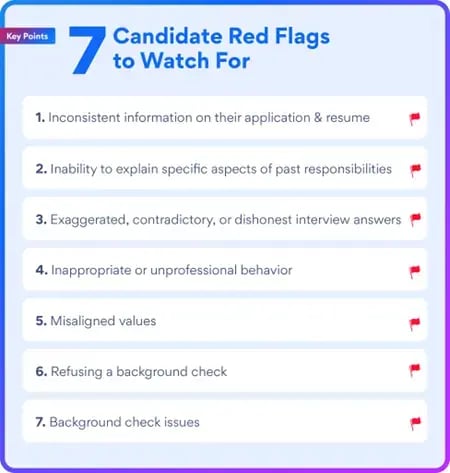
1. Inconsistent Information on Their Application & Resume
One-third of Americans say they’ve lied on a resume or cover letter. Hiring teams need to be on guard against exaggerations, false claims, and omissions on a candidate’s resume, cover letter, or application forms. Employment verification is essential for stress-testing a candidate’s claims about where and when they worked, their level of education, current certifications, etc.
Inconsistencies could be a simple mistake, but they could signal deeper problems. Minor inconsistencies in job titles or dates are common and often result from updates or formatting differences, and do not always indicate dishonesty. Investigate to determine the truth.
2. Inability to Explain Specific Aspects of Past Responsibilities
Watch out for candidates who are vague or evasive about specific job experiences, especially when they’re critical to the role they’re seeking. Again, a red flag isn’t automatically disqualifying. But HR professionals and hiring managers should scrutinize whether the candidate simply had a bad interview, wasn’t actively engaged at past jobs, or didn't actually do the work they’ve claimed to perform.
3. Exaggerated, Contradictory, or Dishonest Interview Answers
Interviews are a great way to get the candidate’s unique perspective. Ask about all the experiences and skills listed on a candidate’s resume and see if their verbal answers match what’s on paper. Interview questions should help verify the candidate's qualifications as well as their honesty. If you’re not getting a thorough or cohesive answer, try asking it in different ways to see whether the answers are consistent. A candidate who contradicts themselves is a red flag; someone who outright lies during the interview shouldn’t be hired.

4. Inappropriate or Unprofessional Behavior
Pay attention to how a candidate speaks and acts, not only with you but around support staff and anyone else they interact with. Do they treat the interviewer or hiring manager differently from others?
If they curse, tell inappropriate jokes, or act rudely in an interview, you can only imagine how they might speak in a less formal setting. Every workplace culture has its own standards, but if the candidate’s behavior doesn’t match your benchmarks, that’s a red flag worth exploring.
5. Misaligned Values
Your company should have clear values that guide its mission, practices, and behaviors. Hiring people with clearly misaligned values can create tension, reduce productivity, and be difficult for everyone involved.
When interviewing, ask candidates what's important to them about their work and what they look for in a company. You want to learn what motivates them beyond the paycheck.
Recommended Podcast: The New Rules of Social Media Screening
6. Refusing a Background Check
Companies need candidates’ permission to conduct background checks legally. That said, a candidate who refuses to allow a background check is sending up a major red flag.
If a candidate refuses, try explaining why the check is needed. Let them know it’s a standard practice and that there are legal requirements to protect the company and the individual. Hearing them out and giving an explanation often leads to consent for the background check.
7. Background Check Concerns
Background checks are designed to reveal red flags. But they’re time-consuming and difficult to do if you’re not experienced. That's why most employers use a background check provider, such as Cisive.
A pre-employment screening might reveal a criminal conviction, an employment discrepancy, or a potential problem with an applicant's identity. If an applicant "fails" the background check, you must legally notify the candidate about the issues and give them a chance to explain before taking further action.
How to Identify Candidate Red Flags
Some red flags are so obvious that they're almost impossible to miss. Others, though, are more subtle. Here are ways to identify red flags:
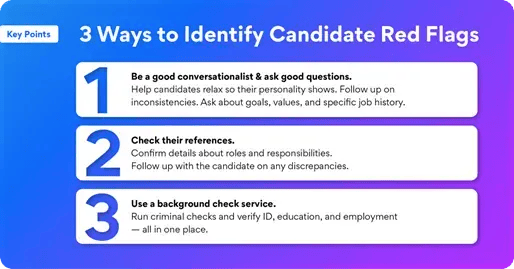
Be a Good Conversationalist & Ask Good Questions
During interviews, try to help candidates relax and be themselves. You want them to give honest, complete answers rather than tensing up and stumbling over their words. If the candidate says something that doesn't make sense or seems possibly untrue, try asking follow-up questions. You want as much information as possible to understand whether they are being evasive or dishonest, or whether they simply miscommunicated.
As part of the interview, ask about the person's career goals and values to see if they align with your organization’s. Ask specific questions about their educational history and past jobs, all while following applicable federal, state, and local laws.
Check Their References
Most references will provide glowing reviews of applicants. If they don’t, that’s a red flag. Either way, HR and hiring managers can use this interaction to confirm details about the candidate's roles and job responsibilities. If there are discrepancies, follow up with the applicant.
Follow All Relevant Laws and Regulations
Employers need to follow specific laws when it comes to inquiring about red flags, whether they make hiring decisions based on those findings, and more. To remain compliant with all applicable laws, follow fair hiring best practices, such as having a background check policy in place, avoiding discrimination in hiring, and following “ban the box” laws.
Use a Pre-Employment Screening Service
You can check a candidate's background manually, but it requires contacting previous employers and schools yourself. You may not get a timely response. Plus, you still have to do a criminal background check and, in many cases, drug testing.
Using a service like Cisive removes this burdensome work from your staff. Cisive's criminal history checks have a 99.9994% accuracy rate, and the results are available in just a few days or even hours.
Cisive provides criminal background checks, ID verification, education and employment verification, including industry-specific checks. The result is a comprehensive understanding of the candidate. Plus, you can sign up for ongoing monitoring, which will alert you to new red flags as they arise during employment.
Cisive is Here to Help You Find Candidate Red Flags
Red flags are warning signs, not stop signs. They should heighten your awareness about a potential issue, but not necessarily prevent you from hiring someone.
Improve your ability to spot candidate red flags in an applicant's background by relying on Cisive's screening tools. Our efficient, cost-effective screening solutions can give you confidence that you're making the right hire.
Speak with a Cisive expert about background checks today.
Frequently Asked Questions
What is considered a red flag on a background check?
Common candidate red flags on a background check include: criminal convictions that are relevant to the role, discrepancies in employment or education history, unverifiable credentials, and identity inconsistencies. What qualifies as a red flag varies by industry and position. For example, a DUI matters more when hiring a driver than a desk worker, and a financial fraud conviction carries more weight in banking than in some other sectors.
Can you hire someone with a background check red flag?
Yes, but it depends on the situation. Many employers successfully hire candidates with red flags after getting more context and determining whether the issue is relevant to the role. What matters is that you follow a consistent, documented process for every candidate and stay compliant with applicable fair hiring laws for every jurisdiction in which you operate. Working with a screening partner like Cisive helps ensure that the process is thorough and legally sound.
What should I do if a candidate refuses a background check?
Explain why the check is required. Most candidates push back out of uncertainty, not because they have something to hide. Let them know it's standard practice, and reiterate what the check covers. If they still refuse, that's a red flag worth taking seriously.