
Most mergers and acquisitions fail to deliver their expected value. One of the biggest reasons is inadequate due diligence. When acquiring companies rush or skip review steps, they increase the risk of hidden liabilities, compliance violations, and workforce deficiencies that can’t be fixed by a purchase-price adjustment.
By understanding what’s required of due diligence in mergers and acquisitions (M&A), you can close a deal that grows your business without creating undue risk.
What Is Due Diligence in M&A?
Due diligence in mergers and acquisitions (M&A) involves the careful examination of a target company by the potential buyer or a trusted third party. The process verifies the target's stated financial health, legal standing, operational capabilities, and compliance posture.
A thorough due diligence process surfaces risks before they become liabilities, validates the deal’s strategic rationale, and informs the purchase agreement structure. When 70% to 90% of M&A deals fail to deliver expected value, failing to flag people or compliance risks can create lasting problems that outweigh the deal’s benefits.
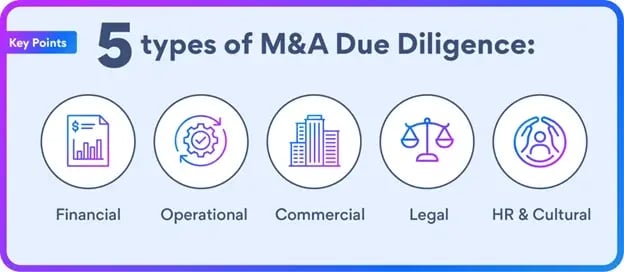
5 Types of M&A Due Diligence
M&A due diligence examines the target company, highlights risks, and gives acquirers a clear view of deal viability.
1. Financial
Financial due diligence examines the target company's financial health, the accuracy of self-reported information, and potential risks and liabilities. Make sure to review tax returns, profit-and-loss statements, cash flow statements, and historical financials. These documents can surface declining revenue, high debt levels, gaps in working capital, or reporting irregularities.
2. Legal
Legal due diligence involves reviewing the target company's legal status, documentation, and corporate structure. This step covers contracts, compliance filings, pending litigation, intellectual property (IP) protections, and permits. Undisclosed litigation or licensing gaps are red flags to address before closing.
3. Operational
Operational due diligence evaluates the target company's internal processes, systems, vendors, and capabilities, including supply chain management, IT infrastructure, and real estate. Identifying operational risks early allows acquirers to include integration costs and timelines into the deal terms, rather than discovering them post-close.
4. Commercial
Commercial due diligence analyzes the target company's market position, customer base, competitive landscape, and long-term growth potential. A strong commercial review examines market trends, customer concentration risk, and competitive threats, as well as opportunities via new markets or strategic partnerships.
5. HR & Cultural
M&A often underperforms because of cultural misalignment, talent flight, and leadership conflicts. Assessing organizational culture, talent retention risk, and leadership effectiveness allows acquirers to build integration plans that account for the human side of the deal.
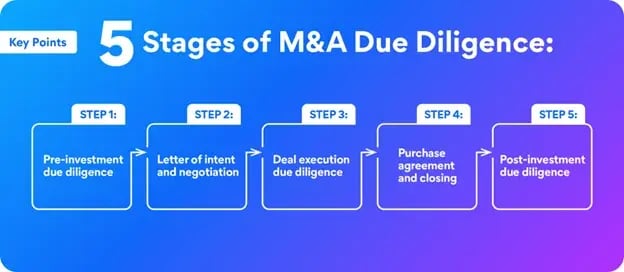
Standard M&A Due Diligence Timeline
Due diligence can take weeks or months, depending on deal complexity. The process moves through five stages.
- Pre-investment due diligence: The acquiring company conducts a preliminary study using publicly available data to determine whether the deal is strategically viable.
- Letter of intent and negotiation: The acquirer submits a letter of intent (LOI) outlining proposed terms. Once signed, this triggers confidentiality agreements and sets the stage for deeper access.
- Deal execution due diligence: The acquiring company gains access to the target's virtual data rooms, including financial records, contracts, HR documentation, and compliance history. External advisors are often engaged at this stage.
- Purchase agreement and closing: If the findings support moving forward, the parties negotiate and finalize the purchase agreement. Some transactions require regulatory approvals or shareholder votes before closing.
- Post-investment due diligence: During the integration process, conducting ongoing rescreening of people, policies, and operations protects the acquirer's reputation and surfaces new risks. Cisive's post-investment due diligence tools track a live dashboard of inputs, including reputational risk, financial changes, and ownership shifts. You get early warning before small issues become costly ones.
Why Compliance Due Diligence Can Make or Break a Deal
Compliance due diligence has become a deal-level priority, especially in regulated industries such as healthcare and financial services.
Under the U.S. Department of Justice's Evaluation of Corporate Compliance Programs, regulators examine whether compliance programs are properly designed, adequately resourced, and actually functioning. Acquirers who inherit a target's operations without remediating known compliance failures can face successor liability for the seller's past misconduct.
The DOJ also considers post-acquisition conduct in charging decisions. Buyers are in a stronger position when they quickly audit the acquired business, train staff on compliance requirements, and document remediation efforts.
Certain industries face additional scrutiny. Healthcare transactions are subject to Stark Law, the Anti-Kickback Statute, and the False Claims Act. Exposure can linger beyond the acquisition, such as when legacy physician-compensation arrangements aren't addressed before closing.
Within the Department of Health and Human Services, the Office of Inspector General compliance program guidance identifies seven foundational elements for due diligence teams:
- Written policies
- Oversight
- Training
- Communication
- Standards enforcement
- Risk assessment
- Corrective action
Be sure to evaluate each element against the target's actual practices, not just its written policies.
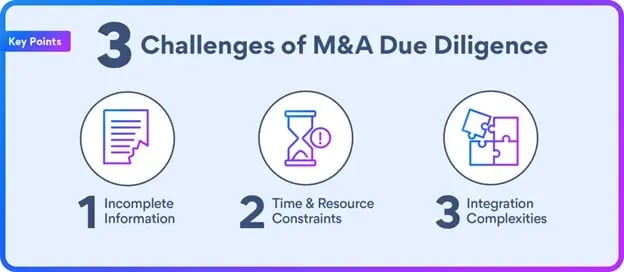
3 Challenges of Due Diligence in M&A Transactions
1. Incomplete or Inaccurate Information
Sellers don't always disclose everything, and what they do disclose might be incomplete or misleading. Cisive helps you eliminate blind spots by cross-verifying disclosed information through executive vetting and proprietary screening databases — catching what sellers may not volunteer. Common and avoidable people-related risks in M&A deals include undisclosed litigation, regulatory sanctions, and misrepresented credentials.
2. Time and Resource Constraints
M&A deals involve large volumes of complex information on a compressed timeline, which increases the risk of missed details and rushed decisions. Extend your team’s capacity via external partners with purpose-built tools and proprietary databases.
3. Integration Complexities
Cultural friction, incompatible systems, and resistance to change can erode the expected M&A synergies. Build integration planning into the due diligence process instead of reacting after the deal closes.

M&A Due Diligence Checklist: Best Practices
Define Objectives
Begin with a clear understanding of the strategic rationale, whether that's market expansion, technology access, talent acquisition, or cost synergies. Define measurable strategic goals for each area of investigation before the team starts work.
Assemble the Right Team
Build a cross-functional team that includes financial analysts, legal advisors, tax experts, operational specialists, and HR leads. For specialized areas, such as executive background screening or compliance risk assessment, bring in external experts with sector-specific experience.
Gather and Verify Information
Use virtual data rooms to access the target's financial records, contracts, and operational reports. Schedule interviews with key personnel to scrutinize whether real-life behaviors match what the target says.
Maintain Open Communication
Keep stakeholders informed through regular updates and documented findings. Surface issues early so they can be addressed in the deal terms rather than inherited post-close.
Translate Findings Into Action
Due diligence findings should drive decisions about whether to proceed, what the deal structure looks like, and what to address in the first 100 days of integration. Assign owners to remediation items, and share material risks with your board before signing off.
How Cisive Can Help
The risks that sink M&A deals rarely show up on a balance sheet. Executive misconduct, undisclosed sanctions, compliance failures, and cultural misalignment tend to surface after closing, when they're far more expensive to fix.
Cisive's executive intelligence and advisory services give acquirers the targeted research, background screening depth, and post-investment monitoring needed to hire with confidence and stay protected after the deal closes.
Ready to strengthen your M&A due diligence process? Schedule a call with a Cisive expert.

Frequently Asked Questions
What is the difference between financial due diligence and legal due diligence in M&A?
Financial due diligence focuses on the accuracy of a target company's financial picture, reviewing historical financials, cash flow statements, balance sheets, working capital trends, and revenue projections. This type of due diligence identifies risks such as hidden liabilities or overstated earnings. Legal due diligence examines the target's legal standing: contracts, pending litigation, IP ownership, regulatory compliance filings, and corporate structure.
These tracks are complementary. Financial due diligence tells you what the deal is worth; legal due diligence tells you what you're actually buying and what exposure comes with it.
How long does M&A due diligence typically take?
The timeline varies based on deal size, industry, and complexity. Smaller transactions with clean documentation can be completed in four to six weeks. Larger or more complex deals, particularly in regulated industries like healthcare or financial services, often require three to six months. Don’t rush due diligence to meet an arbitrary close date; doing so increases the risk of inheriting a preventable problem.
What happens if due diligence reveals serious red flags?
Minor issues such as documentation gaps or resolvable compliance findings are typically addressed through deal terms: price adjustments, escrow arrangements, or pre-close remediation requirements. More serious red flags, such as undisclosed litigation or active regulatory investigations, may prompt renegotiation or a decision to walk away.
In regulated industries, discovering unresolved Stark Law, Anti-Kickback, or False Claims Act exposure can change the risk calculus of a deal. The due diligence report isn't just a document. It's a decision framework.