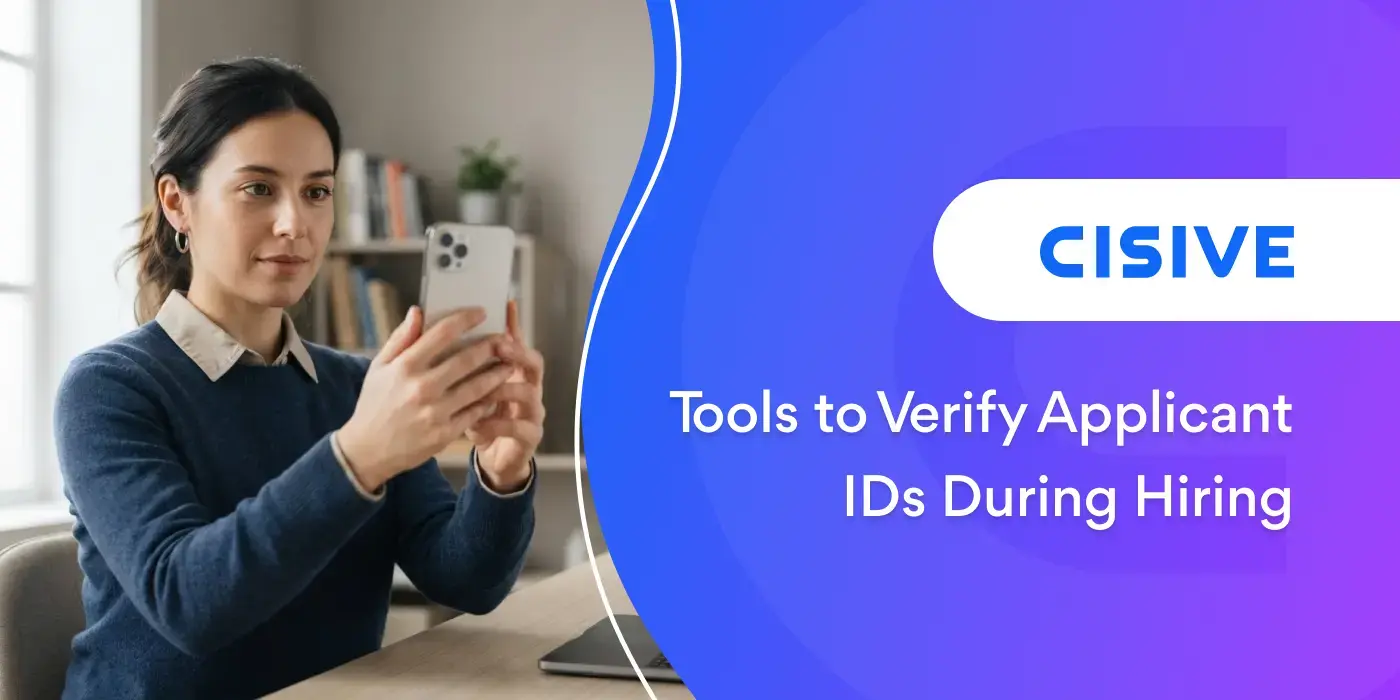
Identity fraud in hiring is no longer an edge case. With remote work, the gig economy, and high-volume recruiting reshaping how companies bring on talent, the risk of fraudulent candidates slipping through has never been higher. For hiring teams in healthcare, transportation, and financial services, verifying that the person applying is exactly who they claim to be is foundational to compliance, safety, and reputation. This article explains how tools to verify applicant IDs during hiring work, what features to look for, and how to protect your organization from fake applicants while maintaining a smooth candidate experience.
Why Applicant ID Verification Is Now Mission-Critical in Hiring
Since 2020, hiring remotely and at scale has created ideal conditions for fake applicants, AI-generated resumes, and stolen identities to enter hiring pipelines. Candidate fraud rose roughly 92% between 2020 and 2021, and the problem has only accelerated as artificial intelligence tools enable the creation of fake documents and synthetic identities. Candidate fraud can cost companies an average of $4.44 million when a bad hire results in a data breach, gaining access to sensitive systems or compromises regulatory standing. Fraudulent applicants often lie on resumes or misrepresent their identity to obtain jobs, and high-volume hiring increases the risk of encountering them.
Traditional background checks cover criminal records, employment history, education, and reference checks. But they verify history, not identification. They assume the candidate profiles they are screening belong to a real person. ID verification is different: it validates that a real person with an authentic government ID is behind every application. Verifying applicant identification can prevent resume fraud and deepfake impersonation, making ID verification vital for remote hiring.
Consider the scenarios that keep compliance officers up at night in many industries: a proxy engineer passing interviews over a video call using someone else's credentials, a nurse using another clinician's license, or a contractor accessing financial systems under a stolen identity. Without modern identification tools, hiring teams risk regulatory penalties, insider threats, and severe reputational damage.
Core Tools and Methods to Verify Applicant IDs
Every serious candidate verification solution should include these technology building blocks. Multiple verification signals enhance the reliability of ID verification processes:
- Government ID verification: Government ID authentication verifies passports, a driver's license, and national IDs for legitimacy. Systems inspect MRZ lines, barcodes, security features, and data consistency. Document authenticity verification helps detect forged or altered identification documents. Independent data verification checks identification details against trusted issuing-authority services.
- Biometric selfie matching: Biometric selfie matching compares a live selfie to ID photos. The candidate uses a smartphone or webcam; algorithms compare facial features to the government ID photo to confirm the same person is present.
- Liveness detection: Liveness detection ensures the person is physically present during verification. Active checks prompt the candidate to turn their head or blink; passive checks analyze texture and micro-movements. Both are designed to defeat deepfakes, static photos, and screen replays.
- Human-in-the-loop review: For higher-risk cases, expert document examiners review flagged IDs, adding a forensic layer on top of automated processing.
Modern Solutions vs. Outdated ID Checks
Many organizations still rely on outdated methods: manual ID inspection over a webcam, emailing scans of IDs, or only checking documents on day one of employment. These approaches do not scale and cannot stop sophisticated fake applicants.
Consider these failure points:
- A recruiter visually "checking" a passport during a video call cannot detect AI-enhanced forgeries or morphed photos.
- HR accepting low-resolution ID images sent by email has no standardized capture, no metadata validation, and no audit trail.
- Relying solely on I-9 at onboarding catches work authorization issues but does nothing to confirm a candidate's identification early in the hiring funnel.
AI tools enable creation of fake documents and synthetic identities that easily fool human review under time pressure.
Modern automated tools perform forensic analysis, biometric comparison, and liveness detection within seconds, producing structured pass/fail outcomes with audit logs. For talent acquisition leaders in healthcare, transportation, and financial services, ID verification should be treated as a core risk-control technology investment, not an operational afterthought.
How IDVerity Protects Regulated Industries from Fake Applicants
IDVerity is Cisive's identity-first layer for candidate verification in regulated sectors. It combines forensic ID document validation, biometric facial recognition, and liveness detection to ensure the government ID presented is genuine and belongs to the person applying.
IDVerity is designed for industries with strict compliance obligations:
- Healthcare: Protects patient safety and license integrity by confirming clinicians are who they claim to be.
- Transportation: Supports public safety and alignment with TSA and DOT expectations by validating driver and operator identification information.
- Financial services: Strengthens KYC, AML, and fraud controls-blocking bad actors from using stolen or synthetic identities to gain access.
IDVerity validates identification before any background screening begins. This means downstream criminal checks, employment verification, and credential reviews are anchored to a trusted ID. The solution uses machine learning for real-time fraud detection and augments it with human review for edge cases, catching tampered IDs, synthetic identities, and impersonation attempts early in the recruiting process. It provides a clear pass/fail outcome and a defensible audit trail for internal audit, regulators, and compliance documentation.

Technology Behind IDVerity: Why It Matters in the Age of AI and Fake Applicants
The sophistication of hiring fraud demands equally sophisticated fraud detection. Here's what makes IDVerity's technology stack effective:
- Forensic document analysis: Inspects microprint and security features on IDs (holograms, fonts, barcodes, MRZ lines, and image artifacts) to distinguish authentic government IDs from high-quality forgeries. Government ID validation checks if identification documents are legitimate at a forensic level.
- Biometric facial recognition: Creates facial templates from both the ID photo and live selfie, matched within strict thresholds. Leading benchmarks, such as those from NIST, require biometric verification to be accurate and fair across diverse populations.
- Advanced liveness detection: Uses motion analysis, texture analysis, depth and light reflection, and challenge-response prompts to defeat deepfakes, AI-generated faces, and screen replays.
Unlike static legacy tools, IDVerity's layered technology is continuously updated in response to new fraud patterns. In environments where one bad hire can trigger regulatory scrutiny or safety incidents, only top-tier, adaptive technology can reliably protect the hiring process and confirm real talent enters the organization.
Designing an ID Verification Flow That Candidates Will Actually Complete
The strongest fraud controls fail if candidates abandon the process. Candidate experience is where organizations either reduce friction or lose real talent to drop-off.
An ideal candidate journey with IDVerity looks like this:
- Candidate receives a mobile-first link or in-ATS prompt.
- They snap a quick photo of their government ID.
- A guided selfie capture confirms biometric verification.
- Verification results return in about 30 seconds.
No app download required. Clear on-screen instructions, progress indicators, and simple language reduce confusion for candidates who may be less tech-savvy. Auto-filling application fields with verified identification data (up to 93% of fields) minimizes data re-entry, improves accuracy, and speeds up background screening.
In high volume hiring, even small improvements in completion rate have a large impact on recruiter workload, time-to-fill, and overall quality of hire.
Where ID Verification Fits into the Hiring Process and Background Screening
ID verification should occur at the start of the hiring process, typically at application, pre-screen, or pre-offer, so hiring teams are not investing time in fake applicants. ID verification helps prevent hiring fraud before interviews even begin. Fraudulent applicants often misrepresent their identity on resumes, and catching them early saves resources at scale.
Recommended checkpoints for regulated industries:
|
Stage |
Action |
|---|---|
|
Post-Application |
Initial identity checks and candidate verification |
|
Pre-Offer/Pre-access |
Re-verification before granting access to clinical, financial, or transportation systems |
|
Internal transfer |
Spot checks for moves into sensitive roles or sensitive systems |
Once IDVerity establishes a trusted identification, that record powers criminal checks, employment verification, license checks, and ongoing background screening, without re-collecting the same data. This identity-first model reduces duplicate work for both HR teams and candidates, and improves accuracy from the recruiting process through onboarding. Effective ID verification tools integrate into the hiring workflow seamlessly.
Compliant processes still require consent, consistent adjudication criteria, and adherence to FCRA, EEOC, and local regulations. Modern tools provide configurable workflows to support these obligations.
Key Features HR and Talent Acquisition Should Look For in ID Verification Tools
When evaluating tools to combat hiring fraud and candidate fraud, use this checklist:
- Accuracy and fraud detection: Look for proven document validation rates, biometric match accuracy, and capabilities against deepfakes, synthetic identities, and fake applications.
- Regulatory alignment: Ensure support for FCRA, KYC, AML, and industry-specific standards. Demand solid audit trails for compliance reviews and external investigations.
- Integration capabilities: Confirm seamless connections to ATS, HRIS, and background check providers so recruiters can trigger and review ID checks inside existing workflows.
- Scalability: The tool must handle surges in applicants, distributed hiring teams, and multiple business units, which is critical for companies hiring at scale across many industries.
- Candidate experience: Prioritize mobile optimization, localization for languages and ID types across countries, accessibility, and clear instructions to reduce friction.
- Reporting and analytics: Dashboards showing pass/fail rates, fraud trends, completion times, and drop-off points help leaders continuously improve their process.
Organizations in regulated industries cannot afford to leave ID verification to chance.
5 FAQs About Applicant ID Verification and Hiring Fraud
These questions address common concerns HR and talent acquisition leaders in regulated industries raise about identity validation tools beyond what's covered above.
How early should we verify a candidate's identification during the hiring process?
Verify identification as early as practical, often right after application or initial screening. This prevents employers from investing time in fraudulent candidates and ensures background screening is performed on the right person. For higher-risk or regulated roles, organizations should also re-verify identification before granting access to clinical systems, financial platforms, or transportation controls.
Will strong ID verification slow down hiring or frustrate candidates?
Modern tools like IDVerity add only a couple of minutes to the process and work in parallel with other hiring steps. A streamlined mobile experience and transparent communication about why identification is being validated reduce friction and often increase candidate trust in the employer's professionalism.
Is ID verification different from I-9 or E-Verify for U.S. employees?
Yes. Form I-9 is used to verify employment eligibility in the United States, while E-Verify checks employment eligibility against government records and complements Form I-9. ID verification for hiring confirms that a real person with a valid government ID is behind the application, before onboarding. Accurate ID verification up front supports cleaner I-9 and E-Verify completion later. Remote onboarding procedures for Form I-9 must meet specific eligibility requirements, which is another reason to verify identity early.
How does ID verification help prevent insider threats and not just fraudulent applicants?
By anchoring every background check and access decision to a trusted identity, organizations dramatically reduce the risk of someone entering under a false or stolen identity and gaining prolonged insider access to sensitive systems. Re-verification at key transitions, such as role changes into more sensitive positions, helps protect the employee lifecycle.
Can applicant ID verification cover international candidates and cross-border hiring?
Leading tools support thousands of government ID types from hundreds of countries. IDVerity, for example, covers 5,000+ IDs across 200+ countries. However, coverage varies, so HR teams should confirm which documents and jurisdictions are supported and ensure alignment with local privacy and data transfer regulations for cross-border background screening and ID verification.