Reasonable suspicion drug and alcohol testing has always been one of the most defensible tools in an employer's compliance toolkit. But the landscape is shifting fast. Cannabis legalization, updated Department of Transportation (DOT) rules, new oral fluid testing options, and tighter federal guidance on post-incident testing have all changed what "doing it right" actually looks like in 2026.
For HR managers and safety professionals, that means policies written even three years ago may be out of date. This guide defines reasonable suspicion drug testing, explains what the law requires and how cannabis legalization is reshaping the rules, and lays out the steps supervisors should take to act with confidence when it matters most.
What is Reasonable Suspicion Drug Testing?
Reasonable suspicion drug testing sits in a specific and important category. It is neither random nor post-hire. It’s triggered by what a supervisor directly observes: behavior, appearance, or performance that suggests an employee may be impaired on the job.
The legal roots go back to 1968. In Terry v. Ohio, the U.S. Supreme Court held that a search is "reasonable" only when it’s based on specific and articulable facts, not on intuition alone. That standard carries directly into workplace drug and alcohol testing. A supervisor can’t act solely on a gut feeling. They need to document what they saw, when they saw it, and why they had reason to believe the employee was impaired.
Iowa's mandatory drug testing statute provides a clear working definition most employers can use as a model. Under Iowa law, reasonable suspicion testing is appropriate when evidence is drawn from specific, objective, articulable facts, including:
- Observable signs of impairment, including slurred speech, bloodshot eyes, unsteady gait, or the smell of alcohol or drugs
- Abnormal or erratic behavior, or a significant drop in work performance
- A report from a reliable and credible source
- Evidence that an employee tampered with a prior drug or alcohol test
- An accident resulting in injury or property damage exceeding $1,000
- Evidence of on-premises drug manufacture, sale, distribution, or use
The critical point: A supervisor doesn’t need to identify which substance is involved. That is the laboratory's job. The supervisor only needs to document what they observed and when. Two or more supervisors making independent observations significantly strengthen this decision.
Some states layer additional requirements on top of this framework. Employers operating in multiple states should confirm whether state-specific definitions or procedural rules apply to their operations.
Signs and Symptoms Supervisors Should Recognize
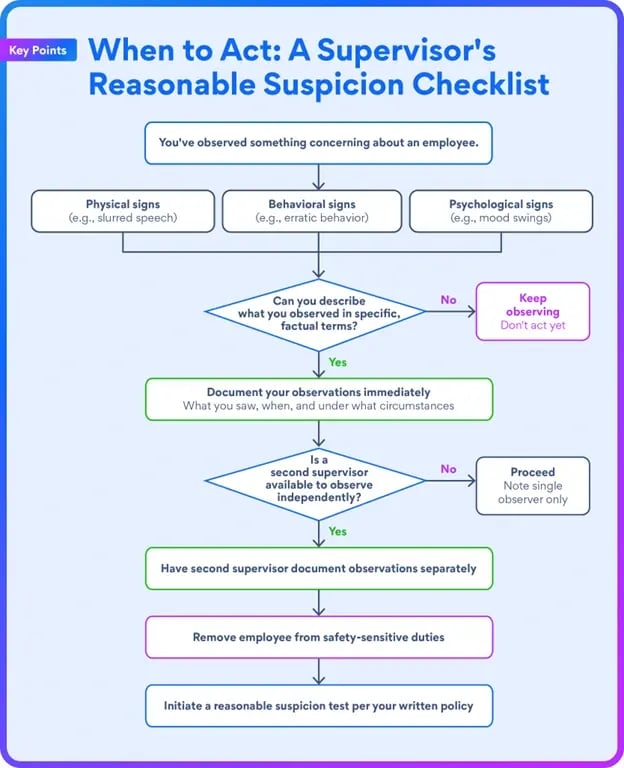
Effective reasonable suspicion programs depend on supervisors who can recognize and document what they are seeing. The key is documenting observable facts, not making medical judgments. Write down what you saw, when you saw it, and under what circumstances. Do it immediately, before the moment fades.
Signs of drug impairment at work fall into three categories.
Physical signs include:
- Slurred or incoherent speech
- Bloodshot, glassy, or watery eyes
- Coordination problems, such as stumbling or difficulty with fine-motor tasks
- Tremors or shaking
- Unusual odors (alcohol, marijuana, chemical smells)
- Flushed or pale complexion
- Excessive sweating or dry mouth
Behavioral signs include:
- Uncharacteristic absenteeism or tardiness
- Sudden drop in productivity or quality of work
- Erratic or unpredictable behavior
- Arguments, irritability, or aggression that are out of character
- Poor judgment or decision-making on tasks normally handled well
Psychological signs include:
- Mood swings or emotional volatility
- Paranoia or hypervigilance
- Difficulty concentrating or following instructions
- Unusual anxiety or agitation
- Euphoria or excessive talkativeness inconsistent with the situation
No single sign is automatically sufficient. The standard requires a pattern of observable facts that, taken together, give a trained supervisor reason to believe impairment is present. That’s why documentation matters.

DOT Reasonable Suspicion Testing Requirements
Employers in federally regulated industries face more specific procedural requirements for reasonable suspicion testing. DOT regulations under 49 CFR Part 382 (FMCSA) require reasonable suspicion testing when a trained supervisor believes a driver with a commercial driver’s license (CDL) has violated the employer's drug or alcohol prohibitions.
Under §382.307, testing must be based on the supervisor's direct, contemporaneous observation of the driver. The observation must occur just before, during, or just after the driver's performance of safety-sensitive functions.
Worth noting: While a 2025 presidential executive order proposes to reschedule marijuana from a Schedule I to Schedule III drug, DOT warns that no testing procedures have changed, including random drug testing.
Recommended Reading: What Are the CDL Drug Test Requirements for Drivers?
Supervisor Reasonable Suspicion Training Requirements Under DOT
Before implementing DOT reasonable suspicion testing, FMCSA requires that supervisors of CDL drivers receive at least 60 minutes each of training on recognizing alcohol misuse indicators and controlled substances indicators. Only then can supervisors legally make reasonable suspicion determinations. Note that owner-operators without supervised drivers aren’t subject to these supervisory training requirements.
Oral Fluid Testing Under DOT
Beginning June 2023, DOT amended Part 40 to implement oral fluid testing as an alternative to urine testing across all standard DOT testing circumstances, including reasonable suspicion. As of May 2026, there are no HHS-certified labs for employers to utilize this option. However, once collection sites and labs are fully certified, DOT-regulated employers will be able to choose oral fluid when it fits their program and policy.
This particularly matters for cannabis. Oral fluid testing detects recent use more accurately than urine, which is best used for flagging metabolites from days-earlier marijuana use that’s outside any window of active impairment. Employers considering the switch should update their written DOT policies and train supervisors on oral fluid collection practices.
Speak to a Cisive Driver iQ pro to learn how DOT testing program updates affect your fleet.
How Cannabis Laws Are Reshaping Reasonable Suspicion
State-level cannabis laws have shifted the legal environment significantly and have exposed many employers’ policies.
As of 2025, more than 40 states have legalized marijuana in some form. A growing number of those states explicitly protect employees' off-duty, lawful cannabis use. Some states restrict or prohibit pre-employment marijuana testing. Random marijuana testing is increasingly constrained in certain jurisdictions, as explained on a recent Cisive webinar featuring Bill Judge and Nick Hartman of the Drug Screening Compliance Institute. Nick Hartman also explained on the Cisive podcast what the April 2026 rescheduling of marijuana means for employers.
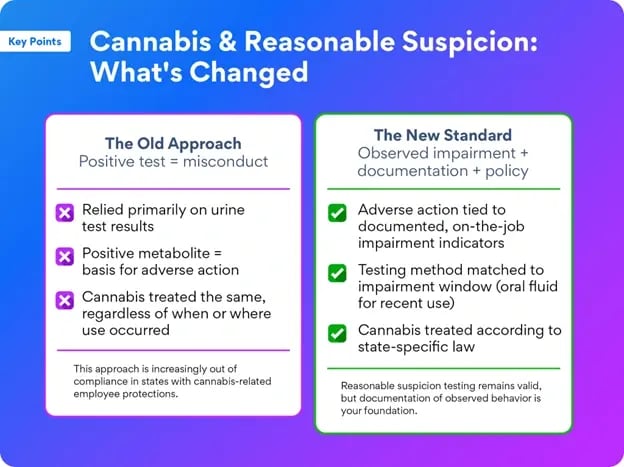
Here is the important distinction most employers are missing: reasonable suspicion testing for cannabis is still permitted in most of these states. What has changed is the standard for adverse action.
California's AB 2188, which took effect in 2024, is a clear example of where the law is heading. Employers can’t take adverse action based solely on tests that detect non-psychoactive THC metabolites, which are the compounds that can show up in urine days later, after impairment effects have ended. If employers rely solely on a positive urine test without documented observation of on-the-job impairment, they’re increasingly exposed to legal challenge.
Some local ordinances go further. San Francisco, for example, restricts broad random testing but allows suspicion-based testing where on-the-job impairment is a clear safety concern.
The practical implication for employers? Reasonable suspicion documentation has to become stronger in states with cannabis protections. A supervisor who observes and carefully documents behavioral, physical, and performance-based indicators can still build a case that the adverse action is based on present impairment, not on a lifestyle choice made on a Saturday night.
The bottom line: Always confirm state and local laws where you operate. A workplace drug testing policy that was fully compliant three years ago may now be outdated for cannabis. Legal counsel and a compliance partner should be in the loop when policies are updated.
Recommended Reading: Is CBD Oil on Drug Tests?
OSHA, Post-Incident Testing, and Anti-Retaliation
The current legal position of the Occupational Safety and Health Administration (OSHA) is that most forms of workplace drug testing are permissible, provided the purpose is workplace safety, rather than punishing workers for reporting injuries. An earlier period of regulatory uncertainty, in which some interpreted OSHA's anti-retaliation provisions as limiting post-incident testing, has largely been resolved. OSHA has since clarified that post-incident testing is allowed when it is applied consistently as part of a safety-focused program.
The key principle is that employers should test based on the incident’s circumstances, not just on who reported an injury. OSHA's guidance discourages "test only the reporter" policies. If the incident involved multiple employees and there is a reasonable basis to believe impairment may have been a factor, testing all relevant employees is the defensible approach.
Where post-incident and reasonable suspicion testing intersect is in documentation. The same standard applies to supervisors, who should document the observable facts that led to the testing decision.
- What happened?
- Who was involved?
- What did the supervisor observe before, during, or after the incident that gave reason to believe impairment was a factor?
That documentation is your protection, both with OSHA and in any other challenges.
Supervisor Training and Reasonable Suspicion Documentation
The weakest link in most reasonable suspicion programs isn’t the policy language. It’s the moment when a supervisor sees something concerning and doesn’t act. Maybe it’s because they aren’t sure they’re right. Maybe they don’t want to damage a relationship. Perhaps they’re simply unsure what to do next.
Training fixes that. Supervisors who have completed structured reasonable-suspicion training are significantly more likely to act when the situation calls for it because they understand that their job is to document facts, not to make a medical diagnosis.
Minimum training standards:
- DOT-regulated supervisors: 60 minutes on alcohol indicators, 60 minutes on controlled substances indicators (per FMCSA §382.307).
- Iowa employers: initial training, plus annual refreshers required under state law.
- All other employers: No federal minimum, but best practices align with DOT standards, with a minimum of 60 minutes’ training covering all major substance categories, repeated annually.
Recommended Reading: Make sure you understand non-DOT vs. DOT drug test requirements.
Documentation steps when reasonable suspicion is triggered:
- Observe and note. Document exactly what you saw, using specific, behavioral language. For example, "Employee appeared to be swaying while standing at their workstation and had glassy, bloodshot eyes," not "Employee seemed off."
- Get a second supervisor if possible. Two independent observations are significantly stronger than one.
- Act in real time. Observations are most defensible when documented at the moment they occur, not reconstructed later.
- Remove the employee from safety-sensitive duties immediately. Don’t wait for test results.
- Use a standardized checklist. A written reasonable-suspicion checklist, filled out at the time of observation, is among the best protections an employer can have.
- Preserve confidentiality. The process, observations, and test results should be handled on a need-to-know basis.
Supervisors who are confident in these steps are far more likely to act, and act responsibly.
Building a Reasonable Suspicion Drug Testing Policy
A solid reasonable suspicion testing policy doesn’t need to be lengthy or complicated. It needs to be specific, consistently applied, and compliant with applicable federal, state, and local law. At a minimum, every policy should include:
- A clear definition of reasonable suspicion that references specific and articulable facts
- A list of observable indicators that supervisors are trained to recognize
- Documentation requirements, including what supervisors must record and when
- Testing procedures, including who conducts the test, under what chain of custody, using which method (urine, oral fluid, or both)
- How DOT requirements apply for safety-sensitive roles (if applicable)
- State and local provisions for jobsites where additional rules apply
- Cannabis-specific language that reflects current state law and focuses adverse action on demonstrated impairment
- Confidentiality provisions
- Consequences for a confirmed positive test or refusal to test
- Anti-retaliation language, consistent with OSHA guidance
Policies should be reviewed at least annually, given how quickly state cannabis laws are evolving. If your organization operates in multiple states, a compliance partner who monitors legislative changes can help you stay ahead of policy gaps before they create legal exposure.
How Cisive Can Help
Reasonable suspicion drug testing works when two things are in place: a policy that reflects current law, and supervisors who are trained and confident enough to act on it. Getting both right is harder than it sounds, especially as cannabis legislation continues to change and DOT compliance requirements evolve.
Cisive has supported compliance-focused employers for more than 40 years, with a 99.9994% accuracy rate. Whether you are building a program from scratch, updating a policy that has not been reviewed since cannabis legalization accelerated, or training a new group of supervisors on DOT reasonable suspicion requirements, Cisive's team can help you stay ahead of the gaps.
Speak to a Cisive pro to review your current drug testing program and get expert guidance on what needs to change.

FAQs
Can we still test for marijuana under reasonable suspicion where cannabis is legal?
Yes, in most states. State cannabis laws generally protect off-duty, lawful use but not on-the-job impairment. Reasonable suspicion testing based on observed workplace behavior remains permissible in the vast majority of jurisdictions. The important shift is that adverse action increasingly needs to be tied to documented impairment indicators, not just a positive metabolite test. Confirm the specific rules in each state where you operate.
Can we use oral fluid for reasonable suspicion testing?
Reasonable suspicion testing now allows for oral fluid testing following an update to Part 40 rules; however, as of May 2026, there are no HHS-certified labs for employers to utilize this option. For non-DOT employers, oral fluid testing is generally permissible and may be preferable for reasonable suspicion because it’s better at detecting recent use. State laws vary, so confirm applicable rules before implementing.
What if an employee disputes the reasonable suspicion determination?
Document everything. A written record of specific, contemporaneous observations made by a trained supervisor is your strongest protection. Documentation from two supervisors is ideal. Employees have the right to contest results in many jurisdictions, including requesting a split specimen retest in DOT contexts. Having a clear, documented, consistently followed process can help employers protect themselves in any dispute.
How do we handle a situation where an employee smells like marijuana but holds a medical card?
State law varies considerably on this front. In states with cannabis employee protections, a medical card may affect how you can respond to a positive test. However, it generally doesn’t override your ability to remove an employee from safety-sensitive duties when you have documented reasonable suspicion of present impairment. Work with legal counsel to ensure your policy addresses this scenario explicitly.