Not every resume is as it seems, especially when it comes to education credentials. Education verification background checks exist for a reason: many candidates inflate degree levels, claim credentials from unaccredited schools, or list programs they never completed.
The problem is bigger than a few embellished bullet points. Education credentials are one of the most common areas of resume fraud. A 2025 ResumeBuilder.com survey of 2,000 U.S. job seekers found that 24% have lied on their resume, and education credentials ranked among the most frequently falsified areas.
Hiring people based on false credentials poses risks of patient harm, regulatory fines, and negligent-hiring claims. In regulated industries like healthcare, finance, and law, a single unverified credential can expose your organization to serious liability.
Education verification background checks confirm what a candidate actually earned before you hire them and before any damage is done.
What Is an Education Verification Background Check?
An education verification background check confirms that a job applicant's claimed credentials match reality. Also called degree verification or education verification screening, these checks verify the schools attended, dates of enrollment, and degrees and certifications actually received.
Employers use them to ensure candidates meet the role's educational requirements and aren't fabricating their credentials. This is a core component of a background screening program. For regulated industries, it’s often a legal requirement.
What Does an Education Verification Background Check Include?
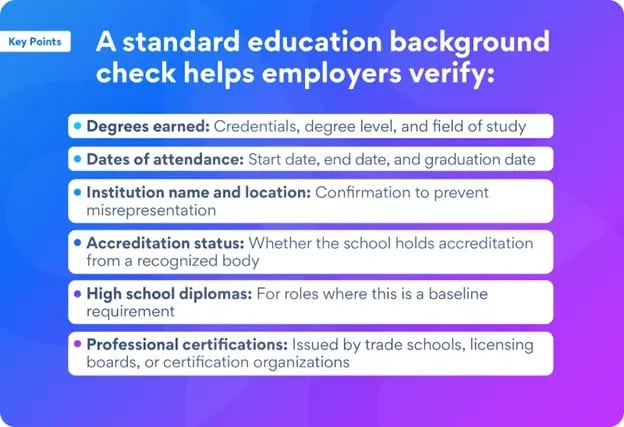
The scope of an education verification background check depends on the role, but most checks cover the following:
- Degrees earned: Credentials, degree level, and field of study
- Dates of attendance: Start date, end date, and graduation date
- Institution name and location: Confirmation to prevent misrepresentation
- Accreditation status: Whether the school holds accreditation from a recognized body
- Professional certifications: Issued by trade schools, licensing boards, or certification organizations
Most roles only require degree-level confirmation. For positions that require specialized knowledge, including engineering, healthcare, or advanced finance roles, transcript review should confirm specific coursework completed.
Cisive's education verification service confirms attendance, enrollment periods, degrees awarded, and graduation dates, with every check handled by in-house personnel. No outsourcing, no shortcuts.
Related Podcast: How Verifiable Credentials are Rewriting the Rules of Hiring Trust
Which Industries Require Education Verification?
Education requirements aren't universal. In regulated industries, skipping credential verification isn't just risky. It can trigger regulatory action, legal liability, or exclusion from federal programs.
- Healthcare: Physicians, nurses, pharmacists, and allied health professionals must hold specific degrees to become licensed. Professional license verification is a compliance requirement here. Organizations that skip it risk exclusion from federal programs like Medicare and Medicaid.
- Finance and accounting: Financial services firms must verify academic credentials and professional licenses to stay in compliance and fulfill their fiduciary duty. Regulators, including FINRA and the SEC, expect documented verification processes.
- Law: Law firms and legal departments confirm degrees to determine bar eligibility and guard against malpractice. An unverified credential in a legal setting can create liability that outlasts the hire.
- Engineering: Professional engineers must hold a degree from an accredited program. Firms that make unqualified hires for safety-critical work create serious liability, and, in some states, face regulatory penalties.
- Education and social services: Schools and social service agencies verify teaching credentials and degrees to meet state certification laws and protect vulnerable populations.
Recommended Reading: Navigating Background Check Compliance in Healthcare
Why Education Verification Background Checks Matter
Diploma Mills Remain Active
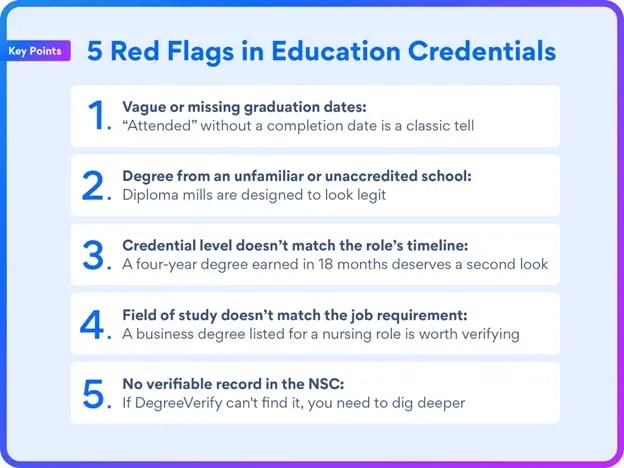
Unaccredited or nonexistent schools sell degrees without requiring significant coursework. Some run phone verification services specifically designed to confirm fake credentials when an employer calls, which means a DIY check can be defeated by design.
A professional education verification process goes further, checking accreditation through the U.S. Department of Education. That's a layer of protection a phone call to a registrar simply can't provide, and a reason to choose a proven background check provider like Cisive. We catch what others miss.
Candidates Frequently Misrepresent Education Credentials
Education credentials are one of the most common areas of resume fraud. A 2025 StandOut CV survey found that 30% of Americans have lied on their resume about a college degree. That's not an outlier finding. It's a structural hiring risk that shows up across industries, seniority levels, and company sizes.
The implication for employers is straightforward: without a formal education verification process, there's no reliable way to distinguish a legitimate degree from a fabricated one.
The Legal Risk Is Real
Hiring an unqualified person for a regulated role creates negligent hiring exposure, and the liability doesn't require intent. If your organization lacks a documented credential-verification process, defending against a negligent-hiring claim becomes significantly harder, even if the bad hire wasn't malicious.
In highly regulated fields like healthcare and finance, that exposure is compounded by regulatory penalties, loss of federal program eligibility, and reputational damage that can outlast the legal proceedings.

DIY vs. Third-Party Education Verification
Some employers rely on manual verification, such as directly contacting school registrars or using the National Student Clearinghouse portal. For low-volume hiring in unregulated industries, that can work.
But manual checks have real limitations. Response times vary widely by institution. Diploma mill fraud is harder to detect when verification is handled by phone or basic portal lookup. And as hiring volume grows, the process doesn't scale. It just consumes more staff time.
Third-party education verification removes that burden while maintaining compliance best practices. When you partner with a firm like Cisive, every check is handled by in-house staff using each institution's preferred contact method: phone, email, or portal. Candidate communication is automated through a secure platform, freeing your team from paperwork and follow-up.
A higher accuracy rate, with turnaround times that can reduce days or weeks of manual work to a matter of hours, directly improves time-to-hire without sacrificing thoroughness.
Recommended Reading: Background Check Process: Key Employer Insights & Steps
How the National Student Clearinghouse Works
The National Student Clearinghouse (NSC) is the backbone of most education verification background checks in the United States. This nonprofit holds degree and enrollment records for U.S. colleges and universities and serves as the primary database for background screening providers nationwide.
Services for employers include:
- EnrollmentVerify: Confirms current or past enrollment at participating schools
- DegreeVerify: Covers roughly 96% of U.S. postsecondary degrees and provides instant credential confirmation
- DiplomaVerify: Extends coverage to high school diplomas
Employers can register directly for NSC database access or work with a third-party screening partner that already has an NSC integration in place.
Keep in mind that NSC coverage isn't universal. Schools not in the database, including many international institutions, some trade schools, and certain community colleges, require direct outreach to verify credentials.
FCRA & FERPA: Education Verification Compliance Employers Must Know
Running an education verification background check isn't just about confirming a degree. It also requires following federal privacy and consumer protection laws. Two federal laws govern this process directly.
Fair Credit Reporting Act (FCRA)
The FCRA treats third-party education verification as a consumer report, which means specific procedural requirements apply before, during, and after the check.
Before ordering a background check, employers must provide a standalone written disclosure and obtain the candidate's signed authorization. This disclosure must be a separate document. It cannot be buried in an employment application or offer letter.
If a hiring decision is influenced by the report, follow the pre-adverse action process. Provide the candidate with a copy of the report and a summary of their FCRA rights before making a final decision. Then issue a formal adverse action notice.
In addition to following FCRA best practices, it’s important to understand that many states have their own FCRA-equivalent laws that add further requirements. Some of these include longer waiting periods and additional candidate notifications, so compliance obligations vary depending on where you're hiring.
Family Educational Rights and Privacy Act (FERPA)
FERPA requires schools to have documented student consent before releasing academic records to third parties. In practice, this means getting upfront written authorization from each candidate before initiating a check.
If a candidate declines to provide consent, the institution is legally prohibited from releasing their records, and you cannot proceed with verification through that channel. This is one reason working with a screening provider that has established, FERPA-compliant channels to schools and the NSC matters. It removes the compliance burden from your team and ensures the process holds up if challenged.
How Cisive Can Help
Education fraud doesn't announce itself. Diploma mills look legitimate by design, and fabricated credentials are hard to spot without a proper verification process.
Cisive's education verification service confirms degrees, dates of attendance, and accreditation status with a 98.83% accuracy rate. Every check is performed by in-house personnel using institution-preferred contact methods. No outsourcing, no shortcuts.
Ready to verify education history with confidence? Speak to a Cisive pro to get started.
Frequently Asked Questions
What does an education verification background check include?
The process confirms degrees earned, field of study, dates of enrollment and graduation, and institution accreditation status. Depending on the role, it may also cover professional certifications, trade school credentials, and high school diplomas.
Does an education background check include GPA?
No. Standard education verification background checks do not include GPA. If GPA is relevant to the role, ask the candidate to provide an official transcript directly from their institution.
How does the National Student Clearinghouse work for employers?
The NSC holds postsecondary records for participating U.S. colleges and universities. Its DegreeVerify service provides instant credential confirmation for roughly 96% of U.S. postsecondary degrees. Employers can access it through NSC's business portal or through a background screening partner with an existing NSC integration. Schools not in the database, including many international institutions, require direct outreach to verify.
Can employers verify international education credentials?
Yes, though the process is more complex. International education verification typically requires direct contact with the institution or the use of a screening provider with global verification capabilities. Database coverage varies significantly by country, so turnaround times can be longer than domestic checks.
Do employers need a candidate's permission to verify their education?
Yes. The FCRA requires written authorization before ordering a third-party education verification check. FERPA requires institutions to have student consent before releasing academic records. Both requirements apply, which is why a compliant hiring process includes a standalone FCRA disclosure and upfront written authorization from each candidate.
How long does an education verification background check take?
Turnaround time varies by institution and verification method. Checks run through the National Student Clearinghouse can return results instantly. Manual outreach to school registrars can take several days to weeks. Working with a third-party provider that uses institution-preferred contact methods significantly reduces turnaround time.