Most organizations test their AI hiring tools before signing the contract, and then treat that test as good for the life of the relationship. In practice, AI hiring tools are recruiting systems that screen or rank candidates, and they need ongoing monitoring after deployment to make sure they remain accurate and fair over time.
Background screening worked this way for years, until it didn't. Screening programs eventually caught up to a basic fact: A background check that's accurate on day one doesn't stay accurate on its own. That's exactly where AI tools sit today. For employers, HR teams, hiring managers, and legal or compliance leaders using—or considering—these tools, the issue is not just performance at launch but who owns oversight, how often bias testing happens, and what process keeps candidate impact visible as the tool changes. Left unchecked, that drift can create unfair outcomes, legal exposure, and a worse hiring experience, which is why this piece focuses on continuous monitoring, regulatory expectations, governance, and practical ways to reduce AI hiring bias.
Background Checks Used to Be a One-Time Event, Too
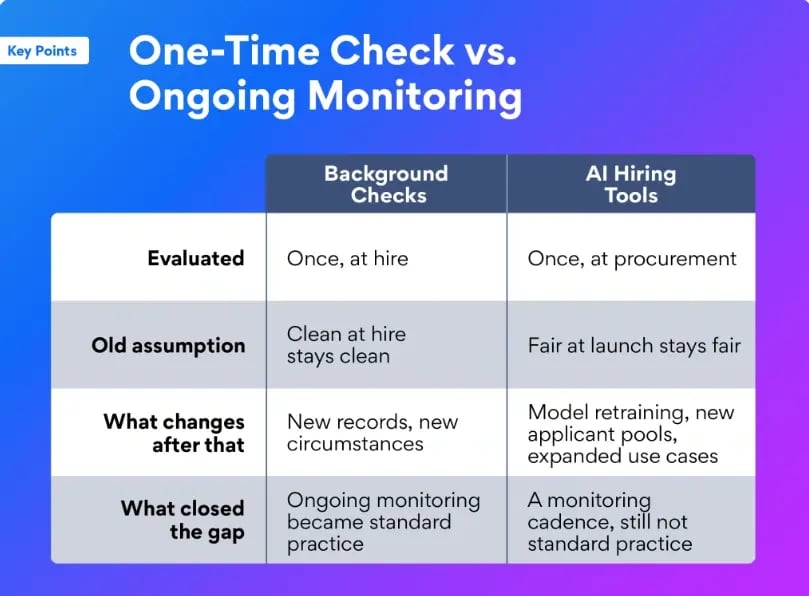
A pre-hire background check used to be treated as good forever. Run it once, file it, move on. That process worked until organizations screening people at scale noticed that a clean record at the time of hire doesn't mean much 18 months later.
Screening changed. Ongoing monitoring stopped being a nice-to-have and became the standard most regulated employers now run on.
AI hiring tools are being treated in the same way that background checks used to be: A vendor demo, a bias audit at signing, and then years of activity without anyone re-examining the tool. The assumption with AI is the one screening outgrew: Whatever was true on day one is assumed to still be true on day 800.
There's no real argument for why holding that assumption with AI hiring tools when it didn't hold with screening. AI systems aren't static objects. They get retrained. They process a different pool of job applicants with each hiring cycle. Software, unlike a filed-away PDF, keeps changing even if no one is watching.
Why an AI Hiring Tool Doesn't Behave the Same Way at Month 12
Kevin Coy, a privacy law partner at Arnall Golden Gregory, doesn't dress this up. "It's not a ‘do it and forget it’ type of situation," he told Cisive's Don't Get Played podcast. The questions he says organizations must keep asking: "Have the bias tests and considerations remained the same? Have new biases been found?"
The mechanics are ordinary, not exotic. Modern recruitment AI often works like an intelligent assistant, handling administrative tasks across the recruiting process rather than replacing human judgment. A model retrained six months after deployment isn't the same model that passed the original bias audit. The applicants feeding the model change with every hiring cycle. The tool's job tends to expand over time, as an automated system moves from sourcing potential candidates in databases and using Natural Language Processing to parse resumes for core competencies to helping screen candidates through a recorded video interview, transcribing interviews, and summarizing evaluations, often without anyone rechecking whether it still does what it was cleared to do.
Consider a tool that’s trained and validated against last year's applicant pool. This year, the company opens a new call center in a different region, posts a different job description, and recruits through a new set of job boards. The tool is now scoring candidates based on different criteria and from a different population than it was tested against. The company didn't touch the AI tool. It just started recruiting in new ways, but the tool kept scoring against the old assumptions.
This scenario doesn’t require anyone to be careless. AI recruiting tools can also uncover qualified applicants through proactive sourcing across wider networks, including passive candidates, which is why small shifts in data inputs can change outcomes over time. Tools are built to keep running. But that comes with ramifications.
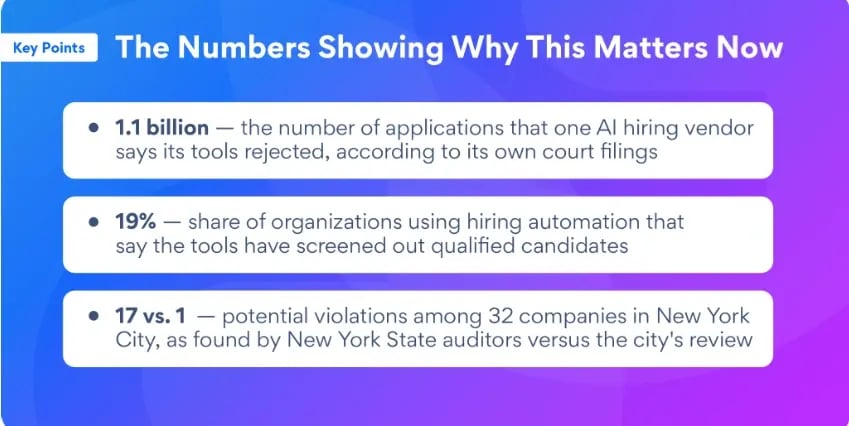
Employers already seem to sense this, even without a formal way to check it. In a recent survey, 19% of organizations using AI recruiting software said their tools had screened out qualified candidates that hiring teams would have otherwise advanced.
What Regulators Expect From AI Hiring Tools and AI Bias After Launch
Regulators aren’t just asking whether AI recruitment tools were fair at launch. Now, they want to know how AI systems are used in the selection process and whether they influence employment decisions fairly over time. Coy and his colleague Lindsay Locke, another attorney at the firm, shared on a recent webinar how state laws are targeting three areas: bans on discriminating against protected classes, notice requirements, and what Coy calls "testing or monitoring requirements to document potential bias and mitigate risk," with regulators increasingly focused on ai compliance, including California’s mandate for human oversight of automated decision systems in hiring and Colorado’s annual impact assessments for high-risk AI systems, especially when ai driven hiring could affect protected characteristics or lead to discriminatory outcomes.
State and Federal Rules Already Point the Same Direction
California is the clearest example. Under its regulations implementing the Fair Employment and Housing Act, regulators directly consider whether an employer has evidence of ongoing anti-bias testing for any tool used in assessing candidates when deciding enforcement and liability, and the state also expects human oversight when an ai system is used in hiring decisions and other employment decisions.
Colorado has recently rewritten its automated decision-making law, with new proposed rulemaking released in August 2026 by the state attorney general that will affect employers using AI hiring tools there; it also treats some employment-related tools as high risk and requires ongoing review through impact assessments.
Federal guidance agrees, even where it doesn't bind anyone. NIST's Artificial Intelligence Risk Management Framework, the closest thing the U.S. has to a standard here, currently treats monitoring as something that runs for the length of a tool's deployment, not just as a box to check before launch, especially as ai models and ai features change over time and could contribute to ai bias or discriminatory practices under Title VII.
What New York City's Enforcement Gap Reveals
New York City is the closest thing to a natural experiment on what happens with a monitoring requirement. Local Law 144 applies to automated tools used in the decision making process, can require an alternative selection process in some cases, and has required an annual, independent bias audit of AI hiring tools and recruitment platforms since 2023, making it the oldest law of its kind in the country.
A New York State Comptroller audit released in December 2025 found the city's enforcement of that requirement was ineffective, which raised concerns about whether annual audits are enough to prevent discriminatory outcomes in practice. Auditors reviewed 32 companies cleared by the city and found at least 17 potential violations missed during the city's own review. Having the requirement on the books didn't mean compliance was effectively monitored.
The Federal Case Testing All of This for Job Candidates
None of these issues is hypothetical, and a federal court in California is currently deciding a case that could affect employers everywhere.
Mobley v. Workday alleges that an employer's AI-driven screening tools screened job candidates in ways that produced disparate impact against a protected class by race, age, and disability. The vendor's own court filings put the number of applications its tools had rejected at 1.1 billion.
No ruling has been issued on the underlying discrimination claims. But the court has already ruled that an AI vendor's tool can count as an extension of the employer using it. This closes off the easiest exit for both sides, as employers and vendors may be held liable when AI-driven hiring contributes to discriminatory outcomes or the tools fall short of fair evaluation. What's left is the actual record of how the tool performed and whether anyone was monitoring it.
Who Owns AI Hiring Oversight After the Tool Goes Live
Coy has a practical answer to who should own AI oversight, but it depends heavily on the size of the organization and its number of employees. In smaller organizations, he said, "It might just be one or two people that are wearing all those different hats." In larger ones, "It might be spread more broadly across the organization," with HR, hiring managers, privacy, security, and legal each weighing in before a tool goes live rather than after something goes wrong, often alongside ta teams and ta professionals who manage these systems day to day.
That's the ideal. In practice, ownership is often vague or unassigned.
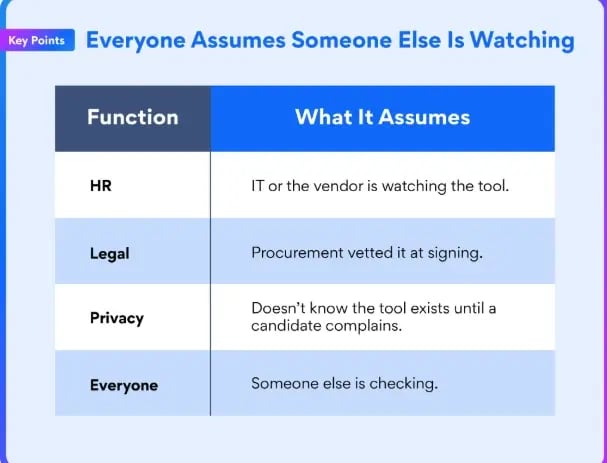
When a hiring algorithm sits inside an organization's applicant tracking system, it may also be part of broader recruitment software used for talent acquisition, from job posting through ranking candidates. HR assumes IT or the vendor is watching it. Legal assumes procurement vetted it at signing. Privacy finds out it exists when a candidate complaint arrives. Each function has a reasonable claim to not being the owner, which means nobody is actually checking.
That gap often becomes visible at the worst possible moment: when a candidate, regulator, or plaintiff's attorney asks who was responsible for ensuring the tool is fair and unbiased.
The fix isn't complicated, but it does require assigning responsibility. One function has to be accountable for a tool's ongoing review across the hiring process, even if the testing work gets outsourced to the vendor or a third party. The cadence, the review triggers, and the documentation habits only work after that ownership question is settled, especially in organizations doing high volume hiring, where high volume workflows make oversight gaps easier to spread.
Building an Ongoing Monitoring Cadence for AI Hiring Tools
Coy's framing of what governance requires tracks closely with how background screening already works: Oversight has to follow a tool throughout the recruitment process, including how AI recruiting tools screen candidates and determine whether someone is a good match, as it's rolled out and implemented, and "as it's being periodically tested thereafter."
“Periodically” is the operative word. One audit, no matter how careful, is a snapshot. A cadence is what turns a snapshot into a practice.
A workable cadence doesn't need to be elaborate, but it should answer questions such as:
- How often does the tool's ability to evaluate candidate qualifications get retested after launch, especially when some systems may rank or screen candidates differently as underlying data changes over time?
- What triggers a review outside the normal schedule (such as a vendor's model update, a change to candidate matching criteria, or a new state law, or updates to generative AI features used to draft interview questions or job descriptions)?
- What gets written down each time to establish a record if a candidate or a regulator asks how a decision was made?
- How do findings get shared back with the vendor when a review finds something, ensuring that retraining or remediation happens?
The last one matters as much as the testing itself. Cisive's guidance on reducing AI hiring bias gets into specific tactics, like blind screening and building a genuinely diverse candidate pipeline. Anonymizing application materials can support more diverse applicant pools and help TA professionals take proactive steps against bias. Those aren't one-time fixes. They're exactly the kind of thing a monitoring cadence should keep checking over time.
How Cisive Can Help
Cisive has argued for years that a hiring decision doesn't stop generating risk after the moment it's made. That's the premise behind Cisive Workforce iQ and continuous background monitoring more broadly.
AI hiring tools deserve the same treatment. A tool that passes its bias test at launch clears a bar, but whether it still clears that bar today is a separate question. Most organizations aren't set up to keep asking that question, at real cost to both the candidate experience and their legal exposure. They can also improve candidate engagement by automating candidate outreach and follow-ups so potential candidates receive timely responses.
If your organization already tracks risk after the point of hire, extending that discipline to the tools in your hiring funnel is the next logical step. Some AI recruiting tools also use conversational chatbots to answer candidate questions around the clock, which matters when 52% of job seekers report being ghosted by employers. Speak to a Cisive pro about what that could look like for your AI hiring stack.