This year, healthcare recruitment and talent acquisition professionals from across the country gathered in Milwaukee, Wisconsin for the 2026 National Association for Health Care Recruitment (NAHCR) conference. Two themes ran through nearly every session: AI is no longer optional to understand, and the human side of recruiting matters more than ever precisely because of it. Healthcare hiring is under real pressure right now: turnover costs, a shrinking pipeline of job seekers, and a workforce asking harder questions about purpose before they'll say "yes" to an offer.
Here are five of the biggest takeaways from this year's conference as we head into the second half of 2026.
1. Leadership Starts With Showing Up for Yourself
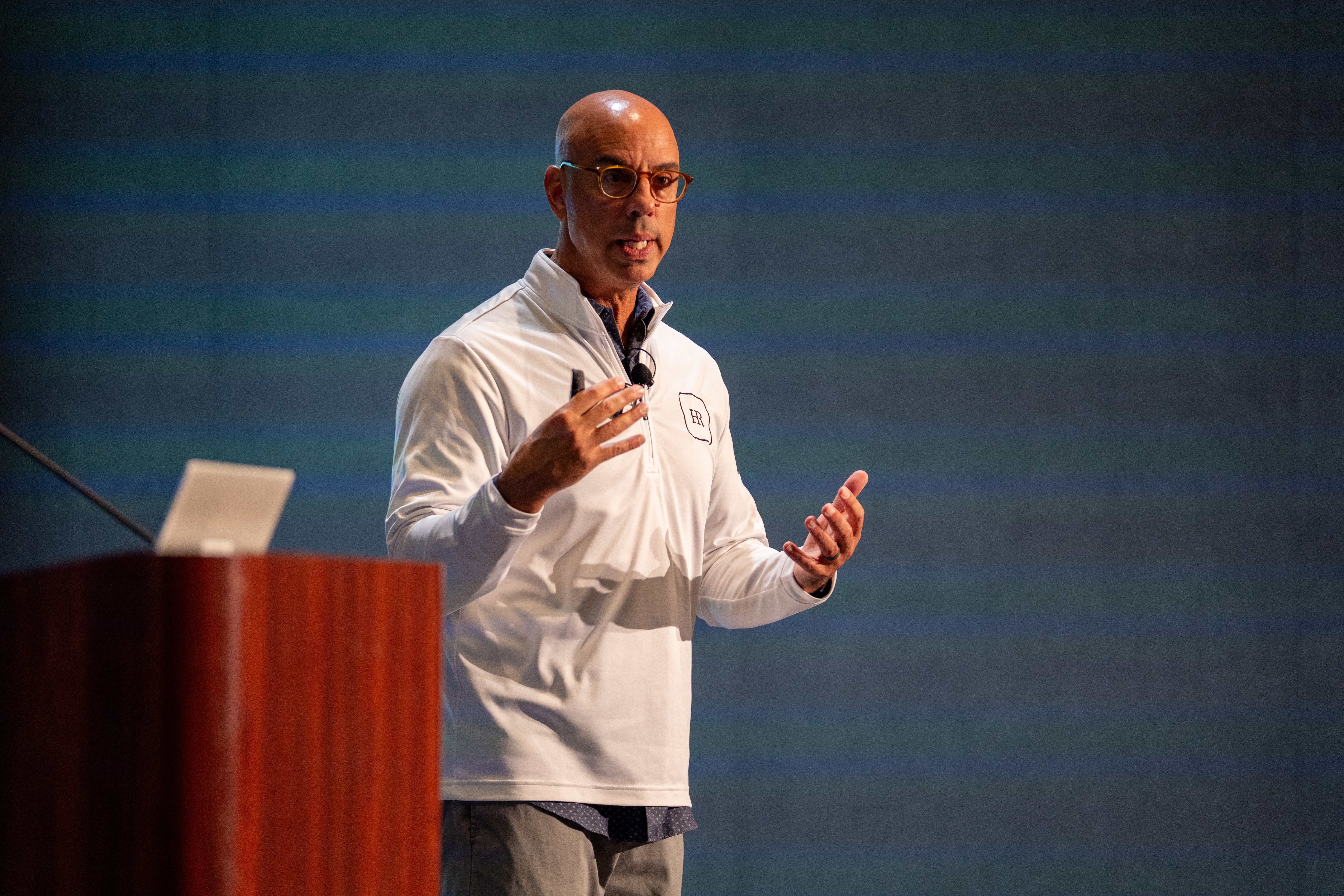
George Rogers, Chief Strategy Officer at Lighthouse Research & Advisory, opened the conference with a deeply personal keynote about purpose and leadership. Rogers shared how a volunteer named Tim spent over 30 years showing up for him as a kid, never judging him, always ending every conversation the same way: "I'm here." That relationship, Rogers said, taught him that leadership isn't about influence over other people; it starts with how well you lead yourself.
Rogers distilled leadership down to three words: love, grace, and trust. He challenged attendees to sit with four questions before assuming that leadership is something you do for others:
- Who am I, and what's my desired outcome?
- What do I actually want?
- Where am I going?
- Who do I want to be when I get there?
Rogers connects this directly to recruiting culture, arguing that culture is simply how employees feel, believe, and behave most of the time; and that how a recruiter or leader makes someone feel determines how that person feels about the entire organization. Citing research from Steve Covey, Rogers noted that only 37% of employees clearly understand their company's purpose, just 27% believe in its values, and a mere 20% fully trust the organization they work for.
To help close that gap, Rogers introduced the CLICK framework:
- Clarity – Communicate the why, not just the what, in a way your audience actually understands.
- Leadership – Lead by example; people watch how you show up far more than they listen to what you say.
- Impact – Every interaction shapes how a candidate or employee feels about your organization.
- Culture – Culture is built from the accumulation of those impacts.
- Keep Promises – Follow through on what you tell candidates and employees to expect.
His closing point landed with the recruiters in the room: new hires typically decide whether they'll stay within their first five days on the job. All the work that goes into recruiting and onboarding is validated, or undone, almost immediately.
2. AI Literacy Is Now a Core Job Skill, Not a Nice-to-Have
Two sessions dug deep into where AI adoption in talent acquisition actually stands today, and the picture is more nuanced than the headlines suggest. In the broader healthcare industry, care delivery is becoming more dependent on technology, which is increasing demand for tech-savvy professionals and shaping the future workforce.
Trent Cotton, Head of Talent Insights and Analyst Relations at iCIMS, shared findings from the company's Definitive Guide to AI Adoption in TA, breaking down how AI is showing up across the hiring lifecycle for recruiters, candidates, and hiring managers alike. A few numbers stood out: fewer than half of organizations surveyed regularly check their AI tools for bias, roughly half have no formal AI governance framework in place, and 58% of TA leaders couldn't clearly articulate the difference between AI and automation. Cotton drew a useful distinction between the three: automation does a task for you, conversational AI researches and converses with you, and agentic AI can act like and with you — and, when instructed, for you.
The highest current use cases remain identifying candidates and matching them to open roles, with screening and sourcing close behind. But Cotton was clear that human oversight remains the cornerstone of responsible adoption. "Recruiters aren't being replaced," he said. They're being elevated to focus more on relationship-building.
Later in the day, Kyle Lagunas, Founder and Principal Analyst at Kyle & Co., pushed the conversation further with a session on AI fluency. He shared that 59% of organizations named a lack of understanding as the leading obstacle to AI adoption in 2025, nearly identical to the 54% who cited the same knowledge gap in 2024. His take: literacy, not tooling, is the highest-ROI capability recruiting teams can build right now, since AI in recruitment can deliver a 10X return on investment when teams have the ability to use it well.
Lagunas described the "fluent recruiter" as someone who experiments with these tools constantly, reads AI output critically instead of copying and pasting it wholesale, and is obsessed with structured, consistent interviewing. The "frustrated recruiter," by contrast, gatekeeps quality by hand and burns out trying to do everything manually.
Lagunas also flagged a compliance angle worth watching: the EU AI Act now names AI literacy as a legal requirement, not just a best practice, and a highly regulated industry such as healthcare represents a high-risk domain under evolving conditions. Organizations building literacy now, he argued, are getting ahead of a regulatory wave that's unlikely to stay confined to the EU for long.
Takeaway for your team: Audit whether your recruiters and hiring managers can actually explain, in plain language, what your AI tools are doing and why. If they can't, that's the gap to close before you add more tools.
3. Healthcare Organizations' TA Teams Are Moving AI From Pilot to Production — Carefully
If the previous two sessions were about the "why" of AI adoption, this one was about the "how" healthcare organizations are moving AI into production within healthcare staffing, not just pilot projects. Jason Pistulka, Founder and Principal Consultant at StratTech Talent Consulting Advisory, joined Patrick Kelley, Director of Talent Acquisition, Onboarding and Credentialing at Healing Partners, to walk through what disciplined AI adoption looks like inside a real healthcare TA function.
Kelley's team scaled quickly to support rapid growth. 90% of their hires are nurse practitioners. His team built their process before they brought in tools, not the other way around.
Here's Kelley's advice for teams considering AI:
- Define the problem – Identify your highest-impact hiring gaps first.
- Start small – Pick one use case rather than automating everything at once.
- Define success metrics – Agree up front on what "working" actually means.
- Think beyond the pilot – Design for adoption and scale from day one, not as an afterthought.
Kelley was candid that his team deliberately avoided conversational AI for candidate-facing interactions, testing it for a few high-volume roles but pulling back because it broke the personal relationship his recruiters work hard to build. Where his team does use AI is for recording and analyzing interview data, and for using predictive analytics to estimate staffing gaps and generate actionable insights on recruitment ROI. Not scoring candidates, but understanding engagement patterns, like whether a candidate lights up more when discussing wound care than when discussing logistics.
Disciplined automation can also improve candidate engagement by managing communication speed, especially as 62% of candidates expect responses within 72 hours during the hiring process. On risk, Kelley's team built a three-part process: report anything the tool flags, train managers on what to do with that information, and give every manager a clear action plan — a structure he credited with driving stronger adoption across the organization.
4. Get Back to Talent Acquisition Strategies and Recruiting Fundamentals — AI Doesn't Change the Basics
John Baldino, President of Humareso, delivered a energizing, no-nonsense session reminding recruiters that fundamentals still win, even in an AI-saturated moment. He opened by pointing out that the hire rate has dropped to its lowest level since the pandemic, while turnover in 2026 now carries an average cost of $46,100 to replace a nurse.
Baldino's advice was refreshingly practical:
- Revisit your social media strategy. Some organizations are still working from social media policies written 15 years ago. If you're recruiting entry-level talent, Facebook's audience skews toward 55-70 year-olds. Instead, employers should meet candidates where they actually are, including TikTok and Instagram reels, while attracting top talent in a competitive market also depends on employer brand, since 75% of job seekers review an employer before applying.
- Watch the numbers. Job openings currently outnumber job seekers, and the declining birth rate means the labor pool isn't growing to keep pace. Recruiters have to work harder and smarter to reach candidates. Some roles are especially hard to fill: Registered Nurses have an average time-to-fill of 83 days, while physicians can take 125-180+ days.
- Hire for the role, not a persona. Evaluate candidates against the actual duties and responsibilities of the job, not against the tenure or experience of someone who's been in the role for 30 years.
- Use "affirmational repetition" to close comp objections before they happen. Compensation remains the top reason candidates decline offers. Healthcare professionals increasingly expect transparency in salary and hiring processes, 58.5% of professionals won't apply without salary transparency, and 66% of nurses prioritize pay when considering job changes. Baldino recommends stating the pay range clearly during the process, then asking the candidate to repeat back what they understood. This catches misalignment earlier rather than at the offer stage.
- Don't waste the first 30 days. With 65% of employees receiving some form of preboarding, Baldino recommends scheduling short 15-minute introductory chats between new hires and colleagues across different parts of the organization during their first month, helping new employees feel connected before they've even settled in.
5. Retention and Work Environment Are People Problems With a Data Trail
The panel, "The State of Health Care Recruiting: Trends, Truths, and What Comes Next," brought together Kyle Lagunas, John Baldino, Claudine Trudeau (AVP of Talent Acquisition at Vi Living), and Lisa Rigoli (Founder and CEO at Element of Change) for a wide-ranging conversation on what's actually driving healthcare hiring and turnover in 2026, including persistent shortages in clinical talent across hospitals and other healthcare systems. Some health systems are also using international recruitment to address shortages.
Panelists agreed that 96% of hiring managers currently rank filling open roles as their most urgent priority, and pushed back on the narrative that AI is simply "coming for" recruiters' jobs. They also noted that healthcare leaders should watch turnover rates alongside open roles; for example, hospital turnover was 18.3% in 2024. As Lagunas put it, the real risk isn't job loss: it's getting burned by leaning on a tool you don't fully understand.
Trudeau shared two concrete process changes from her own organization that moved the needle:
- Cutting friction from the application. Her team stripped down a 50-plus question application, no longer requires a resume, and now only asks for a candidate's most recent job title, employment dates, highest level of education, and ten standard questions. The result was a meaningful increase in applicant flow.
- Simplifying assessments. Vi Living replaced a 90-minute phone assessment (with a full week turnaround to get results) with a five-minute assessment that measures the same success-related motivations — cutting nearly three weeks out of the process without any drop in match quality.
Retention is also tied to healthcare workers' well-being and work life balance, especially after 93% reported stress during the pandemic. Organizations can reduce turnover by offering flexible work schedules.
By 2026, large health systems and other health systems are expanding internal flexible staffing models, creating pools of pre-credentialed clinicians to support shift coverage and fluctuations in patient volume.
Trudeau also emphasized that her biggest retention wins came from investing in training and development for employees who'd already been with the organization over a year — while acknowledging that new-hire retention within the first year remains the harder problem, often tied to onboarding gaps and new hires not feeling welcomed or connected to their team.
On the question of where AI belongs in the candidate relationship, the panel was split but leaned human: several panelists said they weren't comfortable letting agentic AI conduct candidate interviews, arguing that the first point of contact in healthcare recruiting should be a person — though most agreed AI has a legitimate role in filtering and supporting genuinely high-volume, repeatable work so recruiters can focus their time on the candidates who need a real conversation, with these models also helping support staff and other workers manage demand more sustainably for patients and patient care.
Looking Ahead
If there's one thread connecting all five sessions, it's this: healthcare recruiters don't need to choose between embracing AI and staying deeply human in how they hire, especially as the healthcare industry faces aging patients, retirements, and continued shortages that are reshaping workforce planning. The teams getting the most out of 2026 are the ones building real literacy around their tools, staying disciplined about where AI belongs in the process, and doubling down on the fundamentals — clarity, trust, and simply showing up — that have always separated good recruiting from great recruiting.
Healthcare organizations should prepare for future needs by tracking expected shortages — including a nursing shortage projected at 78,610 RNs by 2026, the need for more than 78,000 Registered Nurses by 2025, and physician shortages that could reach 85,000 by 2036 — and by recognize how demand is shifting toward home-based, ambulatory, community-practice, and urgent-care settings as the aging U.S. population drives care closer to patients. Retirements will add more pressure: the number of healthcare workers over 60 doubled from 2000 to 2020, mass Baby Boomer exits by 2026 will strain staffing, and a global shortfall of at least 10 million is expected by 2030, so leaders should focus on creating knowledge-transfer resources and stronger careers pathways for incoming talent, including medical assistants, physician assistants, and other support roles.
Don't miss out on the fun, networking and learning! Mark your calendars for the 2027 NAHCR Conference at MGM National Harbor next July.