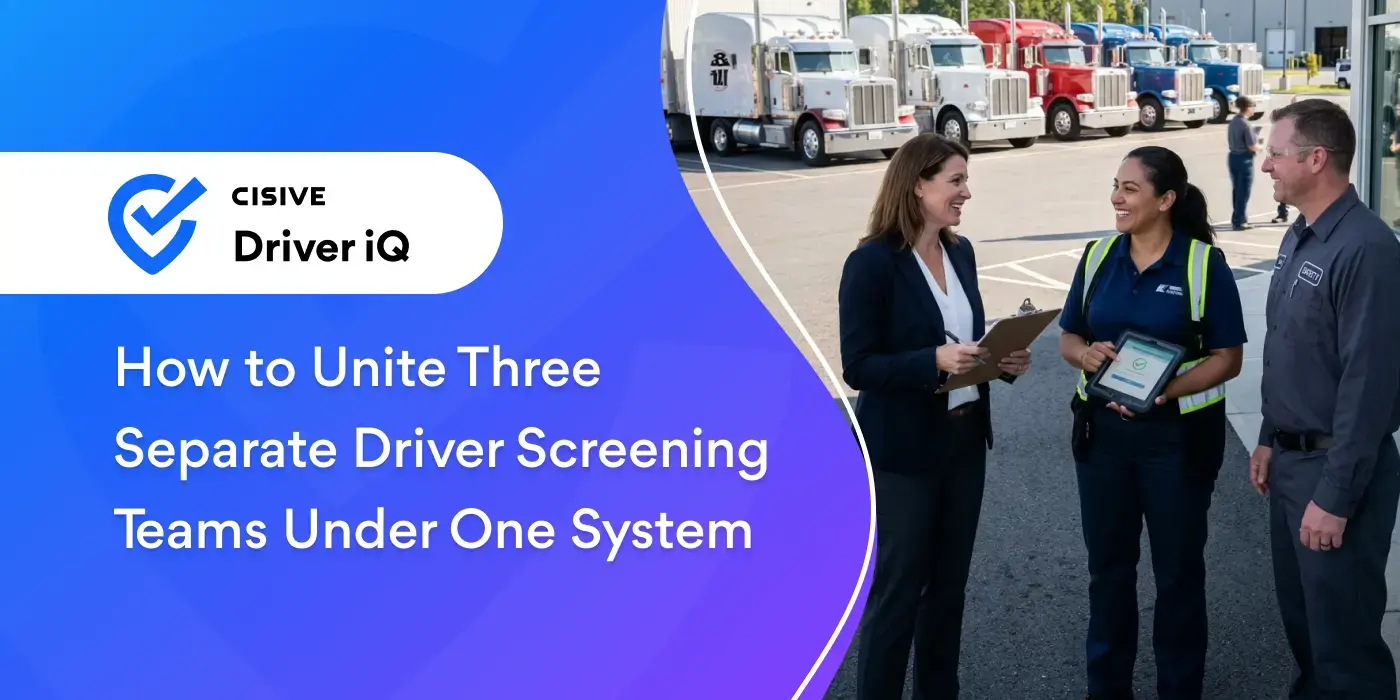
Picture one new driver hire. HR runs the application and background check. Fleet safety pulls the driving record and builds the qualification file. Occupational health schedules the drug test at a clinic across town. Three teams touch the same person, and each may work in a different system. That is the reality for many companies that run vehicles under their own name, and it is where private fleet driver screening tends to break down.
This guide is for HR leaders, safety managers, and operations leaders who want to understand what compliance requires and what a connected screening process looks like.
The Hidden Cost of Disconnected Pre-Employment Screening and Hiring Processes
Most companies did not set out to build three parallel hiring processes. They grew that way. Each team added the tools and steps it needed, and over time the handoffs became manual.
The driver qualification file shows how quickly this gets complicated. Under federal rules, a motor carrier must maintain a qualification file for each driver it employs (49 CFR 391.51). That file pulls together information that usually lives in different places:
- HR typically owns the application, background screening, and onboarding steps.
- Fleet and safety typically own driver qualification, driving record review, and ongoing compliance.
- Occupational health typically owns drug testing and physical screening, often across several clinic locations.
When these functions do not share a system, the same candidate information may be entered more than once, and someone has to chase status updates by email or phone. Records can also drift out of sync. None of that is a screening failure on its own, but it adds friction at the exact moment you are trying to hire quickly and stay compliant, while also making it harder to make consistent hiring decisions and apply established criteria for disqualification fairly.
What a Single Source of Truth Looks Like
The fix is not one more background check. It is one connected process where every screening component feeds the same record, so information moves through once instead of three times.
Cisive’s Driver iQ platform is a single platform for the entire talent journey, and it integrates with common fleet management software. In practice, a connected private fleet process can bring these pieces together:
- Applicant screening and criminal history, completed with FCRA-compliant workflows that include required disclosures and authorizations during pre-employment screening
- Employment verifications, so past employment history is documented
- Driving records, so the safety team has the information it needs to evaluate a driver
- Drug and occupational health screening, coordinated alongside the rest of onboarding
- Continuous driver monitoring, so screening continues after the hire date
- System integration, so data flows into the HR and fleet tools your teams already use
The goal is straightforward. Each team sees the same, current information, and fewer tasks depend on someone remembering to hand something off.
Why Transportation Expertise Matters in Screening
Front-end background screening is a service many providers offer. Driver screening adds a layer of regulatory knowledge, and connecting the whole process adds another. That is where industry experience makes a difference.
Driver iQ was built for the transportation industry and focuses on DOT, FMCSA, and FCRA requirements. Its capabilities reflect that focus:
- A dedicated employment history resource: Driver iQ maintains a Previous Record of Employment (PRE) database built for transportation hiring.
- Clearinghouse support: Driver iQ acts as a Consortium/Third-Party Administrator (C/TPA), managing the relationship between carriers and the FMCSA Drug and Alcohol Clearinghouse, including timely queries on applicants and existing employees.
- Accuracy and speed: Cisive reports 99.9994% background check accuracy, with 78% of criminal searches closed within one hour and an average 31.8% reduction in time-to-fill.
Behind those numbers is a simple idea. A screening partner that understands the rules can automate more of the process and standardize it across locations, while keeping you compliant. That is how we catch what others miss, and it is what allows your team to hire with confidence.
Private Fleet Compliance Covers More Than CDL Trucks
A private fleet is a company that moves its own goods or people as part of its business, rather than hauling for hire. The Federal Motor Carrier Safety Administration describes a private carrier as one that transports its own cargo, typically as part of a business that produces, uses, sells, or buys that cargo. Think of a distributor delivering its own product, a contractor moving equipment, or a retailer running its own delivery vans. When private fleets operate covered vehicles, they follow the same federal safety regulations as for-hire carriers.
What matters for compliance is the vehicle and the operation, not the industry. Here is how the main factors work:
- Vehicle weight: Federal rules generally define a commercial motor vehicle as a vehicle used on a highway in interstate commerce with a gross vehicle weight rating or gross vehicle weight of 10,001 pounds or more, whichever is greater (49 CFR 390.5). A van that stays under that threshold may fall outside those federal rules.
- Driver qualification files: Where federal rules apply, motor carriers must maintain a qualification file for each driver they employ, kept for as long as the driver is employed and for three years afterward (49 CFR 391.51).
- Intrastate operations: Vehicles that stay within one state may be governed by that state’s definitions and thresholds, which vary widely.
- Company policy: Even when no federal rule applies, many employers choose to screen drivers because they carry the same on-the-road risk.
Because each vehicle type and operation can carry its own requirements, a one-size-fits-all checklist rarely works. A partner who understands the differences can configure screening to match each driver role.
Requirements vary by vehicle type, weight, and operation, and they change frequently. This overview is general information. Consult qualified legal counsel for guidance specific to your fleet.
Beyond the Driver’s Seat: Screening the Full Workforce
Many private fleet employers have more people in the warehouse than behind the wheel. A distribution business, for example, may employ a large operations team that faces the same hiring pressures as the drivers: background checks, drug testing, and scheduling across multiple locations.
A connected process helps here too:
- Background screening for operations roles, handled in the same platform as driver screening
- Drug testing and occupational health screening before day one, which can help confirm a candidate is ready for the physical demands of the job, such as lifting and carrying
- Coordinated clinic scheduling across locations, so candidates are not waiting on manual follow-up
- Ongoing screening after hire, so changes are not missed once someone is on the team
Driver iQ’s approach keeps drug testing and occupational health screening connected to the rest of the hiring workflow, with an electronic chain of custody process built into onboarding. The result is a process that treats your whole workforce, not just your drivers, as part of one hiring and compliance system.
From For-Hire Expertise to Private Fleet Solutions
Private fleet screening is not a new idea invented from scratch. It builds on the compliance knowledge and driver-focused experience Driver iQ developed serving for-hire carriers, and applies it to companies that run vehicles under their own name.
That experience matters because the work behind driver screening is the same whether the truck carries someone else’s freight or your own product: verify who the person is, confirm their history, understand their driving record, support drug testing requirements, and keep monitoring after the hire. We anticipate challenges, and we deliver seamless integration so your HR and safety teams can work from the same information.
If your hiring and compliance processes still run in separate lanes, a conversation with a screening expert is a practical next step. Visit Cisive Driver iQ solutions to learn more, and make the right call for your fleet and your workforce.
Frequently Asked Questions About Private Fleet Driver Screening
What is a private fleet?
A private fleet is a company-operated group of vehicles used to move the company’s own goods or people as part of its business, rather than for hire. The Federal Motor Carrier Safety Administration describes a private carrier as one that transports its own cargo as part of a business that produces, uses, sells, or buys that cargo. Examples include distributors, contractors, and retailers with their own delivery operations.
Do private fleets need driver qualification files?
It depends on the vehicle and the operation. Where federal rules apply, motor carriers must maintain a driver qualification file for each driver they employ (49 CFR 391.51), kept during employment and for three years afterward. Intrastate operations may follow state rules instead. Because applicability is specific to your fleet, confirm requirements with qualified legal counsel.
Does private fleet screening only apply to CDL drivers?
No. Screening needs depend on the vehicle, its weight, and how it is operated, not only on whether a driver holds a CDL. Federal rules generally apply to commercial motor vehicles at 10,001 pounds or more in interstate commerce, and many employers screen drivers of lighter vehicles as a matter of company policy.
What should HR and safety teams look for in a screening partner?
Look for transportation expertise, FCRA and DOT compliance knowledge, integration with your HR and fleet systems, coordinated drug and occupational health screening, and ongoing monitoring after hire. A partner who connects these pieces helps reduce duplicate work between teams. Driver iQ offers applicant screening, employment verifications, driving records, continuous driver monitoring, and retention and roster management.
Can one provider handle both driver and non-driver screening?
Yes. Driver iQ supports background checks, drug testing and occupational health screening, and ongoing screening for both driver and non-driver roles. Using one provider for your full workforce can help keep processes consistent across locations and job types, and it keeps HR and safety working from the same information.
How does continuous monitoring help a private fleet?
Screening at hire is a snapshot in time. Continuous monitoring extends that visibility after the hire date. Driver iQ’s Continuous Driver Monitoring is designed to help employers know who is driving their vehicles. Ask your provider exactly what is monitored and how alerts are delivered so the process fits your safety program.