
Private equity due diligence has always been high stakes. But the cost of missing a red flag has only grown, as regulators expand their scope far beyond traditional financial health and legal reviews.
According to Boston Consulting Group's 2026 M&A outlook, fewer but larger deals are dominating the pipeline. Even a single misstep can materially impair a fund's performance.
This guide covers every dimension of conducting due diligence on a private equity transaction: what it looks like, where deal teams consistently fall short, and how to build a program that scales.
What Is Private Equity Due Diligence?
Private equity due diligence is the structured, multi-disciplinary investigation of a target company that’s conducted before capital is committed. This process spans the financial, legal, operational, commercial, and reputational dimensions of the business.
This guide focuses on acquisition due diligence on the general partner (GP) side, which is when a firm evaluates a portfolio company target before a buyout or investment.
Acquisition due diligence is no longer just a pre-deal exercise. Leading firms now treat it as an ongoing risk management function that continues through the holding period.
Why Thorough Due Diligence Determines Deal Outcomes
The potential red flags with M&A are numerous, including undisclosed regulatory violations, litigation history, and leadership misconduct. Private equity firms face increasing regulatory and compliance obligations, including source-of-funds documentation, anti-money-laundering compliance, and ESG reporting. That expands the diligence scope far beyond reviewing tax returns and purchase agreements.
The financial consequences of inadequate diligence are well-documented. A study of 40,000 M&A deals revealed that 70–75% of acquisitions fail to create shareholder value. Another study found that nearly 60% of executives blame due diligence shortcomings for failed integrations.
Reputational risk compounds the financial exposure. Acquiring a company without mapping the potential risks can damage your firm's standing with limited partners (LPs) and co-investors.
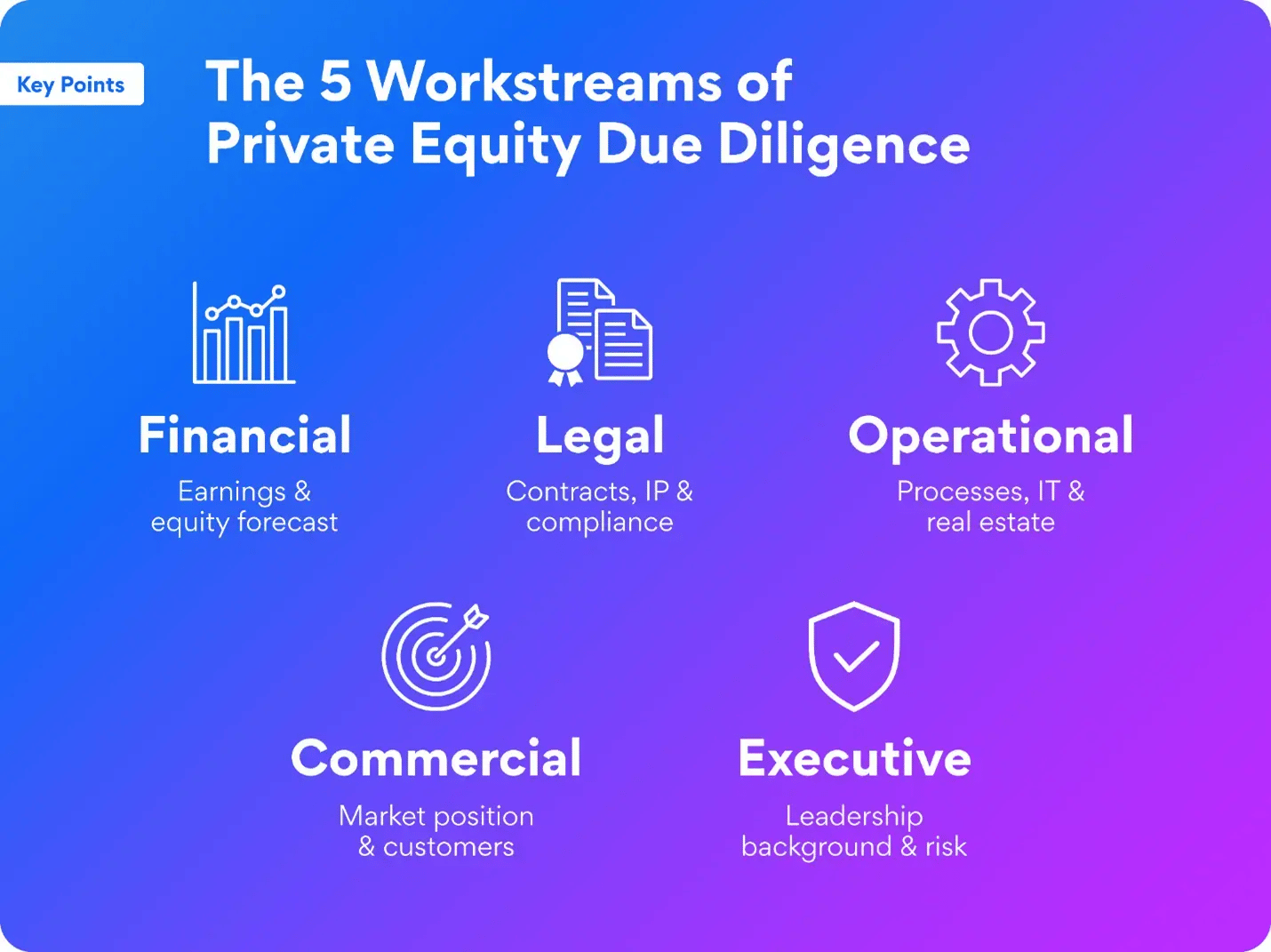
Key Components of the Due Diligence Process
Financial Due Diligence
Financial due diligence is the foundation. You're reviewing historical financial information, including profit-and-loss statements, balance sheets, and cash flow. The data must be accurate and consistent in order to yield trend signals. For example, a quality-of-earnings (QoE) analysis separates recurring revenue from one-time items, surfacing the normalized EBITDA that supports the deal valuation.
You're also examining working capital dynamics, which include accounts receivable aging, debt obligations, capital expenditure requirements, and the assumptions behind the target's financial forecasts. Key red flags to watch for include:
- Revenue concentration in a single customer or contract
- Aggressive revenue recognition practices
- Liabilities not on the balance sheet that won’t otherwise appear until after close
Legal Due Diligence
Legal diligence covers corporate structure, ownership, and governance documents. This step covers every material contract: customer agreements, supplier relationships, human resource and employment terms, and change-of-control provisions that may affect the deal structure. Legal due diligence also includes intellectual property (IP) ownership and any ongoing IP disputes.
You're also mapping litigation history, pending regulatory investigations, and compliance with applicable regulations across labor, data privacy, and environmental frameworks. Closing the gaps prevents surprises after the deal closes.
Operational Due Diligence
Operational diligence assesses whether the business can perform at scale under new ownership. You’re conducting a thorough evaluation of internal processes, supply chain resilience, IT infrastructure, cybersecurity posture, and real estate or physical asset obligations. For leveraged buyouts (LBOs), you need to understand how the business operates in reality, not just on paper. This is essential to projecting integration costs and identifying improvement opportunities.
Customer and vendor concentration deserve particular scrutiny. A business plan that assumes 30% of revenue from a single customer presents a different risk profile than a diversified customer base. Your findings can affect company valuation and the purchase-agreement structure.
Commercial Due Diligence
Commercial diligence validates the investment thesis against market reality. You're sizing up market trends, mapping the competitive landscape, and assessing whether the target's products and services have durable market positioning and pricing power. Performing a customer-base analysis, including churn, cohort retention, and satisfaction signals, helps you verify the model’s growth projections.
If the revenue forecast assumes market expansion that the market isn't delivering, that's a commercial diligence finding.
ESG & Regulatory Due Diligence
ESG diligence has moved from optional to standard at most institutional private equity firms. Research on ESG in commercial due diligence finds that M&A decision-makers increasingly factor sustainability practices into performance projections. LP pressure, regulatory requirements, and activist scrutiny have made environmental compliance, labor practices, board diversity, and anti-corruption controls a mandatory part of the pre-deal review.
For cross-border transactions, anti-money-laundering and sanctions screening adds another layer. Office of Foreign Assets Control (OFAC) screening, anti-bribery compliance under the FCPA and UK Bribery Act, and foreign direct investment review requirements can affect deal timelines and structure. Compliance experts now treat this as a gating item, not a late-stage review.

The Critical (and Often Overlooked) Role of Executive Background Intelligence
Why Leadership Assessment Is a Diligence Imperative
The target company's leadership team is one of the highest-risk elements of any acquisition. Private equity firms routinely build management retention into the investment thesis. Independently verifying the integrity and background of key executives is foundational to due diligence, not supplementary.
Standard methods of financial and legal diligence don't reliably surface management fraud, undisclosed legal history, conflicts of interest, or credential misrepresentation. Instead of catching them pre-close, you find out afterward.
A comprehensive background check of an executive can materially affect deal structure, purchase price, and post-close governance arrangements.
What Comprehensive Executive Background Intelligence Covers
A thorough executive diligence process includes:
- Global criminal history and civil litigation searches:: Covering all relevant jurisdictions, not just domestic databases
- Regulatory and sanctions screening: OFAC, debarment lists, FINRA and Securities and Exchange Commission regulatory actions, and international equivalents
- Adverse media and reputational intelligence: Negative press, fraud allegations, and behavioral concerns that don't appear in structured databases
- Credential verification: Educational degrees, professional certifications, and employment history
- Beneficial ownership and conflict-of-interest analysis: Undisclosed affiliations, related-party relationships, and competing business interests
For cross-border deals, in-country expertise is non-negotiable. Records systems vary across jurisdictions. A background check in one country might examine data that’s inaccessible or structured differently in another location. Understanding what a background check reveals, including limitations by geography, is essential context for any international diligence program.
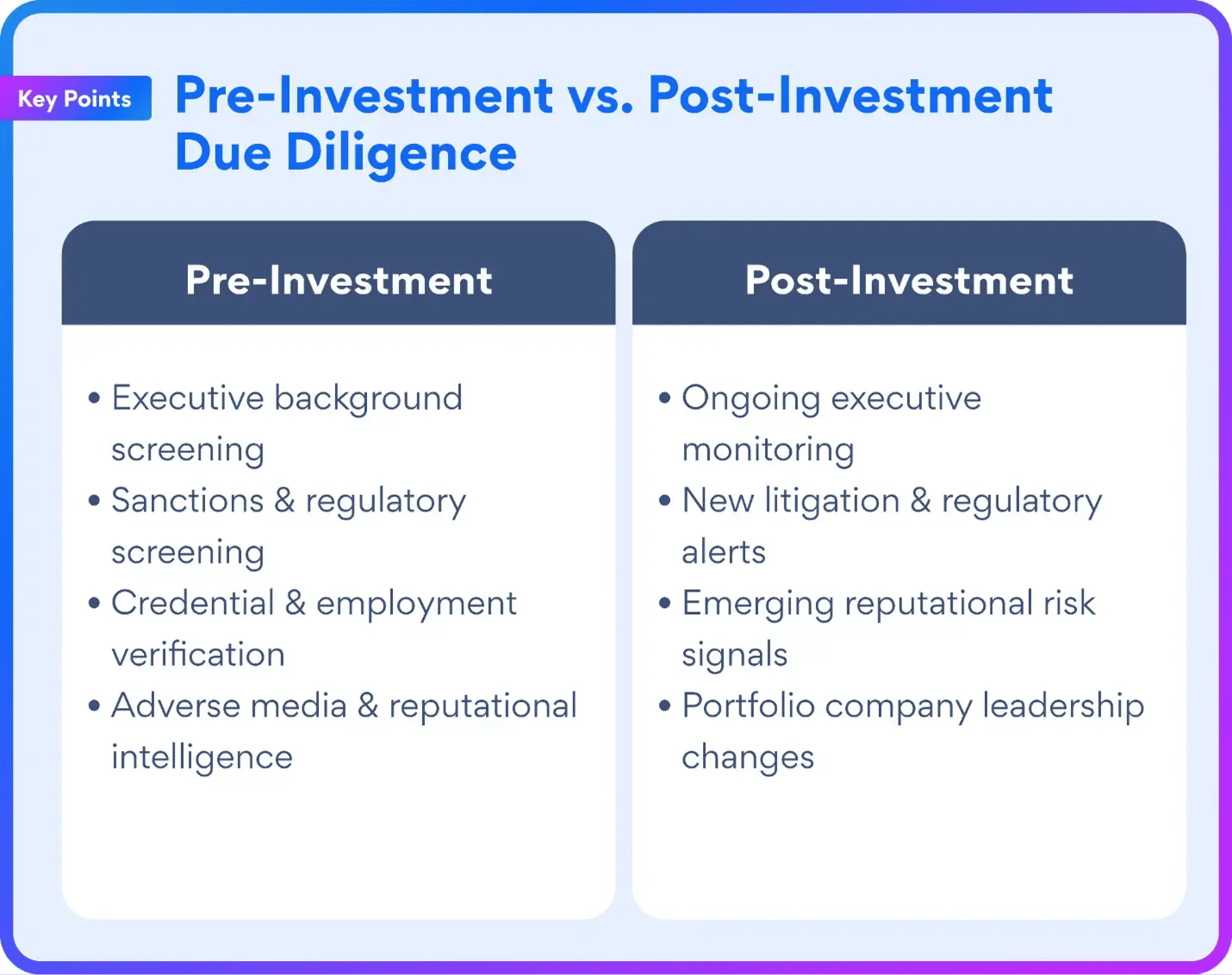
Pre-Investment vs. Post-Investment Due Diligence
Pre-investment diligence is the comprehensive vetting phase, covering executives, key counterparties, and beneficial owners before the deal closes. This is where most firms concentrate their efforts.
Post-investment monitoring is where many private equity firms underinvest. New regulatory actions, emerging litigation, and reputational incidents keep occurring even after a deal closes, and they can affect enterprise value, LP relationships, and exit multiples throughout the holding period.
Cisive's post-investment due diligence provides continuous monitoring of portfolio company executives, so firms aren't relying on quarterly board updates to catch material risk. As LP governance expectations rise, ongoing monitoring is increasingly the standard of care.
Due Diligence for Acquisitions: How the Process Differs by Deal Type
Private Equity Buyouts
In LBOs, cash flow quality and debt-service capacity carry disproportionate weight. Private equity firms structure these deals around the target's ability to service leverage, so diligence must stress-test those assumptions. Make sure to perform value creation roadmap diligence, which covers operational improvement opportunities, margin expansion potential, and add-on acquisition targets.
Strategic & Corporate Acquisitions
Due diligence for a business purchase by a strategic acquirer emphasizes synergy analysis and integration planning over standalone financial performance. Cultural and organizational fit carries more weight here, as the acquirer is absorbing the target's people, processes, and brand.
Strategic acquirers also assume full reputational and compliance responsibility for the target. That makes executive background intelligence even more consequential. The target's leadership history becomes the acquirer's asset — or liability.
Cross-Border & International Transactions
Due diligence when buying a company across borders introduces compounding complexity. Legal and regulatory frameworks differ by country, including data privacy requirements. The currency risk differs by location, too. A domestic-focused diligence template doesn't translate.
In-country expertise is essential for verifying records, litigation history, and regulatory compliance, especially in jurisdictions where English isn’t the standard language. Sanctions, export control, and anti-bribery compliance add additional workstreams. Cisive's Executive Intelligence capabilities extend across 196 countries and territories, providing the local expertise required for complex, cross-border deals.
Common Due Diligence Mistakes That Derail Deals
These are the patterns that consistently scuttle deals or leads to surprising after the close:
- Treating executive background checks as a formality. Surface-level checks miss undisclosed litigation, regulatory history, and reputational risk. This is especially important for executives whose careers span multiple countries.
- Relying solely on management-provided information. Financial representations from the target are unverified until independently confirmed. Informed decisions require independent data.
- Neglecting post-close monitoring. Regulatory actions, litigation, and leadership misconduct don't pause at closing. Hidden risks evolve throughout the holding period.
- Skipping commercial diligence under time pressure. Cutting commercial diligence is one of the most reliable paths to a market-sizing error or erroneous growth thesis.
- Underestimating cross-border complexity. Applying a generic diligence template to an international acquisition creates compliance gaps, particularly around sanctions and in-country records.
- Siloed workstreams. Companies that don’t synthesize financial, legal, and reputational diligence will miss interconnected risks. The executive who misrepresented credentials, for example, may also be the one who signed the supplier contracts.
Reviewing how leading background check companies structure their diligence capabilities can help deal teams calibrate their own approach and identify gaps in their current vendor’s coverage.
How to Build a Scalable Private Equity Due Diligence Program
A scalable framework starts with being clear about workstreams and ownership across financial, legal, operational, commercial, and executive intelligence tracks. Here are three tips.
- Apply a tiered screening approach: Calibrate depth and resource allocation to deal size, complexity, geography, and risk profile.
- Select partners with global capabilities: This is especially true for executive background intelligence, sanctions screening, and adverse media monitoring. For cross-border transactions, in-country expertise isn't a differentiator. It's a requirement.
- Build documentation discipline from day one: A well-organized data room and a clear diligence record bolsters negotiations and reduces closing risks. It also satisfies LPs and boards, who increasingly expect documentation for diligence scope, findings, and remediation rationale.
How Cisive Can Help
Private equity due diligence is only as strong as the intelligence behind it. Financial models and legal reviews cover a lot of ground, but the executive team at the acquiring company can carry risks that neither workstream reliably surfaces.
Cisive's Executive Intelligence brings criminologists, legal experts, and global research capabilities to pre-investment and post-investment types of due diligence. With coverage across 196 countries and a 99.9994% accuracy rate built over 40+ years, Cisive is built for the complexity serious deals demand.
Speak to a Cisive pro to learn how executive background intelligence integrates into your existing diligence framework.

Frequently Asked Questions About Private Equity Due Diligence
What is private equity due diligence?
Private equity due diligence is a comprehensive, multi-disciplinary investigation of a target company before capital is committed. The process covers financial, legal, operational, commercial, and reputational dimensions. It’s a risk mitigation tool that validates the investment thesis. Leading firms treat it as an ongoing function throughout the holding period.
What does due diligence include when buying a company?
The core workstreams are financial, legal, operational, commercial, and executive or reputational intelligence. Cross-border deals add sanctions screening, in-country records searches, and anti-bribery compliance as additional layers.
What is the difference between acquisition due diligence and merger due diligence?
Both involve rigorous investigation of the target, but the emphasis differs. Merger and acquisition due diligence typically places additional weight on cultural integration, synergy realization, and combined-entity compliance. Acquisition due diligence in a private equity context focuses more heavily on standalone financial performance, debt-service capacity, and an independent assessment of the management team.
How long does private equity due diligence take?
Standard private equity diligence processes run four to 12 weeks from letter of intent to close, depending on deal size, complexity, and geography. Technology and specialized partners can compress certain workstreams, but complex cross-border transactions can take longer.
Why is executive background screening important in due diligence for business acquisitions?
Acquiring a company means inheriting its leadership team's full history. Undisclosed litigation, regulatory sanctions, credential misrepresentation, and reputational risk don't surface in standard financial or legal diligence. Comprehensive executive intelligence closes that gap and protects acquirers from surprises that affect enterprise value and exit planning.
What is post-investment due diligence?
Post-investment due diligence is the ongoing monitoring of portfolio company executives, business partners, and counterparties after an acquisition is completed. A continuous monitoring program helps private equity firms protect enterprise value throughout the holding period, even as LP governance expectations rise.