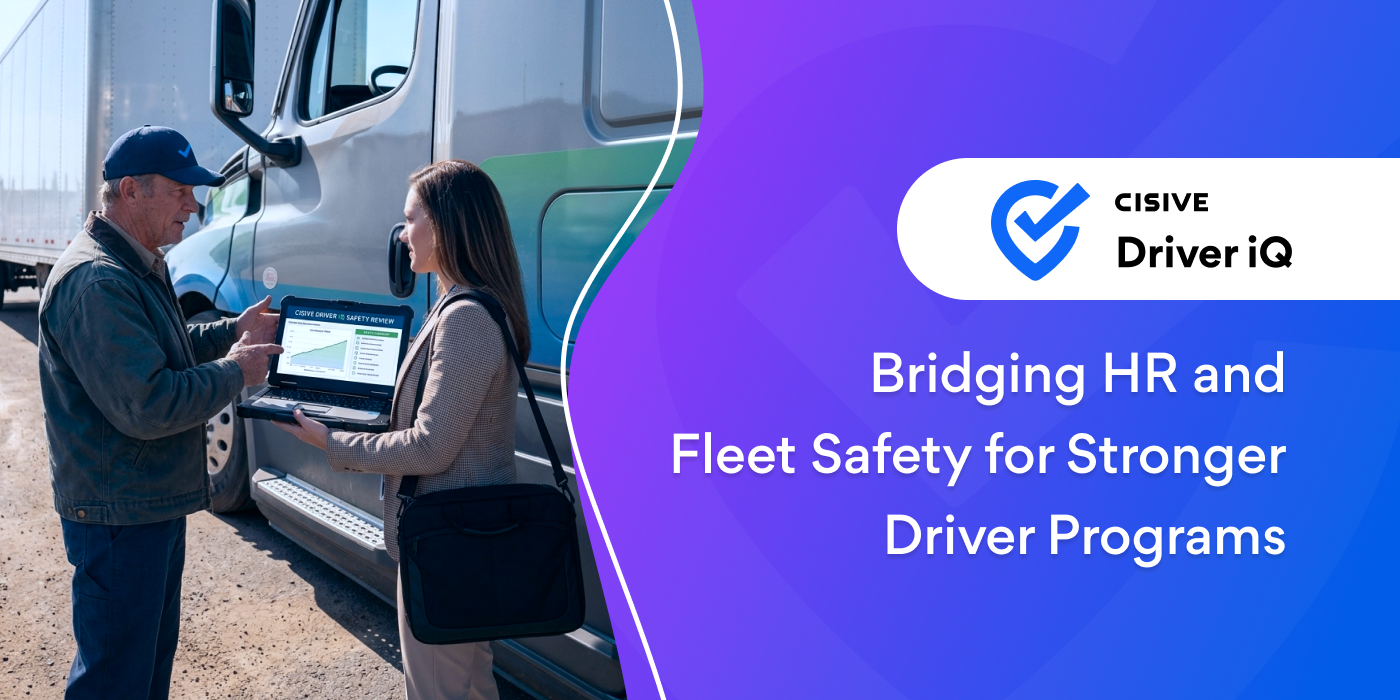
Ask an HR manager and a fleet safety manager to describe the driver hiring process, and you will often get two different answers. HR sees a requisition, a stack of applications, and an offer letter. Fleet safety sees a driving record to pull, a road test to schedule, and a Clearinghouse query to run. Both are right, and that is exactly the problem. When these two functions work from separate systems and separate timelines, hiring slows down and details get missed, whether the role is a CDL tractor trailer position or a sales rep who occasionally drives a company car.
This guide looks at where HR departments managing company drivers can close that gap: how the hiring and screening process actually works, how to divide ownership with fleet safety, where DOT and FMCSA rules apply and where they do not, and how better collaboration gets drivers on the road faster.
Why HR and Fleet Safety Often Work in Silos When Hiring Drivers
To HR, a driving role often looks like any other requisition: post the job, screen resumes, run interviews, extend an offer. Fleet safety, meanwhile, is running a separate process somewhere else in the building: checking driving records, scheduling road tests, and confirming vehicle assignments, often in a spreadsheet or system HR has never seen.
The result is predictable. HR sets a start date before fleet safety has confirmed the candidate is cleared. Fleet safety does not find out a driver was hired until after the offer has already gone out. Neither team is doing anything wrong exactly. They are just working from different pictures of the same hire.
This is not only a compliance problem. It shows up on non-DOT vehicle roles just as often as it does on CDL positions, because the root cause is a process design gap, not a regulation. Closing that gap, more than any single screening step, is what actually speeds up driver hiring.
The Driver Hiring and Screening Process, Step by Step
While ownership and timing details vary by role, most driver hiring processes move through the same general steps:
- Application and employment history review. Every driving role should start with a signed application that captures recent employment history. DOT-regulated positions generally call for documenting a longer employment history window under federal rules, so confirm current requirements with your compliance team or FMCSA guidance before finalizing your application form.
- Driving record check. Pull and review a motor vehicle record for anyone who will drive as part of the job, not just CDL holders. For CDL drivers, that record gets checked against a broader, federally defined list of disqualifying factors.
- Clearinghouse query, for DOT-regulated CDL roles. If the position requires a CDL, employers need to query the FMCSA Drug and Alcohol Clearinghouse before the driver takes on any safety-sensitive duties. Query timing and frequency requirements are worth confirming against current FMCSA guidance, since they are the kind of detail that gets updated.
- Prior employer safety history check. DOT-regulated roles generally require reaching out to a driver's prior DOT-regulated employers about safety performance. It is not a federal requirement for non-DOT roles, but a similar reference check is still good practice.
- Drug testing and, where applicable, medical certification. DOT-regulated drivers need pre-employment drug testing and a valid medical certification. Non-DOT roles typically fall under whatever drug testing policy your company already has in place.
A screening partner like Driver iQ can help manage the Clearinghouse queries and driving record checks that come with DOT-regulated hiring, but outsourcing individual checks only solves half the problem. The bigger lever for speed is making sure HR and fleet safety can see the same status on each step at the same time.
Where DOT and FMCSA Requirements Apply, and Where They Do Not
One of the fastest ways to slow down driver hiring is to treat every driving role the same. Not every company driver operates under the same set of federal rules, and knowing the difference matters:
- CDL and other safety-sensitive driving roles. These positions are generally subject to a defined set of DOT and FMCSA rules covering screening, drug and alcohol testing, and driving record review.
- Non-CDL company vehicle roles. A sales rep who drives a company car or a technician driving a branded service van typically is not subject to FMCSA rules at all, though your own policy or your insurer may still require a driving record check.
- Mixed fleets. Plenty of private fleets run both types of roles side by side. HR should confirm with fleet safety, legal counsel, or your insurance provider which roles trigger which requirements rather than assuming one checklist covers every driving position.
- Why it matters. For DOT-regulated roles specifically, missing a required step can carry real regulatory consequences. Treat DOT-regulated hiring as its own workstream instead of assuming it looks like every other driving role on your team.
DOT and FMCSA requirements are updated periodically and vary by vehicle type, driver classification, and how a role is structured. Confirm current requirements against FMCSA guidance, or with qualified compliance counsel, before applying this to your fleet.
The Driver Onboarding Process: From Offer to First Dispatch
Once a candidate accepts, the onboarding sequence should move quickly, without skipping any step that applies to the role. The order below works for most fleets, though some steps are optional add-ons worth a conversation with your screening provider, and some carriers deliberately sequence drug testing later in the process:
- Extend a conditional offer, and flag any screening or DOT-specific requirements that still need to be completed for that particular role.
- Order the driving record (MVR) check.
- Consider a CDLIS check for DOT-regulated CDL roles. This isn't a federal requirement, but if the driver has held their current CDL for less than three years, a CDLIS (Commercial Driver's License Information System) check can surface driving history tied to a prior license that a standard MVR won't catch.
- Run the PSP (Pre-Employment Screening Program) report. A PSP report isn't required either, but it's a common addition to pre-employment screening for reviewing an applicant's roadside inspection and crash history. Running it at the same time as, or just after, the CDLIS check matters: if a prior license number turns up in the CDLIS results, that same number can be checked against the PSP database, so inspection and crash records tied to an earlier license don't get missed.
- For DOT-regulated roles, complete the prior employer safety history check.
- For DOT-regulated roles, complete the pre-employment Clearinghouse query.
- Schedule required drug testing. Some carriers intentionally hold this until later in the process, once other screening results are back, since it's one of the more costly steps to run on a candidate who may not clear earlier checks. Wherever it falls in your sequence, it needs to be complete before the driver is dispatched.
- Confirm a road test or equivalent skills check where applicable, then have HR and fleet safety jointly sign off that the driver is cleared before the first dispatch.
That last step, the joint sign-off, is where a lot of onboarding breaks down. Build it into the process rather than assuming someone will catch a missed item. And if CDLIS and PSP checks are part of your screening mix, ask your provider whether they can run them together. Matching license numbers between the two is what makes sure the PSP results reflect an applicant's full history, not just what's attached to their current license.
HR vs. Fleet Safety Manager: Who Owns What in Driver Hiring
A lot of the friction in driver hiring comes down to unclear ownership. Here is a starting point for dividing responsibilities:
- Typically HR-owned. Job postings, applications, interviewing, offer letters, standard new-hire paperwork, and coordinating the overall onboarding timeline.
- Typically fleet safety-owned. Driving record standards, road tests or skills verification, DOT-specific screening for regulated roles, and ongoing driver monitoring.
- Where responsibilities overlap. Drug testing coordination, adverse action decisions when a background or driving record raises a concern, and confirming a driver is cleared before their first day behind the wheel. These overlap points are exactly where things fall through the cracks if there is no shared source of truth.
- Put it in writing. A simple ownership matrix, a RACI or something similar, for each of these steps keeps both teams aligned, especially as hiring volume or fleet composition changes. Revisit it more than once and you will usually find at least one step nobody actually owns.
How Better Collaboration Reduces Time to Hire
This is where the biggest gains usually live, not in adding more screening, but in how HR and fleet safety work together around it:
- The cost of separate systems. When HR's applicant tracking system and fleet safety's screening tools live in different places, status updates get relayed by email, chat, or a hallway conversation. Every handoff like that adds a day or two you did not need to lose.
- Shared visibility. Give both teams a shared view of where each candidate stands: application submitted, screening in progress, cleared to start. Whoever owns the next step can move the moment it is ready instead of waiting to be told.
- Parallel processing. Steps that do not depend on each other, like reference checks and driving record review, can run at the same time once both teams agree in advance on what is safe to run in parallel.
- Pre-agreed decision criteria. When HR and fleet safety agree ahead of time on how to evaluate an imperfect driving or background record, a decision does not stall while someone tracks down an answer or an opinion.
- Regular check-ins. A short, recurring sync between HR and fleet safety on open driver requisitions surfaces bottlenecks while they are still small, before they turn into a week of lost time.
- This is not just for CDL roles. These same gains apply whether you are hiring a long-haul driver or a delivery associate driving a branded van. The collaboration problem is not unique to compliance-heavy positions.
Ongoing Monitoring: Compliance Does Not End at Hire
Hiring the driver is the beginning, not the finish line. Ongoing monitoring keeps both teams honest about who is actually road-ready:
- Driving record reviews. Many companies periodically review driving records for anyone who drives for work. DOT-regulated CDL drivers are subject to a federally required review cadence, so check current FMCSA guidance for the specific frequency.
- Clearinghouse monitoring, for DOT-regulated CDL roles. Employers need to keep up with periodic Clearinghouse queries for active CDL drivers. As with the pre-employment query, confirm the current required frequency against FMCSA guidance.
- Random drug and alcohol testing. DOT-regulated positions require ongoing enrollment in a compliant testing pool at rates set by federal guidance. Non-DOT roles usually fall under your company's own policy instead.
- Continuous monitoring options. Some employers supplement periodic checks with continuous driving record or background monitoring for DOT-regulated and non-DOT roles alike, catching a disqualifying event between review cycles rather than after the next scheduled check. Driver iQ's continuous driver monitoring service is one option built for this.
- The collaboration point, again. Ongoing monitoring only works if HR and fleet safety have already agreed on who reviews the results and who acts on them. Fold this into the same ownership conversation as hiring, rather than treating it as a separate program.
Common Breakdowns Between HR and Fleet Safety When Hiring Drivers
Most driver hiring problems trace back to a handful of repeatable breakdowns:
- Starting or dispatching a driver before fleet safety has confirmed every required screening step for that specific role is complete.
- HR treating every driving role the same without checking whether it is DOT-regulated, which can mean missing a required step, or running one that was not necessary in the first place.
- Letting recurring reviews, like driving records or Clearinghouse queries where they apply, lapse because no one owns the renewal calendar.
- Applying a blanket disqualification policy to any criminal or driving record finding instead of evaluating it in context.
- HR and fleet safety each assuming the other one already confirmed a step, with no shared record either of them can check.
Building a Collaborative, Scalable Driver Onboarding Program
If your driver hiring process runs on tribal knowledge and good intentions, here is how to build something that scales:
- Map every step in the hiring process, from application to first dispatch, and note which steps apply to every driving role versus DOT-regulated roles only.
- Assign clear ownership between HR and fleet safety for each step, including the ones where responsibility overlaps.
- Give both teams shared visibility into hiring status instead of relying on emails or verbal updates to fill the gap.
- Partner with a screening provider that can support general background and driving record screening as well as DOT-specific requirements, so the process does not require two disconnected tools.
- Revisit the process periodically. Fleet composition, hiring volume, and FMCSA guidance all change, and a process built two years ago may not fit the fleet you have today.
This article is for informational purposes only and does not constitute legal advice. Consult qualified counsel or a DOT compliance specialist to confirm current obligations for your fleet.
Frequently Asked Questions
What is required before a company driver can start driving?
It depends on the role. At minimum, expect a completed application, a driving record review, and any required drug testing. For DOT-regulated CDL roles, add a pre-employment Clearinghouse query and a valid medical certification. Before the driver's first day, HR and fleet safety should jointly confirm that every applicable step, not just the ones each team happened to remember, is actually complete.
What is the FMCSA Drug and Alcohol Clearinghouse, and does it apply to every driver?
The Clearinghouse is a database that tracks drug and alcohol program violations for CDL holders, and it applies specifically to DOT-regulated CDL positions rather than every company driving role. Employers with CDL drivers generally run a pre-employment query before the driver takes on safety-sensitive duties, often through a Third-Party Administrator that manages the process on the carrier's behalf.
How often should a company review driving records for employees who drive for work?
Many companies review driving records on a recurring basis for anyone who drives as part of their job. DOT-regulated CDL drivers are subject to a federally required review cadence, so confirm the current frequency against FMCSA guidance rather than relying on last year's policy. Non-DOT roles can generally follow whatever schedule your company sets.
Do non-DOT company vehicle roles need the same screening as CDL drivers?
No. Non-CDL roles that involve driving a company vehicle, like a sales car or a branded service van, typically are not subject to FMCSA requirements. Many employers still run a driving record check and hold drivers to a clean-record standard as a matter of policy or insurance, but the federal screening steps required for CDL drivers simply do not apply.
Can HR reduce time to hire without creating compliance gaps?
Yes. Shared visibility between HR and fleet safety, running independent steps in parallel, and agreeing on decision criteria in advance can all shorten the hiring timeline without skipping a single required step, DOT-regulated or otherwise. The fastest processes are not the ones that cut corners. They are the ones that remove unnecessary waiting.
What is the most common cause of hiring delays for company drivers?
More often than not, it is the collaboration gap covered throughout this piece: HR and fleet safety working from separate systems and timelines, with no shared visibility into where a candidate actually stands. Fixing that gap tends to shave more time off the hiring process than any single compliance step ever will.