Healthcare employers can't afford hiring mistakes. When a new hire has direct access to patients — particularly children, elderly individuals, or people with disabilities — the cost of a bad hire isn't measured in turnover. It's measured in harm.
A Level 2 background screening is the highest standard of pre-employment vetting required in healthcare. It goes beyond a name search, using fingerprints for identity verification, and pulling criminal history records from state and federal databases. This guide breaks down how a Level 2 background check works, what it covers, and what your organization needs to know before extending a job offer.
What Is a Level 2 Background Screening?
A Level 2 background screening is a fingerprint-based criminal history check that searches state and federal databases. Florida formally defines the term under Section 435.04 as requiring fingerprint submissions to the state, along with a national check through the FBI's Integrated Automated Fingerprint Identification System (IAFIS).
The Level 2 designation is specific to Florida law, but the underlying requirement of fingerprint-based screening exists in most states. If your organization operates outside Florida, a comparable fingerprint-based criminal background check is likely required for healthcare workers, regardless of the name.
- A full Level 2 screening typically includes:
- Arrest and conviction records
- Federal and state exclusion list screening (including the OIG List of Excluded Individuals/Entities)
- Sex offender registry check (multistate, five-year lookback in Florida)
- Employment history and education verification
- Professional license verification and disciplinary actions
- Drug screening
Level 2 vs. Level 1: What's the Difference?
The distinction matters more than most HR teams realize.
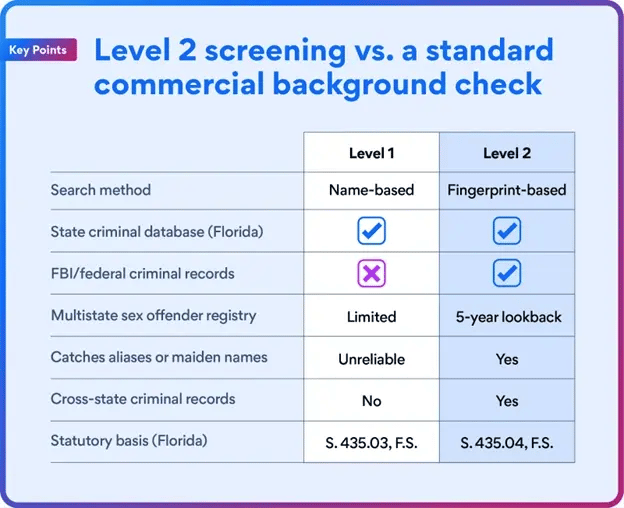
- A Level 1 background check is name-based and limited to state criminal databases. It's faster and cheaper, but it misses a lot. Name-based searches don’t surface crimes committed under a maiden name, aliases, or in other states. Level 1 checks can't verify identity using biometrics.
- A Level 2 background screening uses fingerprints to confirm identity before conducting records searches. That biometric anchor makes possible cross-state criminal history checks and alias detection.
|
|
Level 1 |
Level 2 |
|
Search method |
Name-based |
Fingerprint-based |
|
State criminal database (Florida) |
✓ |
✓ |
|
FBI/federal criminal records |
✗ |
✓ |
|
Multistate sex offender registry |
Limited |
✓ (5-year lookback) |
|
Catches aliases or maiden names |
Unreliable |
Yes |
|
Cross-state criminal records |
No |
Yes |
|
Statutory basis (Florida) |
S. 435.03, F.S. |
S. 435.04, F.S. |
Outside of Florida, the same functional distinction applies: Name-based checks are the floor. In contrast, fingerprint-based checks through state and federal law enforcement agencies are the standard for positions of trust.
How Does a Level 2 Background Screening Work?
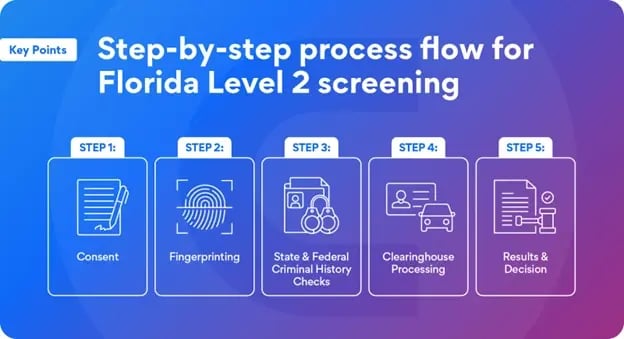
Here’s a typical process for conducting a Level 2 background screening or equivalent.
Step 1: Consent
Employers must obtain written consent from the applicant under the federal Fair Credit Reporting Act (FCRA). Florida statute reinforces this requirement. Consent is typically collected during the application process.
Step 2: Fingerprinting
The applicant visits an approved Live Scan fingerprinting location. In Florida, fingerprints must be submitted electronically to the Florida Department of Law Enforcement (FDLE). At the Live Scan appointment, fingerprints and a photograph are captured and submitted directly to FDLE. The applicant receives a Transaction Control Number to track the status of their screening.
Paper-based hard-card submissions are only permitted for out-of-state applicants using approved out-of-state providers.
Step 3: State and Federal Criminal History Checks
In Florida, FDLE runs the state-level check. Fingerprints are simultaneously submitted to the FBI database for a national criminal history records check. Florida also requires local criminal records checks through local law enforcement agencies.
Step 4: Clearinghouse Processing
In Florida, screening results are routed through the state’s Care Provider Background Screening Clearinghouse. This is a secure system that stores fingerprint data and shares results among qualified employers and state agencies. FDLE continues to match fingerprints against new arrest records on an ongoing basis. If a screened employee is arrested after hire, the relevant agency is notified.
Step 5: Results and Decision
Employers receive a report detailing any findings. Screening results are not a simple pass/fail — employers must evaluate findings against Florida's disqualifying-offense list, consider the exemption process where applicable, and document their decision-making.
What Can Disqualify You in a Level 2 Background Screening?
Florida Statute Section 435.04(2) defines the disqualifying offenses for Level 2 screening. The list is longer and more specific than most HR teams expect.
Key categories include:
- Crimes against children: Child abuse, aggravated child abuse, child neglect, luring or enticing a child, sexual performance by a child
- Crimes against elderly or disabled adults: Adult abuse, neglect, exploitation
- Sexual offenses: Sexual battery, unlawful sexual activity with minors, sexual misconduct with patients or clients, lewdness, and indecent exposure
- Violent crimes: Murder, manslaughter, aggravated assault and battery, kidnapping, human trafficking, arson
- Drug offenses: Chapter 893 drug crimes (felonies or crimes involving a minor)
- Fraud and financial crimes: Theft and robbery (felony), healthcare fraud, burglary
- Domestic violence: Defined under S. 741.28
Florida-Specific Rules for HR to Know
HR teams should especially note the following:
- Disqualification applies to pending cases, not just convictions. Under Florida law, anyone who has been arrested and is awaiting final disposition is disqualified until the case resolves. Employers who become aware of a current employee’s arrest for a disqualifying offense must immediately remove them from contact with vulnerable populations. Don’t wait for a conviction.
- There is no lookback limit for 435.04 offenses. Florida's Level 2 disqualifying offenses have no statutory time limit, unlike the FCRA's seven-year default. A conviction from 30 years ago for sexual battery or elder exploitation will trigger disqualification.
- Exemptions are possible, but limited. A disqualifying offense isn’t necessarily permanent. Under Section 435.07, exemptions may be granted, case by case, upon completion of conditions for a misdemeanor or two years after completing a sentence for a felony. Exemptions aren’t available for sexual predators, career offenders, or sexual offenders as defined by Florida statute.
OIG Exclusions and Federal Lists
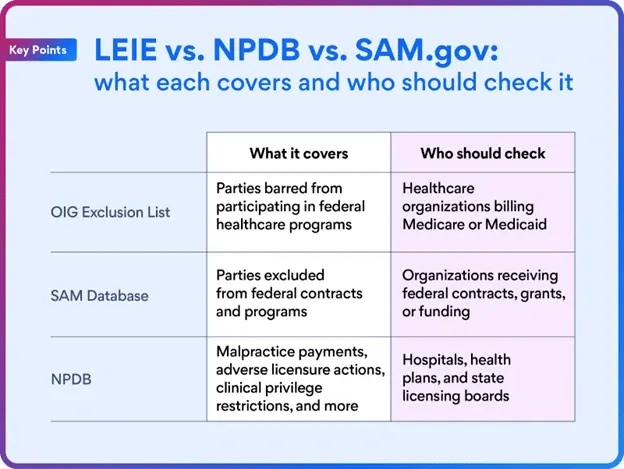
Anyone on the OIG List of Excluded Individuals/Entities can’t work for any organization that receives Medicare or Medicaid reimbursement in virtually any capacity. Employers who hire excluded individuals risk significant civil monetary penalties.
The OIG list is separate from the National Practitioner Data Bank (NPDB), which covers malpractice payments and licensure actions, and the System for Award Management (SAM) exclusion database, which lists individuals and entities that can’t do business under federal contracts or programs.
Each database should be searched independently as part of a comprehensive healthcare background check.
Why Level 2 Screening Is Required in Healthcare
Healthcare hiring differs from most other industries because workers have direct access to vulnerable patients, controlled substances, and sensitive health information. Level 2 screening meets the seriousness of this process.
- Fingerprints catch what names can't. A name-based search only returns what the applicant tells you. Fingerprint-based screening verifies identity, allowing records searches to detect crimes committed under maiden names, aliases, or in other states.
- Ongoing monitoring extends protection past day one. Florida's Clearinghouse retains fingerprints and continuously matches them against new arrest records. If a nurse is arrested six months after joining your team, you'll be notified, even without running a new screening.
- Licensing checks surface disciplinary actions that criminal records won't show. A physician whose license was suspended for patient safety violations may have no criminal record. Pairing Level 2 criminal history checks with professional license monitoring closes that gap.
- Federal requirements set the floor, but state law often goes higher. The Centers for Medicare & Medicaid Services require fingerprint-based criminal background checks for high-risk Medicaid providers under 42 CFR § 455.434. Florida's Level 2 system meets and exceeds that baseline. Since July 1, 2025, virtually all licensed healthcare practitioners in Florida must complete Level 2 screening as a condition of initial licensure and renewal under HB 975.
Recommended Reading: Your Must-Have Guide to Healthcare Background Check Compliance
Limitations to Know Before You Rely on the Results
Level 2 background screenings are the most thorough pre-employment check available for healthcare workers, but compliance-focused employers should understand the gaps.
- No access to medical records. HIPAA prohibits employers from gathering an applicant's medical history, including during background checks. A Level 2 screening won’t surface substance-abuse disorders, cognitive impairment, or mental health conditions that might affect fitness for duty.
- Active warrants don't always appear. Florida statute bars hiring anyone "arrested and awaiting final disposition," but not every arrest is in the database. Unexecuted warrants, particularly bench warrants for failure to appear, aren’t always fed to state and federal systems. Local warrants from smaller jurisdictions are also less likely to surface.
- Sealed records get treated differently in healthcare. Expunged or sealed records, in general, can’t be used against an applicant. Healthcare is different. People getting screened through Florida’s Clearinghouse for positions requiring Level 2 screening can’t lawfully deny or fail to disclose arrests, even for expunged or sealed records. This is a narrow but significant exception that applies to Clearinghouse-processed screenings.
- Database coverage has gaps. The FDLE and FBI databases depend on consistent reporting from Florida's 67 counties and thousands of local law enforcement agencies. Incomplete screening can result from nondigitized records, delays between arrest and database entry, and out-of-jurisdiction offenses that were never reported to the national system.
- The 90-day rescreening rule. If a healthcare employee takes a 90-day break from a position requiring Level 2 screening, a new screening is required before they return to direct-care work. This creates a tracking obligation for HR, particularly for part-time, seasonal, and returning employees.
How Cisive PreCheck Can Help
Level 2 background screening compliance involves many moving parts — managing Florida Clearinghouse submissions, monitoring OIG exclusion lists, and tracking license renewals and disciplinary actions across dozens of state boards.
Cisive PreCheck is built specifically for healthcare so you make the right call. Our team handles the complexity of fingerprint-based criminal history checks, exclusion screening, drug and occupational health testing, and ongoing license monitoring. With Cisive, your HR and medical staff services teams can focus on getting qualified candidates to the bedside faster.
Speak with a PreCheck pro to learn how we can strengthen your screening program and eliminate blind spots.
FAQs
What disqualifies you from a Level 2 background screening?
Disqualifying offenses under Florida Statute Section 435.04 include violent crimes, sexual misconduct, child or elder abuse, certain drug felonies, fraud, and human trafficking. Disqualification applies not just for convictions but also to anyone arrested and awaiting final disposition. Exemptions are possible for some offenses after a waiting period, but not for sexual predators, career offenders, or sexual offenders as defined by Florida law.
Is a Level 2 background screening fingerprint-based?
Yes. A Level 2 background screening requires fingerprint submission to the FDLE and the FBI. This contrasts with Level 1 background checks, which rely on a name-based state search. The fingerprint-based approach verifies identity and enables cross-state criminal history checks that name-based searches can’t reliably replicate.
Does a Level 2 background screening show sealed records?
In most contexts, job candidates can deny expunged or sealed records. Healthcare is an exception. Applicants screened through Florida's Care Provider Background Screening Clearinghouse, which processes Level 2 healthcare screenings, are required to disclose arrests, even if they’ve been sealed or expunged.