A background check report isn't self-explanatory. You need to understand court abbreviations, disposition terminology, and overlapping legal requirements. Some findings are legally off-limits to act on, while a seemingly minor flag could create real risk for your organization. Knowing how to read a background check accurately is what separates defensible hiring decisions from compliance liabilities.
Why Background Checks Matter for Employers
A bad hire costs more than leaving a role vacant. Beyond recruiting and onboarding expenses, a hiring decision made without adequate screening can expose your organization to negligent hiring claims, workplace safety incidents, and regulatory penalties — particularly in regulated industries like healthcare, where background screening isn't optional.
Pre-employment background checks give employers a verified, objective overview of a candidate's history. Misreading a disposition or skipping the adverse action process can create the very liability you were trying to avoid.
Recommended Reading: What Makes a Good Background Check?
What's Included in a Background Check Report
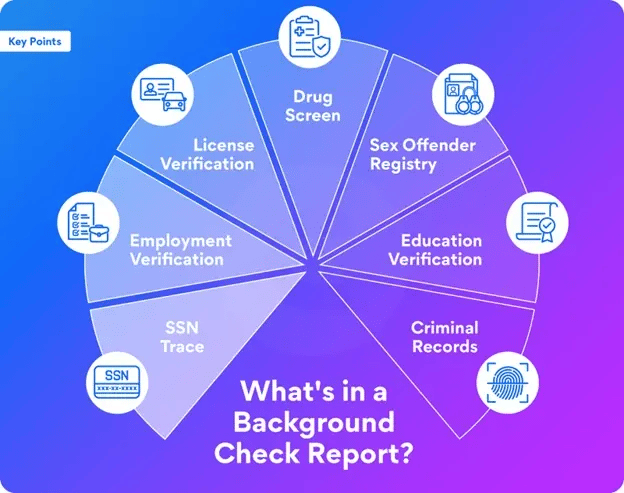
The contents of a background check report depend on what your organization ordered and the nature of the role. A background check report typically includes some combination of the following components:
SSN Trace and Identity Verification Every report starts with a Social Security number trace, which confirms the SSN is valid, verifies the candidate's date of birth, and generates an address history. Records searches should cover any states where an address is found. An SSN trace doesn't confirm the number belongs to the applicant — that requires a separate Consent Based Social Security Number Verification.
Criminal Record Search This is the most consequential part of a background check. A full criminal search draws from county court records (the most accurate source), state repositories, national multistate databases, federal court records, and sex offender registries. National databases are supplemental and shouldn't be used as a standalone source.
Employment & Education Verification Employment verification confirms job titles and dates as reported by past employers. Research suggests many candidates misrepresent how long they held a prior position, making this step worth careful review. Education verification confirms whether claimed degrees are real, accredited, and awarded to the candidate.
Professional License Verification Healthcare background checks are an example where verifying professional licenses is crucial. A suspended, restricted, or lapsed license is significant — employers can face regulatory consequences for knowingly employing such people.
Sex Offender Registry This check covers national and multistate databases and is separate from criminal history. The national sex offender registry is publicly searchable. Registry status can persist even when conviction records have been partially sealed.
Drug Screen Results Where applicable, drug test results are reported as negative, positive, dilute, substituted, or canceled. A canceled result requires recollection. A dilute result may require a second collection under employer policy or DOT regulations.
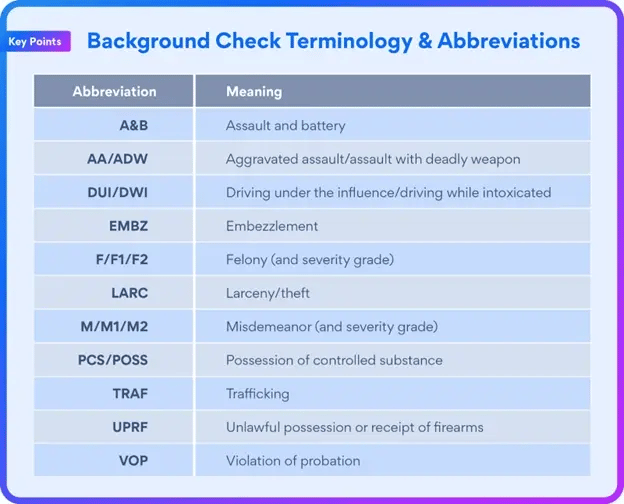
Background Check Terminology & Abbreviations
Criminal background checks are written in court language that HR teams don't encounter every day. Here's what you'll find.
Common Abbreviations
For a full reference, consult this glossary of common court abbreviations.
|
Abbreviation |
Meaning |
|
A&B |
Assault and battery |
|
AA/ADW |
Aggravated assault/assault with deadly weapon |
|
DUI/DWI |
Driving under the influence/driving while intoxicated |
|
EMBZ |
Embezzlement |
|
F/F1/F2 |
Felony (and severity grade) |
|
LARC |
Larceny/theft |
|
M/M1/M2 |
Misdemeanor (and severity grade) |
|
PCS/POSS |
Possession of controlled substance |
|
TRAF |
Trafficking |
|
UPRF |
Unlawful possession or receipt of firearms |
|
VOP |
Violation of probation |
Disposition Terminology
The disposition field tells you what actually happened in a case — it's the most important field for hiring decisions.
- Guilty/Convicted: A formal conviction was entered. A conviction doesn't automatically disqualify a candidate.
- Not Guilty/Acquitted: A non-conviction. Should not factor into hiring decisions.
- Dismissed: The case was terminated before a verdict. A non-conviction, whether with or without prejudice.
- Nolle Prosequi (Nol Pros/NP): The prosecutor dropped the case. Non-conviction. The underlying arrest record may still appear on a report — a nol pros is not equivalent to a conviction.
- Adjudication Withheld: No formal conviction entered. A non-conviction in most states. Florida is a notable exception under healthcare screening law.
- ARD/Diversion: Pre-trial diversion program. Successful completion results in dismissal and a non-conviction.
- Pending: The case hasn't been resolved. Consult legal counsel before acting.
- Sealed/Expunged: Legally removed from public access. Employers generally may not use expunged records in hiring decisions.
Offense Levels
- Felonies (Class A–E or F1–F5): The most serious, typically punishable by more than one year of incarceration.
- Misdemeanors (Class A–C or M1–M2): Less serious, typically punishable by less than one year.
- Infractions/summary offenses: The least serious. Some jurisdictions, including Philadelphia, bar their use in hiring decisions as part of ban the box programs.
What to Look for When Reviewing a Report
When criminal record findings appear on a background check report, consider four factors before making any hiring decisions:
- Status of the offense: Confirm the disposition. A dismissal, nol pros, or acquittal is not a conviction. Don't conflate an arrest with a finding of guilt.
- Type and gravity of the offense: Examine the specific charge and how serious the underlying conduct was.
- Relevance to the job role: Ask whether this criminal history bears on the candidate's ability to perform this specific job safely and reliably. This is the factor employers most often skip and regulators most often scrutinize.
- Age of the charges: Recency matters even within your state's allowable lookback window.
These four factors are the framework the EEOC expects employers to apply and document.
Recommended Reading: The Background Check Process Explained
Hiring Law Compliance: What Employers Must Do
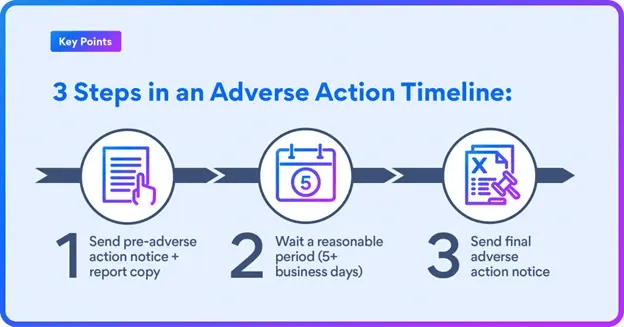
The Fair Credit Reporting Act (FCRA) governs how employers can use background check results obtained through a consumer reporting agency. Using a third-party screening provider means you must obtain written consent before conducting the check — and follow a mandatory two-step process before any adverse action.
- Send a pre-adverse action notice with a copy of the background check report and the CFPB's "Summary of Your Rights Under the Fair Credit Reporting Act."
- Allow a reasonable waiting period — typically five business days — for the candidate to dispute inaccurate information.
- Send a final adverse action notice identifying the credit reporting agency and the candidate's right to a free copy of the report.
Skipping any step is a standalone FCRA violation. Civil penalties can reach nearly $5,000 per violation, and class actions under the Fair Credit Reporting Act have aggregated these amounts at scale.
State and local law adds more. Philadelphia's amended ban the box ordinance, effective January 6, 2026, limits felony lookbacks to seven years, misdemeanor lookbacks to four, and requires 10 business days for candidate response. New York City has its own Fair Chance Act Notice form. EEOC guidance bars blanket criminal exclusion policies — every criminal record finding should go through individualized assessment, documented and tied to the specific role.
Recommended Reading: Best Background Check for Employers
How Cisive Can Help
Accurately reading a background check starts with a report you can trust. Cisive's 99.9994% accuracy rate means you're reviewing verified information every time. Our specialists help you build screening programs matched to your industry requirements and the legal landscape across every jurisdiction where you hire. When a report raises questions, our 24/7 internal support team is there to help.
Speak with a Cisive expert to build a screening program that holds up.
FAQs
How do employers read a background check?
Employers review background check reports section by section: identity verification (SSN trace and date of birth confirmation), criminal records, employment and education verification, license checks, and any additional screenings such as drug testing. When criminal record findings appear, employers should identify the specific disposition, evaluate the offense type and severity, assess relevance to the role, and consider how much time has passed. Any decision to decline a candidate based on background check results must follow the FCRA adverse action process.
Can you reject a candidate based on a background check?
Yes, but not automatically. EEOC guidance bars blanket exclusion policies. Evaluate each finding against the nature of the offense, recency, and job relevance. If you decide not to hire based on background check results, the FCRA requires a pre-adverse action notice, a waiting period, and a final adverse action notice. Skipping any step creates legal exposure.
How far back do background checks go?
It depends on the record type, jurisdiction, and role. The FCRA generally limits consumer reporting agencies to a seven-year window for roles paying under $75,000 annually — this cap doesn't apply to higher-paying positions. Many states set stricter lookback limits, and regulated industries like healthcare and financial services may have additional requirements. Your screening provider should apply the correct rules for each jurisdiction where you hire.