Healthcare recruitment strategies have never been more critical or more difficult to execute. The Association of American Medical Colleges projects a physician shortage of up to 86,000 by 2036, while nurse vacancies at many health systems remain above pre-pandemic levels.
Outdated hiring playbooks (reactive job postings, slow credentialing timelines, generic employer brand investment) aren't getting the job done. The health systems that consistently close roles are building smarter processes, not just posting more openings.
What Is Healthcare Recruitment & Why Is It So Challenging?
Defining Healthcare Recruitment
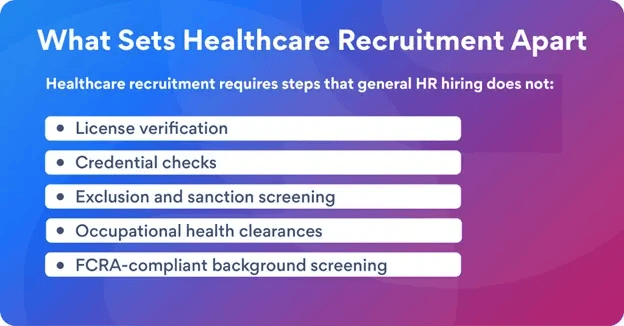
Healthcare recruitment is the process of attracting, screening, credentialing, and hiring clinical and nonclinical staff. Unlike general HR hiring, the recruitment process in healthcare requires license verification, credential checks, and exclusion and sanction screening, as well as occupational health clearances sometimes.
These are compliance obligations that simply don't exist in most other industries. Miss a step, and someone who shouldn't be there could wind up in contact with patients.
Why Healthcare Recruiting Is Uniquely Difficult
The Bureau of Labor Statistics projects registered nursing jobs will grow 5% through 2034, which is above average. But that doesn't account for the retirement wave that’s already thinning the workforce. Health systems compete with travel nursing agencies offering premium short-term contracts while dealing with burnout. Mental health pressures and post-pandemic attrition further complicate nurse retention.
Lengthy credentialing timelines and delayed healthcare employee background checks only add to the friction, giving candidates more opportunities to accept another offer before you can close.
Why Traditional Recruitment Strategies Fall Short in Healthcare
Most health systems built their hiring infrastructure for a different labor market. Posting roles on job boards and waiting for inbound job seekers made sense when qualified candidates were plentiful. Today, that approach fills your applicant tracking system (ATS) with people who've already accepted offers elsewhere. A five-page application, a two-week credentialing turnaround, and a manual background check process only make it worse, signaling to candidates that your organization can’t keep pace with modern hiring.
There's also an employer brand gap. If candidates can't tell from your career site and social channels why your organization is different from the one down the street, they'll decide based on compensation alone.
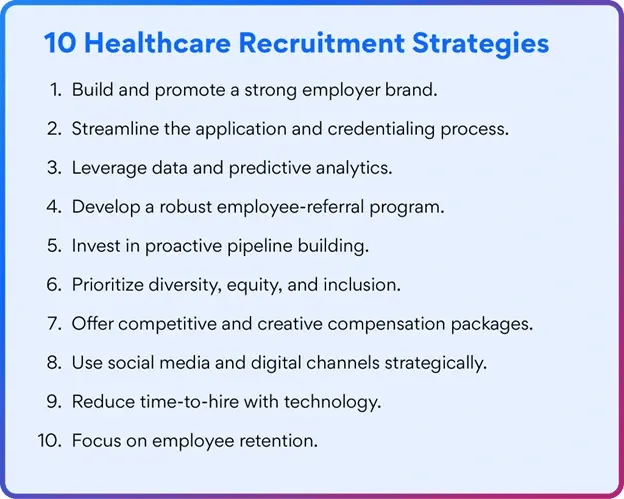
10 Healthcare Recruitment Strategies to Attract Top Talent in 2026
1. Build & Promote a Strong Employer Brand
A strong employer brand communicates what it's actually like to work at your organization — your people, values in practice, and how you treat staff when things get hard. Employee testimonials, unit-level spotlights, and candid content on LinkedIn and Glassdoor do more to attract top talent than polished recruitment ads. Here are three best practices:
- Feature nurses, allied health staff, and support workers, not just leadership.
- Highlight DEI initiatives, recognition programs, and career development pathways.
- Refresh content regularly so it reflects today's workforce, not a pre-pandemic snapshot.
2. Streamline the Application & Credentialing Process
Every unnecessary step in your recruitment process is an invitation for healthcare professionals to accept a competing offer. Mobile-friendly applications, digital document collection, and clear timelines make a measurable difference. Partnering with a provider built specifically for healthcare can cut weeks off the window between offer and start date. Do these things:
- Reduce application length to the minimum required for initial screening.
- Send automated status updates at each stage of credentialing and screening.
- Use digital credential verification tools rather than manual follow-up.
3. Leverage Data & Predictive Analytics
Reactive hiring is expensive. Health systems with workforce analytics capabilities can forecast vacancies weeks or months out to eliminate blind spots and give recruiting efforts more runway. Tracking source-of-hire, time-to-fill, and offer acceptance rates by role shows exactly where the process has gaps. Try the following:
- Connect workforce planning data with HR to anticipate turnover.
- Use ATS reporting to identify which sourcing channels produce the fastest, highest-quality hires.
- Benchmark your time-to-fill against industry averages to set realistic improvement targets.
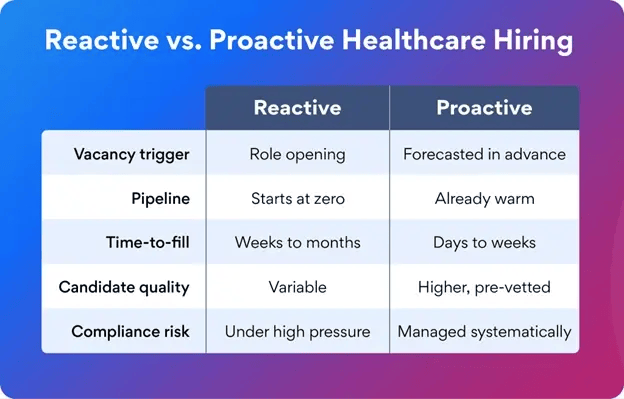
4. Develop a Robust Employee-Referral Program
Employee referrals consistently produce higher-quality hires who stay longer. That’s especially important in healthcare, where team cohesion directly affects patient care. Incentives don't have to be large; recognition, modest bonuses, and an easy process will drive participation. Three steps to start:
- Extend the employee-referral program to clinical and nonclinical staff alike.
- Close the loop. Share outcomes with referring employees, even when it's a no.
- Promote the program during onboarding, not just at launch.
5. Invest in Proactive Pipeline Building
The health systems winning on recruitment aren't waiting for healthcare workers to apply. They're building relationships with nursing schools, allied health programs, and educational institutions before graduates hit the job market. A talent pool of passive candidates, past applicants, and referrals reduces your dependency on job boards. Try these tactics:
- Develop diverse early-career pipelines by partnering with educational institutions, including historically Black colleges and universities, Hispanic-serving institutions, and community colleges.
- Create a structured process for staying in touch with strong candidates who weren't ready to move.
- Track which academic partnerships produce the most successful placements.
6. Prioritize Diversity, Equity & Inclusion in Recruiting
Diverse clinical teams improve patient outcomes. Recruitment strategies for healthcare organizations should address bias in job descriptions, screening criteria, and sourcing channels. Audit your job descriptions, review your screening criteria, and make sure your sourcing channels reach candidates you're not currently seeing. Three more tips:
- Use structured interviews with standardized scoring to reduce subjective bias.
- Set measurable DEI representation goals at the unit and department levels.
- Partner with organizations that serve underrepresented communities in healthcare education.
7. Offer Competitive & Creative Compensation Packages
Base salary benchmarking is table stakes. Go further by offering sign-on bonuses, student loan forgiveness, housing stipends, and work-life balance benefits, like flexible scheduling, that acknowledge life outside work. Build compensation transparency into the process earlier, because late-stage conversations lose candidates who've already accepted elsewhere. Have your compensation team do the following:
- Benchmark total compensation against regional and national competitors.
- Offer scheduling flexibility where clinical operations allow.
- Consider phased sign-on bonuses tied to retention milestones rather than at-hire lump sums.
8. Use Social Media & Digital Channels Strategically
Healthcare candidates are on social media, including LinkedIn, Facebook groups, and professional forums. Content that performs (day-in-the-life posts, team spotlights, mission-driven stories) builds brand awareness that attracts candidates. Paid social targeting complements that by reaching passive candidates in specialties. Consider the following:
- Assign recruitment social content to someone with the time and authority to keep it active.
- Test short-form video on LinkedIn and Facebook for hard-to-fill clinical roles.
- Track engagement and conversion from social to the application.
9. Reduce Time-to-Hire With Technology
Open clinical roles affect staffing ratios, existing staff workload, and patient care. Reduce administrative drag with ATS and customer relationship management tools that are built for high-volume healthcare hiring, AI-assisted screening, and automated scheduling. Background screening is one of the most time-sensitive steps, but you can have a fast and compliant healthcare background check program with the right integrations in place. Take these steps:
- Evaluate whether your ATS is designed for healthcare hiring volume, credential complexity, and integrated background screening.
- Automate interview scheduling and candidate communication to reduce recruiter administrative load.
- Use automated, background screening integrations that are compliant with the Fair Credit Reporting Act (FCRA) to shorten onboarding times.
10. Focus on Employee Retention as Part of Your Recruitment Strategy
High turnover undermines your recruitment investments. When healthcare organizations become known for burning out staff, candidates don’t even bother to apply. Your ability to recruit and retain health professionals depends on professional development opportunities, clear career pathways, and a culture that takes retention seriously. Here are three keys:
- Use exit interview data to identify patterns; share findings with department leadership.
- Train managers to have career development conversations, not just performance reviews.
- Show leadership the explicit link between retention outcomes and recruitment budgets.
How to Build a Long-Term Healthcare Recruitment Strategy
These recruitment strategies for healthcare work best when part of a comprehensive strategy and paired with a purpose-built healthcare screening program. The health systems that consistently win on talent bring together workforce planning, employer brand investment, pipeline development, and compliance-ready screening, rather than relying on siloed initiatives running on separate tracks and budgets.
Success requires alignment between HR, clinical leadership, and compliance teams, along with screening and credentialing partners that integrate with existing platforms and maintain the highest compliance standards. Organizations navigating staffing shortages without letting compliance slip know that these pressures are more manageable when your screening program is built for healthcare from the ground up.
Your screening process doesn’t have to add days to your time-to-fill, create compliance gaps, or create manual work. If you’re ready to hire with confidence, speak to a Cisive PreCheck pro.
Frequently Asked Questions About Healthcare Recruitment Strategies
What are the most effective healthcare recruitment strategies?
The most effective recruitment strategies in healthcare combine proactive pipeline building, a differentiated employer brand, fast and compliant credentialing, and data-driven hiring. Organizations that invest in all four see faster time-to-fill, lower cost-per-hire, and better retention than those relying on reactive job posting alone.
What is the biggest challenge in healthcare recruitment?
Three challenges converge as one: Workforce shortages, burnout, mental health-driven attrition, and the complexity of credentialing and compliance. The problem isn't just finding qualified candidates. It's moving quickly enough to secure them, all without cutting corners on compliance.
How can healthcare organizations improve nurse recruitment?
Competitive total compensation, flexible scheduling, visible professional development pathways, and a fast and transparent hiring process all make a real difference. Nurse candidates are evaluating the entire experience, from the first touchpoint to the first day on the unit.
What is the difference between healthcare recruitment and retention?
Recruitment is how you bring talent in; retention is how you keep it. Treat recruitment and retention strategies in healthcare as a tightly connected pair, not separate programs. Organizations with low turnover have stronger employer brands, which makes future recruiting easier.
How does background screening affect healthcare recruitment?
Slow or noncompliant screening delays time-to-fill and introduces risk at one of the most consequential steps. Partnering with a healthcare-specialized provider that integrates with your ATS and maintains full FCRA compliance keeps things moving without creating gaps that expose your organization to regulatory or patient safety risk.