Data privacy in healthcare is a compliance obligation and a patient safety issue. When protected health information (PHI) is exposed, the consequences are many: Regulatory fines. Loss of patient trust. Lawsuits. Remediation costs. Reputational fallout that can take years to recover from.
This guide breaks down what data privacy in healthcare means, relevant laws and regulations, the challenges facing healthcare organizations right now, and concrete steps you can take to secure sensitive patient data.
Table of Contents:
What Is Healthcare Data Privacy?
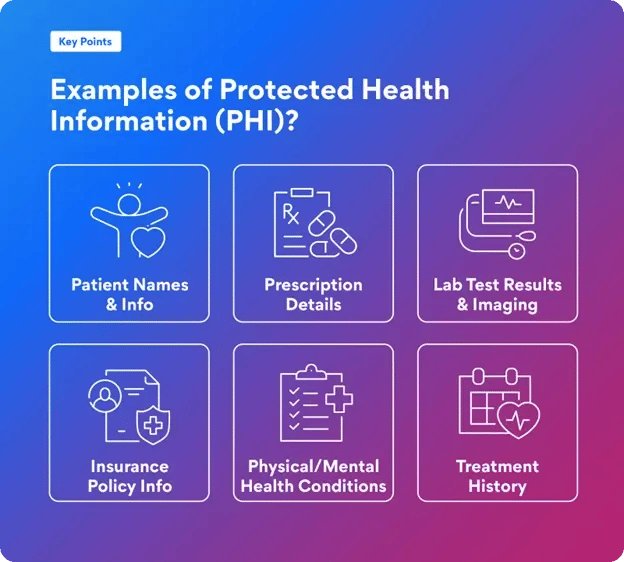
Healthcare data privacy refers to the preservation of sensitive patient information from unauthorized access, disclosure, or misuse. Such information includes names, addresses, Social Security numbers, diagnoses, treatment records, insurance information, and test results. Collectively, this information is known as PHI.
Bad actors view PHI as extremely high value. Unlike a compromised credit card, which can be canceled, medical records are permanent. A stolen medical record can enable insurance fraud, identity theft, and targeted scams over many years. Stolen medical information sells at a significant premium on the dark web compared with financial data.
Protecting data privacy in healthcare means more than locking down servers. It requires controlling who can access patient information, defining how that information flows between systems and stakeholders, and preserving transparency and accountability at every step.
Healthcare HR and compliance teams must ensure that only trustworthy, vetted people have access to sensitive systems. Such verification begins at the point of hire and continues throughout the employee life cycle.
What Laws Protect Patient Health Data?
Local, state, and national regulations, including those outside of the United States, govern how healthcare organizations manage patient data. Maintaining compliance with healthcare data protection laws is essential. Enforcement is increasing, while the financial penalties for noncompliance are substantial.
HIPAA
The Health Insurance Portability and Accountability Act (HIPAA) is the foundational U.S. law protecting the privacy and security of patients' PHI. HIPAA applies to covered entities and their business associates, including vendors, contractors, and technology partners that handle PHI on an organization’s behalf.
The law’s Privacy Rule governs how covered entities — including health plans, healthcare providers, and clearinghouses — may use and disclose PHI. Meanwhile, the Security Rule sets requirements for protecting electronic PHI (ePHI).
Enforcement by the Department of Health and Human Services (HHS) Office for Civil Rights (OCR) has intensified significantly. In 2024 alone, the office closed 22 HIPAA penalty cases and collected more than $9.9 million in fines. Violations included those resulting from inadequate risk analyses, unauthorized disclosures, ransomware attacks, and improper website-tracking tools. The OCR Risk Analysis Initiative, launched in 2024, focuses on organizations that experienced cyberattacks without having completed proper security risk assessments.
The message is clear: Weak compliance programs will be scrutinized, especially in the event of a breach.
GDPR
The General Data Protection Regulation (GDPR) applies to EU member states and governs how organizations collect, store, process, and share personal data, including personal health information. GDPR applies to U.S.-based healthcare organizations with patients who are EU citizens.
GDPR requires explicit patient consent before collecting or using personal information. It also requires healthcare institutions to protect patient data against unauthorized access or disclosure. Noncompliance carries fines of up to 4% of global annual revenue.
Other Relevant Laws
Beyond HIPAA and GDPR, healthcare organizations may be subject to:
-
- Health Information Technology for Economic and Clinical Health Act (HITECH Act): This U.S. law strengthens HIPAA's privacy and security rules for electronic health records (EHRs) and increases civil and criminal penalties for violations.
- California Consumer Privacy Act (CCPA): This California law gives state residents rights over the collection and use of their personal information, including health data held by covered businesses.
- Personal Information Protection and Electronic Documents Act (PIPEDA): Canada's private-sector privacy law governs data collection and disclosure of personal information, including by healthcare providers.
- Data Protection Act 2018 (DPA): This law supplements GDPR for U.K.-based organizations handling patient health data.
For healthcare systems operating across borders, including those performing global background checks, the safest approach is designing your compliance program to the most stringent applicable regulation and applying that standard consistently.
3 Key Challenges to Healthcare Data Privacy
Increasing Digital Complexity in the Healthcare Industry
Healthcare's shift toward EHRs, telemedicine, connected devices, and cloud platforms has created a more efficient industry — but also a significantly larger attack surface. Each platform integration, third-party vendor, and remote access point is a potential vulnerability.
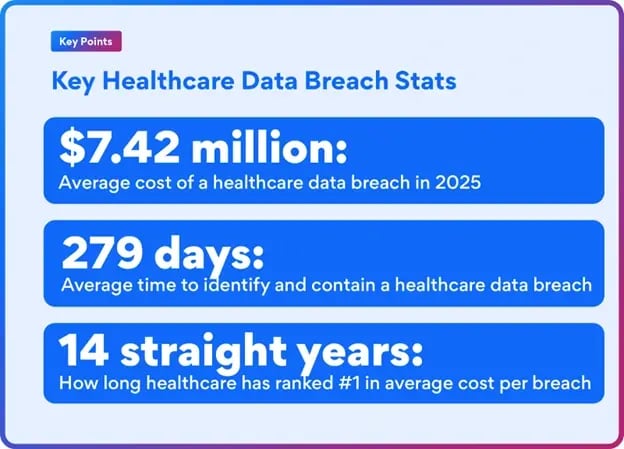
Healthcare data breaches averaged $7.42 million per incident in 2025, making healthcare the costliest industry for breaches for 14 straight years. These breaches take 279 days, on average, to identify and contain — five weeks longer than the global average across industries.
Insider Threats & Unauthorized Access
When systems are interconnected across providers, insurers, researchers, and third-party vendors, each stakeholder becomes a potential point of failure. Business associate breaches, in particular, are a growing source of exposure and are often undercounted in public reporting.
Insider threats are a significant source of healthcare data breaches, whether because of negligence, mistakes, or deliberate misuse. Nearly one-third of healthcare incidents were caused by internal threat actors, according to the 2025 Verizon Data Breach Investigations Report.
Insiders with legitimate system access can view records without necessarily citing a legitimate business purpose. They can share sensitive information with unauthorized parties or be manipulated into providing attackers with a foothold. An access-control policy alone isn’t sufficient; you need to know who you're hiring in the first place.
Thorough healthcare background screening, including criminal history checks, license verification, and exclusion screening, is one of the most direct risk-mitigation tools available. Hiring an individual on the HHS Office of Inspector General exclusion list, for example, creates safety risks for patients and exposes your organization to civil monetary penalties and reputational risk.
Rapidly Evolving Cyber Threats and Emerging Technologies
Ransomware, phishing, and credential-based attacks are accelerating in frequency and sophistication. Healthcare organizations continue to be prime targets because their data is valuable, their operations are time-sensitive, and their systems regularly rely on legacy infrastructure that can be difficult to patch.
Shadow AI — employees using AI tools without employer approval or proper security controls — has emerged as a new and underappreciated vector for PHI exposure. More than one in eight companies in 2025 reported breaches of AI tools or models, and 97% of those organizations lacked proper AI access controls.
Healthcare organizations that fall behind on emerging-threat vectors face a higher risk of cyber incidents, not to mention steeper penalties when federal investigations find that their risk analysis didn’t account for known threats.
6 Best Practices for Protecting Data Privacy in Healthcare
1. Establish Clear Policies for Handling PHI
Every employee who touches patient data needs a clear, plain-language framework for what they're allowed to do. That means written policies on the following: access, data sharing, password management, encryption, and the proper disposal of physical and electronic records.
Policies need to be effectively communicated. Build data privacy into employee onboarding, reinforce it through annual training, and make sure your workforce knows both the procedures and the repercussions of noncompliance.
2. Implement Secure Health IT Infrastructure
Encryption, multi-factor authentication, access controls, and timely software patching are the foundational layers of PHI security. They remain the most common gaps discovered by OCR during investigations.
Automate software updates wherever possible. Review access privileges regularly, and remove access promptly when employees change roles or leave the organization. Regulators treat preventable breaches more harshly — and breaches involving overly broad user permissions are preventable.
Related read: Healthcare Risk Management Software: Secure Your Facility
3. Perform Regular Risk Assessments Across the Enterprise
OCR's Risk Analysis Initiative isn't going away. The most frequently cited violation in recent enforcement actions has been inadequate risk analysis.
A proper risk assessment is comprehensive, covering all systems, environments, and workflows where PHI exists: on-premises servers, cloud platforms, mobile devices, third-party applications, and physical records. Document everything. If you face an investigation, your risk analysis is your primary evidence of a functioning compliance program.
Risk assessments are also recurring: Update them after significant system changes, and review at least annually.
4. Provide Ongoing Employee Training
Phishing attacks succeed because they target people, not systems. One of your most effective security controls is training employees to recognize suspicious emails, avoid clicking on unverified links, and report potential incidents.
Training should be mandatory, regular, and specific. Use real-life examples and conduct phishing simulations. Make clear that data privacy is everyone's responsibility.
5. Establish and Test an Incident-Response Plan
When a breach occurs, the clock starts immediately. HIPAA requires notifying affected individuals within 60 days of discovering a breach. Delayed breach notifications are among the most common and most penalized HIPAA violations. A tested, documented incident-response plan can make the difference between a contained incident and a compliance disaster.
Your plan should define clear roles across IT, legal, compliance, and HR. It should cover detection, containment, impact assessment, notification timelines, and post-incident review. Run tabletop exercises at least annually.
6. Vet Anyone Who Has Access to Patient Data
Access controls and encryption protect your systems. But they don't tell you whether the person logging in has a history of healthcare fraud, a license suspension, or an active OIG exclusion. That's what healthcare compliance screening is for.
Pre-hire screening covers criminal background checks, license and credential verification, and exclusion and sanction screening, ensuring that you’ve vetted anyone with access to your most sensitive systems.
Establish clear policies for conducting background checks and making hiring decisions based on the results. Communicate these policies to relevant stakeholders, including HR and hiring managers, to ensure consistent and fair decision-making.
Make sure to conduct ongoing monitoring after making a hiring decision, as an employee's status can change at any time.
Related read: Navigating Background Check Compliance in Healthcare
How Cisive PreCheck Can Help
Data privacy in healthcare depends on creating a strong, comprehensive compliance program — and that begins with knowing who you're hiring. Negligent hiring and inadequate screening aren't just HR risks. They create direct liability exposure for covered entities.
Cisive PreCheck is the healthcare industry's dedicated background screening and compliance partner. With 30+ years of experience in healthcare-specific screening, PreCheck delivers criminal background checks, license and credential verification, exclusion and sanction monitoring, and OIG/GSA database screening, all built for the regulatory requirements and workflow demands of healthcare organizations.
PreCheck integrates directly with leading ATS and HCM platforms, so screening fits seamlessly into your existing hiring process. And with Cisive's 99.9994% accuracy rate, you're not just checking boxes, you're building a workforce you can trust.
Ready to strengthen your hiring program and reduce compliance risk? Speak to a PreCheck pro today.
FAQs
What is data privacy in healthcare?
Data privacy in healthcare refers to the protection of sensitive patient health information (PHI) — including medical records, diagnoses, test results, and personal identifiers — from unauthorized access, disclosure, or misuse. It encompasses both the technical safeguards and the policies that govern how PHI is collected, stored, and shared.
What laws regulate data privacy in healthcare?
In the U.S., the primary laws regulating data privacy in healthcare are HIPAA and the HITECH Act. Other relevant laws include GDPR (EU), CCPA (California), PIPEDA (Canada), and DPA (U.K.). Healthcare organizations operating across borders must account for all applicable jurisdictions.
What is the difference between data privacy and data security in healthcare?
Data privacy governs how identifiable health information is collected, used, and shared. Data security refers to the technical and administrative controls that protect such information from unauthorized access or breach. HIPAA requires addressing both, with OCR investigations scrutinizing a healthcare entity’s performance and preparedness.
What are common risks to healthcare data privacy?
The most frequent risks include ransomware and phishing attacks, insider threats, weak access controls, inadequate vendor oversight, and failure to conduct enterprise-wide security risk assessments. In hiring, a significant risk is employing someone with a history of healthcare fraud or featured on the OIG exclusion list.
Why is healthcare the most targeted industry for data breaches?
Medical records have lasting value to bad actors — they can be used for insurance fraud, identity theft, and targeted scams for years after a breach. Healthcare organizations also tend to operate with legacy systems and complex multistakeholder data environments, creating a larger attack surface than many other industries.