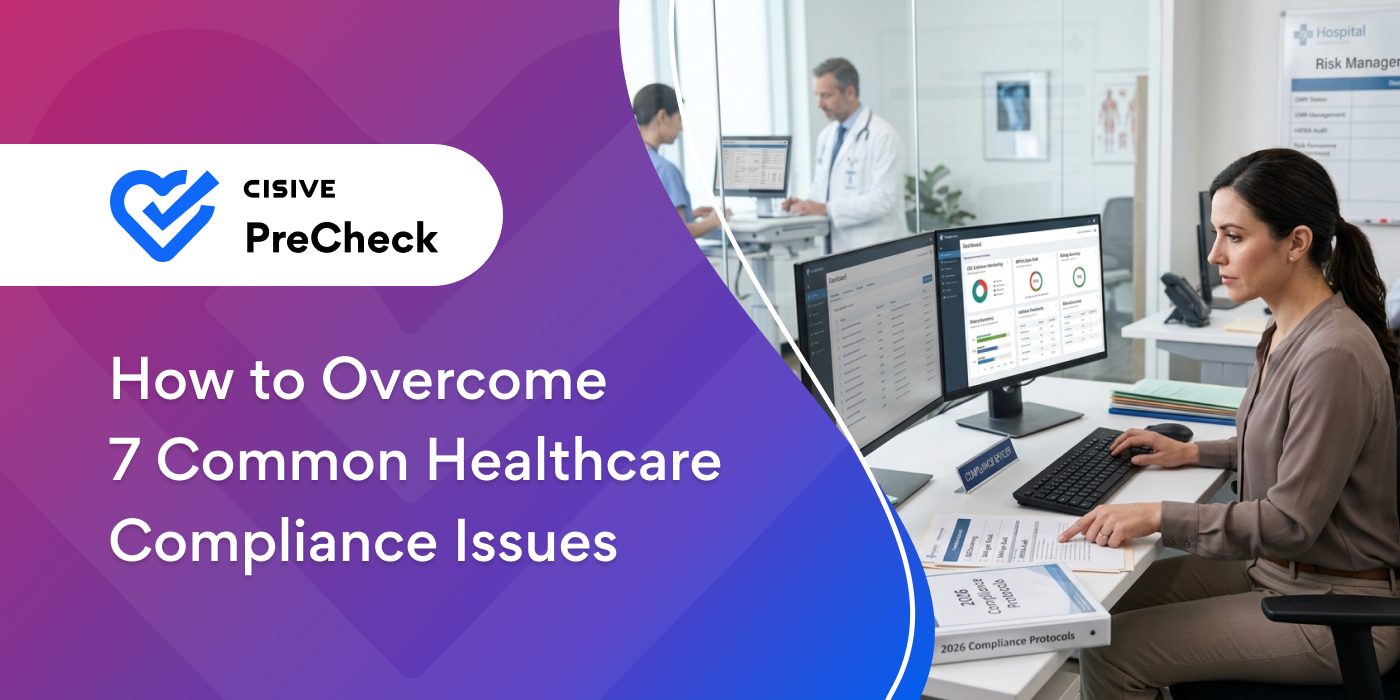
Healthcare organizations face an increasingly complex compliance landscape, with shifts in enforcement priorities and regulatory standards. There are severe consequences for getting these standards wrong. Understanding the top compliance issues in healthcare is essential for any organization that wants to keep its policies and practices up to date.
What Are Compliance Issues in Healthcare?
Organizations in healthcare face compliance issues when they don’t follow laws, regulations, and regulatory standards governing care delivery, patient information handling, or claim submission to federal and state payers.
Federal oversight spans agencies, including the Department of Justice (DOJ); Department of Health and Human Services (HHS); and units of HHS, such as the Office for Civil Rights (OCR), Office of Inspector General (OIG), and Centers for Medicare & Medicaid Services (CMS).
Noncompliance can bring financial penalties potentially reaching hundreds of millions of dollars, exclusion from Medicare and Medicaid, criminal exposure, and reputational damage.
Why Compliance Is Critical in the Healthcare Industry
Regulations continue to evolve: OIG recently updated guidance for Medicare Advantage risk management, while OCR created a program to safeguard the confidentiality of patient records related to substance use disorders.
The financial consequences are significant. Fiscal year 2025 saw a record $6.8 billion in False Claims Act recoveries, with $5.7 billion (83%) involving the healthcare industry. Health Insurance Portability and Accountability Act (HIPAA) civil penalties run from $145 to $2,190,294 per violation. OIG exclusion violations can cost up to $50,000 per incident, plus repayment of every dollar received from federal payers for services the excluded individual touched.
Compliance failures also damage your reputation among patients, payers, and regulators, with the fallout lasting for years.
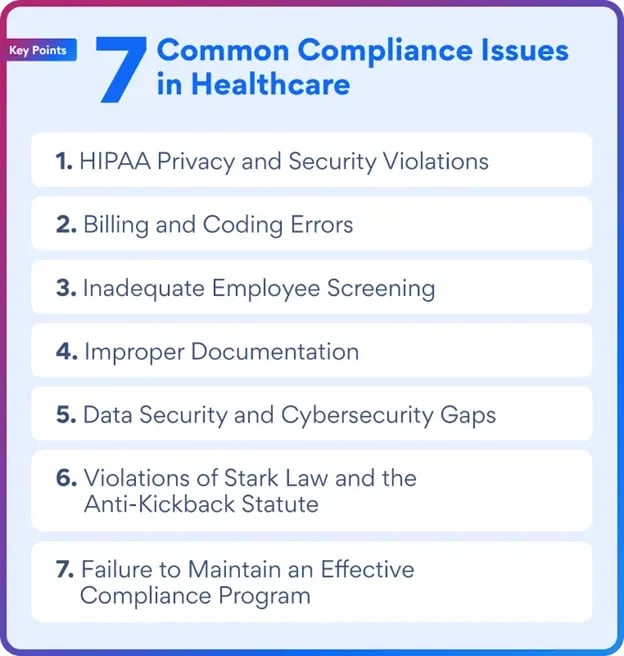
7 Common Compliance Issues in Healthcare
1. HIPAA Privacy and Security Violations
HIPAA violations are the most consistently cited healthcare compliance failure. Data privacy violations in healthcare generally involve the Privacy Rule, which governs use and disclosure of protected health information (PHI); and the Security Rule, which governs safeguards for electronic PHI (ePHI).
The most common violation is failure to conduct an enterprise-wide risk analysis. At least 10 OCR resolution agreements in 2025 involved this violation, with penalties ranging from $25,000 to $3 million each.
Common Security Rule deficiencies include:
- Missing or outdated risk analyses
- Lack of multi-factor authentication and encryption
- Lack of Business Associate Agreements with vendors who access ePHI
- Insufficient workforce training on HIPAA obligations
2. Billing and Coding Errors
A primary driver of False Claims Act liability is billing compliance errors, including upcoding, unbundling, duplicate billing, and claims lacking documentation of medical necessity.
Another noteworthy exposure: The Affordable Care Act requires organizations to return overpayments from federal payers within 60 days of identifying the overpayment. Failure to do so is a “reverse false claim” violation that can result in penalties of $14,308 to $28,619 per occurrence.
3. Inadequate Employee Screening
Healthcare employee background checks should flag anyone on the OIG's List of Excluded Individuals and Entities. Violations trigger immediate consequences, including:
- Denial of payment
- Repayment of received payments from federal payers
- Civil monetary penalties
- Potential False Claims Act liability across every claim handled by the excluded party
They must independently screen all current and prospective employees and contractors. Avoid surprise exclusions by conducting monthly rescreening against the OIG list and SAM.gov database.
Remember: Healthcare organizations retain liability even when delegating employee screening to a third party. Our healthcare background-check compliance guide can help you build a compliant background-screening program and avoid blind spots before they become enforcement actions.
4. Improper Documentation
Whenever you bill services to a federal payer, document the patient's medical necessity. Missing signatures, undated entries, and cloned progress notes that duplicate prior records without patient-specific clinical reasoning are grounds for denied claims and audit findings.
The OIG's updated General Compliance Program Guidance (GCPG) adds the quality of patient care as a component of the compliance program. Failures in documentation often signal simultaneous risk to billing and patient safety.
5. Data Security & Cybersecurity Gaps
Since 2019, large healthcare data breaches caused by hacking have increased by 89%, and ransomware-related breaches by 102%. In 2025, healthcare data breaches affected nearly 57 million Americans. Data security failures carry direct financial and reputational consequences.
6. Violations of Stark Law & the Anti-Kickback Statute
Numerous federal laws set clear lines for what constitutes healthcare-related fraud and abuse.
The federal Stark Law prohibits physician self-referrals for designated health services to entities with which the physician has a financial relationship, unless a specific exception applies.
The Anti-Kickback Statute (AKS), meanwhile, prohibits the offering or receiving of anything of value to induce referrals for items or services covered by federal programs. Both laws contribute to exposure under the False Claims Act. Legal review of contracts and referral arrangements is the most direct way to identify noncompliant structures before they become enforcement actions.
A January 2026 OIG advisory opinion found that sign-on bonuses paid to caregivers who also made agency selection decisions for Medicaid beneficiaries aren’t protected by the AKS employment safe harbor. This guidance will likely affect healthcare organizations’ recruiting and onboarding decisions.
7. Failure to Maintain an Effective Compliance Program
The GCPG outlines seven elements of an effective compliance program:
- Written policies and procedures
- Compliance leadership and board oversight
- Role-specific training
- Internal reporting channels
- Risk assessments
- Monitoring and auditing
- A formal process for responding to detected offenses
How Healthcare Organizations Can Prevent Compliance Issues
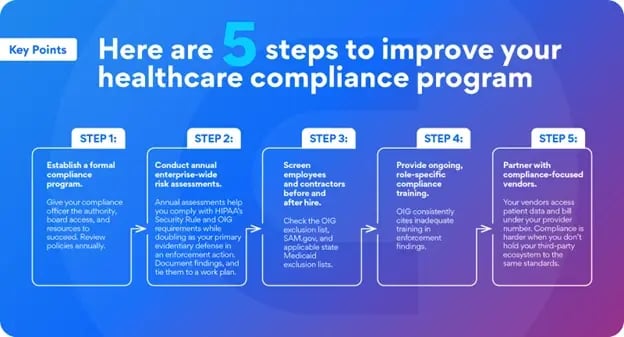
Here are five steps to improve your healthcare compliance program.
- Establish a formal compliance program. Give your compliance officer the authority, board access, and resources to succeed. Review policies annually.
- Conduct annual enterprise-wide risk assessments. Annual assessments help you comply with HIPAA’s Security Rule and OIG requirements while doubling as your primary evidentiary defense in an enforcement action. Document findings and tie them to a work plan.
- Screen employees and contractors before and after hire. Check the OIG exclusion list, SAM.gov, and applicable state Medicaid exclusion lists.
- Provide ongoing, role-specific compliance training. OIG consistently cites inadequate training in enforcement findings.
- Implement reporting and whistleblower protections. Employees need a confidential, retaliation-free way to raise concerns internally. Organizations that surface and correct issues on their own are in a far better position than those whose problems first appear in a government audit.
- Partner with compliance-focused vendors. Your vendors access patient data and bill under your provider number. Compliance is harder when you don’t hold your third-party ecosystem to the same standards.
Healthcare compliance failures are rarely the result of bad intentions. They're the result of gaps: missed screenings, outdated policies, undertrained staff, and vendors held to a lower standard. The organizations that stay out of trouble treat compliance as an ongoing operational function, not a periodic project.
Recommended Reading: Maintaining Compliance During Healthcare Staffing Shortages
How Cisive PreCheck Can Help
Managing compliance issues in healthcare requires scalable processes. Cisive PreCheck is built specifically for healthcare organizations that need to screen accurately, completely, and continuously. From OIG exclusion monitoring to license verification and sanctions tracking, PreCheck anticipates challenges so HR teams and compliance officers can close the gaps that create the most direct financial and legal exposure.
Is your organization reassessing its screening and compliance program? Speak to a PreCheck pro to learn what a purpose-built healthcare screening solution looks like in practice. With a 99.9994% accuracy rate across 40+ years in the industry, Cisive PreCheck gives healthcare organizations the precision that compliance demands.
Frequently Asked Questions About Healthcare Compliance Issues
What are the top compliance issues in healthcare?
The most common compliance issues in healthcare include HIPAA privacy and security violations, billing and coding errors, inadequate employee screening, improper documentation, cybersecurity gaps, Stark Law and Anti-Kickback Statute violations, and failure to maintain an operational compliance program.
Why is compliance important in healthcare?
Healthcare compliance protects patients and organizations while safeguarding the financial viability of federal healthcare programs. Noncompliance can result in exclusion from Medicare and Medicaid, civil monetary penalties, False Claims Act liability with treble damages, and criminal prosecution. Compliance failures also erode trust and reputation with patients.
What happens if a healthcare organization violates compliance laws?
Consequences can include civil monetary penalties, repayment of federal program reimbursements, exclusion from Medicare and Medicaid, False Claims Act liability, Corporate Integrity Agreements with OIG monitoring, and criminal prosecution in cases involving intentional fraud.
How can healthcare providers reduce compliance risk?
Effective risk management starts with a genuine, operational compliance program. This includes annual enterprise-wide risk assessments, monthly screening of employees and contractors against exclusion lists, proactive billing and coding audits, a real-time response process for detected overpayments, and physician compensation arrangements at fair market value. Compliance risk isn’t static; the best organizations treat compliance as an ongoing operational function, not a one-time project.