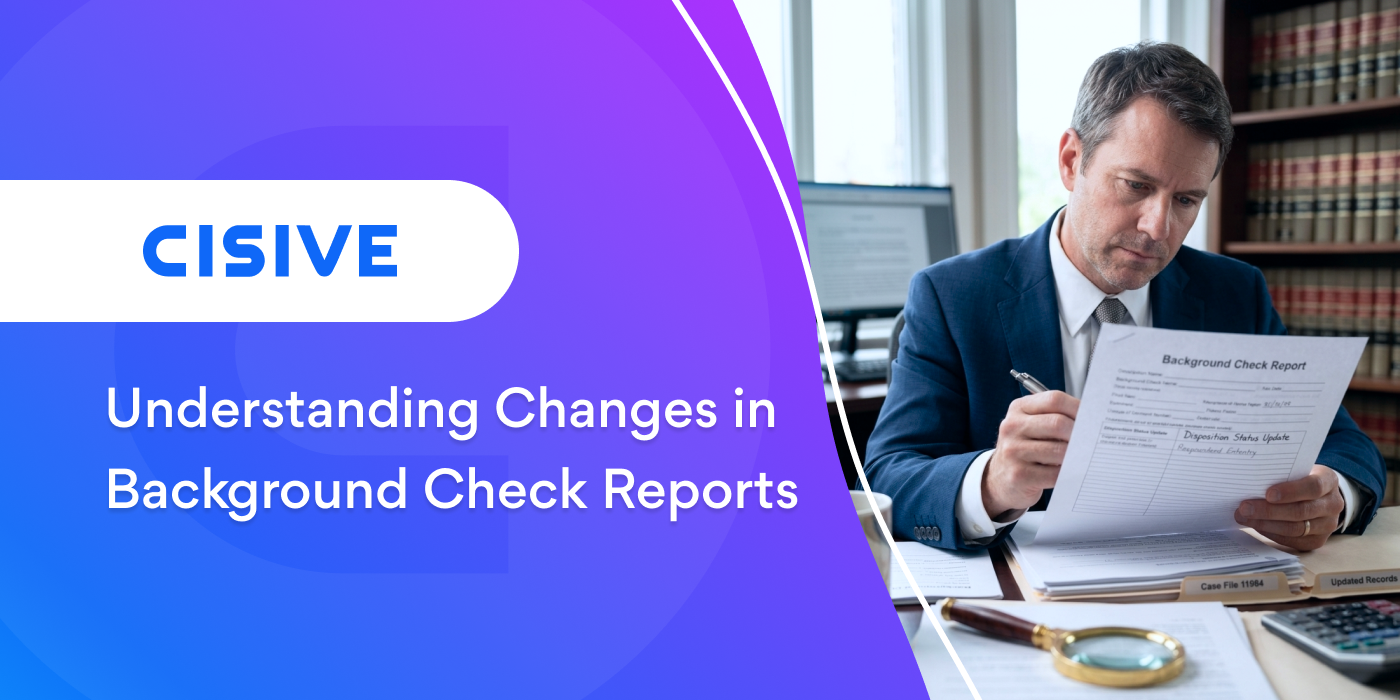
Understanding Changes in Background Check Reports: What Employers Should Know
Just as credit reports evolve over time as new information is verified and old information ages off, background check reports—formally known as consumer reports—are not static documents. The information contained in a background check reflects a snapshot in time, compiled and verified according to strict legal standards, and it can change between the time one report is generated and the next.
As a Consumer Reporting Agency (CRA), we want you to understand why this happens, how our verification process works, and what to expect when a consumer disputes the accuracy of their report during your hiring process.
Pre-Employment Background Checks Are Dynamic, Not Static
It’s a common misconception that a background report is a fixed record, similar to a certified copy of a court document. In reality, a consumer report is a compiled product, built from multiple data sources, each with its own update cycles, correction processes, and reporting timelines. Public records get amended. Court dispositions get updated. Records get sealed or expunged. Identity-matching algorithms get refined. All of this means that two reports on the same individual, pulled at different times, may not be identical—even without any dispute having been filed.
This is directly analogous to how credit history reports work: a credit file isn’t “wrong” simply because it looks different this month than it did last month. It reflects the current state of the verified, legally reportable information that is provided by the furnishers of the data.
How Information Is Selected for Inclusion in a Consumer Report
Several factors go into determining what information is actually included in a background screening report:
-
Legal reporting limits. Federal and state law, including the Fair Credit Reporting Act (FCRA) and applicable state statutes, governs how far back certain types of information (such as criminal history and employment history) can be reported, and what categories of information may be reported depending on the nature of the report and its permissible purpose. This can also vary by industry.
-
Relevance. Not all available information about a subject is necessarily appropriate to include. Information must be relevant to the purpose for which the report was requested.
-
Identity verification. Before any record is attributed to a subject, we work to confirm that the record actually belongs to that individual—using identifiers such as name, date of birth, and other available identifying information—to reduce the risk of misattribution.
Because these three factors—legal permissibility, relevance, and identity confirmation—are applied every time a report is generated or updated, the resulting report is a current, best-available representation of accurate, attributable, and legally reportable information at that moment in time.
The Reinvestigation Process
When a consumer believes information in their report is inaccurate, they have the right under the FCRA to dispute it. This triggers a reinvestigation, during which we go back to the original source or sources of the disputed information to verify its accuracy.
Reinvestigations can, and sometimes do, reveal contradictions to the original reporting. A record may have been updated at the source since it was first reported. A jurisdiction may have amended or sealed a record. When this happens, it can result in a revised report—which may mean a correction, an update, or in some cases the removal of the disputed item.
This is a normal and expected part of how consumer reporting works. It reflects the system functioning as intended: giving consumers a mechanism to correct their records and giving CRAs a mechanism to continuously verify accuracy against source data.
Why CRAs Don’t Disclose the Specific Factors Behind a Revision
Clients sometimes ask why a report was revised, or what specifically prompted a change, expecting a detailed explanation of the internal factors involved. In most circumstances, it would be inappropriate or potentially illegal for us to share or explain certain underlying factors to our clients.
There are several reasons for this:
- Consumer privacy. The details of a dispute and the reinvestigation process often involve sensitive personal information about the consumer that is not appropriate to share beyond what the law requires.
- Legal boundaries. The FCRA establishes specific requirements for what must be communicated to consumers and to report users, and those requirements do not generally include a narrative explanation of internal reinvestigation findings. In some cases, explaining the specific reason behind a revision would directly undermine the purpose and intent of the law. For example, if a record was removed because it had been expunged or sealed, disclosing that fact to a client would effectively communicate the existence of a record that the law intends to treat, for reporting purposes, as if it did not exist. Providing that explanation would defeat the very protection the law was designed to afford to the consumer.
- Consistency and fairness. Applying the same standard of confidentiality across all cases helps ensure that our verification process remains impartial and is not influenced by client or consumer- specific expectations.
We cannot provide commentary beyond the results of the reinvestigation. What we can provide is the outcome, specifically whether the information was verified as accurate, updated, or removed, in a revised report reflecting the verified information. If the consumer report remains a factor in the employment decision after the dispute and reinvestigation process is completed, any employment decision must be based on the findings reflected in the updated report.

What This Means for You
If you receive a revised background check report on an individual you’ve previously screened, this doesn’t necessarily indicate an error on the part of your Consumer Reporting Agency or a red flag about the individual.
You need to make informed hiring decisions. We help facilitate with our ongoing commitment to accuracy in the screening process, through verification, legal compliance, and responsiveness to consumers’ legal rights to dispute their information.
If you have questions about a specific report or our processes generally, we encourage you to reach out to your account representative.
If you're interested in continuous monitoring to receive near-real time alerts post-hire, contact your Cisive pro and ask about Workforce iQ. You have options for continuous criminal monitoring, driver monitoring, and healthcare license monitoring, as well as exclusions and sanctions screening and monitoring for high-risk financial services roles.
This article is intended for general informational purposes and does not constitute legal advice. Clients should consult with their own legal counsel regarding compliance obligations under the FCRA and applicable state law.